

A Pulitzer Winner, Martyna Majok Revises Her Powerful Play ‘Queens’ to Strong Effect
The new off-Broadway production fleshes out several characters and introduces additional information and different circumstances. The playwright has said she considers it more a new work than a revival.
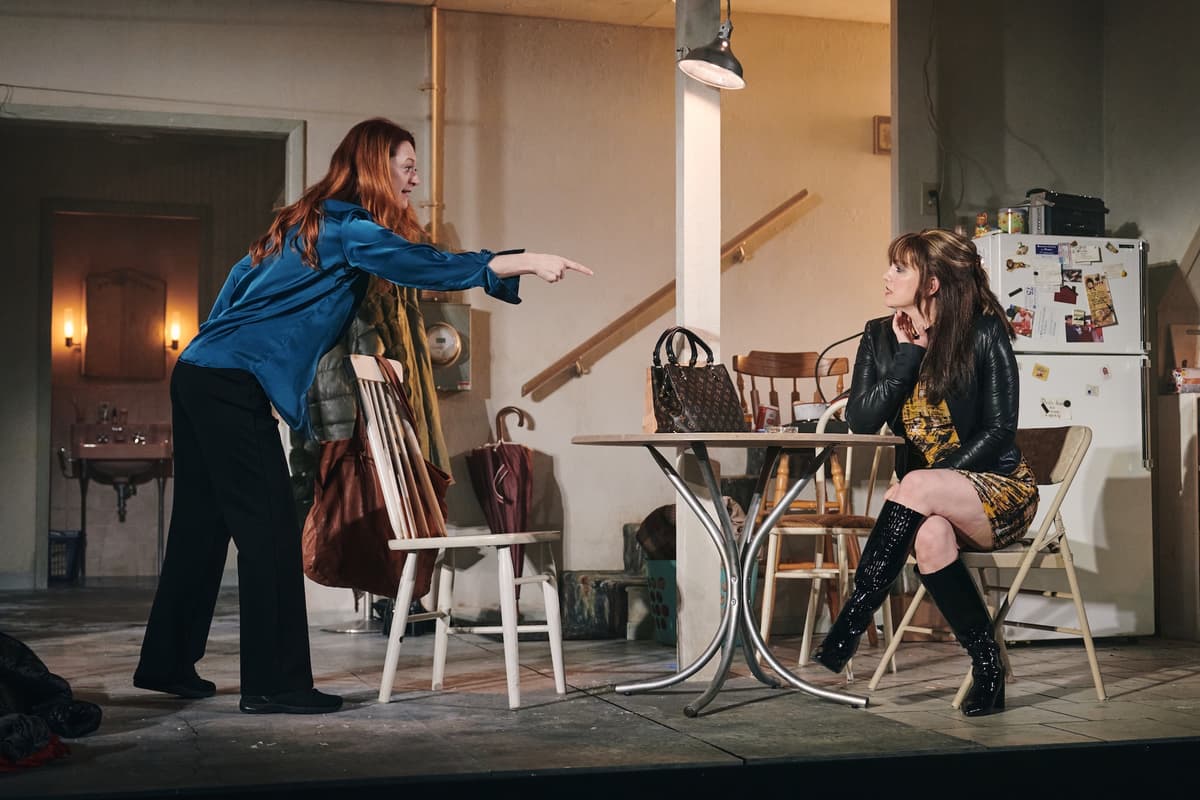
With “Queens,” Martyna Majok not only gave voice to women who had long been marginalized and oppressed but also provided a terrific vehicle for stage actresses. The play, which had its premiere at New York in 2018 — the same year that Ms. Majok won the Pulitzer Prize for drama for another work, “Cost of Living” — follows a group of female immigrants from various countries who find refuge, and conflict, in a hidden basement apartment in the titular borough.
“Queens” now returns to Manhattan, substantially revised and freshly powerful. Ms. Majok has cut or trimmed scenes and added others, fleshing out several characters and introducing additional information and different circumstances. The new off-Broadway production — which the playwright considers more a new work than a revival, she has said — arrives at a particularly fraught time for the real-life counterparts of these women.
A Polish native herself, Ms. Majok has poignantly addressed the plight of immigrants chasing some version of the American dream in her other plays, “Ironbound” and “Sanctuary City”; the latter focused on a pair of teenagers, both brought to our country as children, in the aftermath of September 11.
That infamous date also looms large in “Queens,” which initially shifts back and forth between a winter night not long after the terrorist attacks and a summer evening in 2017, roughly half a year into President Trump’s first term. The second act introduces a couple of new characters and lends context and more drama, in scenes that unfold in 2016 and 2017 in Ukraine and in 2011 back in Queens.
The young Ukrainian woman whose story bridges these locations is named Inna. When she appears in the first scene, played by Julia Lester, a marvelous musical comedy performer who demonstrates real dramatic chops here, it’s 2017, and she has arrived at the basement apartment by way of the Port Authority.

We’ll later learn that Inna’s American journey has been longer and even more torturous than we might suspect when she greets Renia, the Polish-born landlady, with a punch in the face, believing that Renia — portrayed by Marin Ireland, one of her generation’s most consistently affecting actors, in one of her finest, most wrenching performances to date — could be the mother who abandoned her years ago.
Although Inna is wrong, there are significant parallels between her mom’s story and Renia’s, and some of the similarly harrowing accounts of the other women with whom Renia has shared space through the years. There’s Pelagiya, the Belarusian who preceded her as landlady, given a delicious tartness in Brooke Bloom’s portrait. Aamani, after running from intolerant relatives in Afghanistan, now faces discrimination where she sought liberation; Nadine Malouf makes her unease hauntingly palpable.
Isabela, played by a feisty Nicole Villamil, is Honduran and, like Renia, left a daughter behind. We eventually meet Glenys as a teenager, hardened but vulnerable and whipsmart, all qualities captured by an endearing Sharlene Cruz. Andrea Syglowski and Anna Chlumsky round out the flawless cast — nimbly directed by Trip Cullman — as, respectively, a friend of Inna’s driven to humiliating and dangerous measures back in Ukraine and a woman who reappears from Renia’s past like an avenging ghost.
In its current form, “Queens” plays with time, cleverly and beguilingly, so that events and exchanges from different periods can unfold side by side. And when Marsha Ginsberg’s evocative scenic design takes us from the ramshackle basement in Queens to a cozy, sweetly appointed living room outside of Kyiv, it reinforces how desperately these women wanted the freedom they associated with America.
In a more bracing turn, the set actually cracks open to suggest not just the passing of time but a storm of memories. Much about these women is left vague at first, but Ms. Majok’s writing, at once piquant and deeply compassionate, brings the pieces together almost in the style of a thriller, and given what her characters have been through, they can be unsettling, to say the least.
But “Queens” isn’t a lament: The play’s title clearly nods not only to a part of New York City, but to the spirit and soul of women who emerge, above all else, as survivors. Ms. Majok’s feminism is not, moreover, of the stern, self-righteous, or sexless variety: These gals put on flirty dresses — designed by Sarah Laux, who provides grittier costumes when necessary — and alternately joke, spar, and bond in sessions that can evoke slumber parties.
They also each pay a stiff price for their striving — none more than Renia, who by the end of “Queens” has both earned and lost more than anybody else. “I am nothing like you,” she tells another woman, after receiving her certificate of naturalization. “I’m American now.” If this is something of a Pyrrhic victory, the play overall celebrates, movingly and unabashedly, the fortitude behind it.