
A Rising Playwright To Watch, Talene Monahon, Brings Us a Hilarious, Thought-Provoking Satire, ‘Meet the Cartozians’

Under David Cromer’s typically supple direction, six superb actors each juggle two roles, every pair linked by trait, circumstance, or irony.
Julieta Cervantes
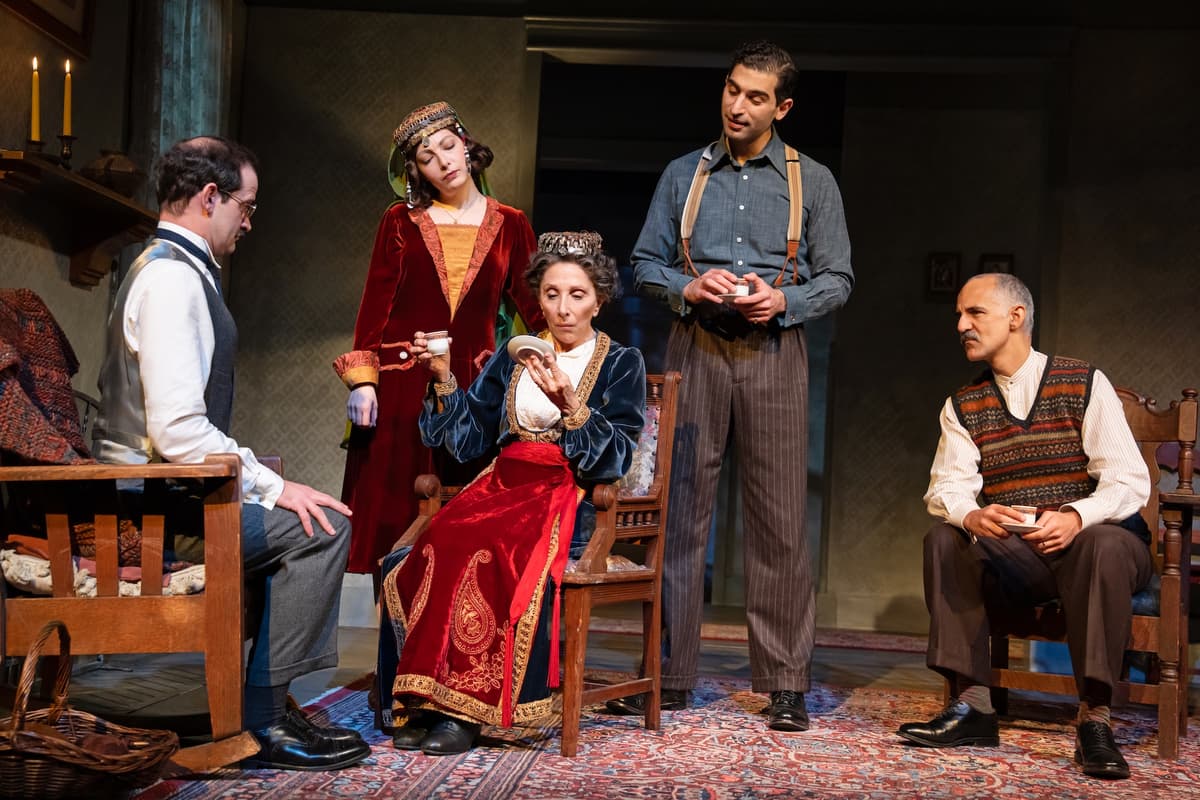
Will Brill, Tamara Sevunts, Andrea Martin, Raffi Barsoumian, and Nael Nacer in 'Meet the Cartozians.' Julieta Cervantes

It may seem like a bit of a stretch to consider a historically significant trial from a century ago alongside a culturally significant but widely mocked reality TV program, but a rising playwright, Talene Monahon, has used this recipe to craft a new satire that can be as hilarious as it is thought-provoking. 

For “Meet the Cartozians,” Ms. Monahon drew on her Armenian heritage, which she shares with a certain trio of famous sisters whose father, Robert Kardashian, gained attention in their youth as a lawyer representing O.J. Simpson. What’s less well known is that Robert’s own grandfather, a man named Tatos, had immigrated to the United States just in time to escape the Armenian genocide launched in 1915.

A decade later, another Armenian native called Tatos, surname Cartozian, was granted citizenship by our government, but had it revoked by a naturalization examiner under growing pressure to limit the number of immigrants from certain countries. Race was also relevant — the Immigration Act of 1924 set quotas for Eastern and Southern Europeans and essentially excluded Asians — and thus figures prominently in Ms. Monahon’s play. 

Act One, set in 1923 and 1924, follows Tatos Cartozian and his family in Portland, Oregon, as they try to prepare a legal defense; Act Two unfolds 100 years later at a home in Glendale, California, where a group of prominent Armenian Americans has been assembled to help an unnamed superstar clearly modeled on Kim Kardashian better explore her background — on camera, naturally.

Nael Nacer, Andrea Martin, and Susan Pourfar in ‘Meet the Cartozians.’ Julieta Cervantes

I should note here that I didn’t watch a single episode of “Keeping Up with the Kardashians” during its long run, and didn’t see the point of streaming it now, since like anyone else with a phone or a computer, I’ve been unable to avoid keeping up with Kim’s antics — or those of the other Ks, her mother, sisters, and half-sisters — to at least some extent over the past two decades, hard as I’ve tried. 

Even with that limited authority, I can report that Ms. Monahan could have been much, much meaner to these women. The fictional celebrity in “Cartozians” makes only a brief and ultimately poignant appearance, after the playwright first establishes the profound roles that skin color as well as religion have traditionally played in the immigration process and then, with mischievous humor and considerable ingenuity, explores how these factors have grown increasingly complicated in the age of identity politics.

Under David Cromer’s typically supple direction, six superb actors each juggle two roles, every pair linked by trait, circumstance, or irony. Will Brill, who won a Tony Award last season for his portrait of a louche rock musician in “Stereophonic,” first plays Wallace McCamant, the patrician, patronizing attorney representing Tatos in his court battle. Wallace sees his Irish ancestors in the Armenians, “good Christian people who’ve been dealt a rough hand.”

Mr. Brill later pops up as Alan O’Brien, the reality star’s airheaded camera bro, whose own Irish lineage becomes a point of contention in a hysterical (in both senses of that word) debate over how privilege and prejudice affect different groups in our era. Leslie Malconian, an Armenian-American poet portrayed by an elegant Susan Parfour, laments that one of her pieces was rejected from a festival for POC — one of numerous acronyms bandied about, in this case indicating people of color.

“Or maybe your poem was just bad,” counters Rose Sarkisian, a wealthy septuagenarian played by a predictably delightful Andrea Martin. Ms. Martin is equally amusing, and more haunting, as Tatos’s mother, Markrid, who struggles to understand Wallace’s strategy for convincing a jury of her family’s viability as citizens, and not just because of language differences.

“White person means Christian person, yes?” Markrid asks Wallace, who responds, “Well, not exactly. Or actually no, technically—no.” Throughout the play, Ms. Monahon charts the unique dilemmas that have faced Americans determined to be, in today’s parlance, “white-adjacent” (a term not used in the play); this includes not only Armenians but many Asians, Jews, and yes, the Irish and other European immigrants and their descendants, who have faced no shortage of discrimination and persecution.

With its sharp satirical eye and its refreshing intellectual nuance, “Meet the Cartozians” confirms the arrival of a voice worth listening to.


The New York Sun

© 2025 The New York Sun Company, LLC. All rights reserved.

Use of this site constitutes acceptance of our Terms of Use and Privacy Policy. The material on this site is protected by copyright law and may not be reproduced, distributed, transmitted, cached or otherwise used.

The New York Sun

Sign in or  create a free account

or
By continuing you agree to our Privacy Policy and Terms of Use