

A Star of ‘Severance,’ Jen Tullock, Embodies 11 Characters in a Riveting New Off-Broadway Play
‘Nothing Can Take You from the Hand of God,’ crafted by Tullock with a longtime collaborator, Frank Winters, is inspired by her devout Christian upbringing in Kentucky.
One of last season’s most celebrated Broadway offerings was an adaptation of “The Picture of Dorian Gray,” for which Sarah Snook, fresh off her bravura performance in HBO’s “Succession,” earned rave reviews and a Tony Award by juggling 26 roles, with the assistance of video projections and multiple live camera feeds.
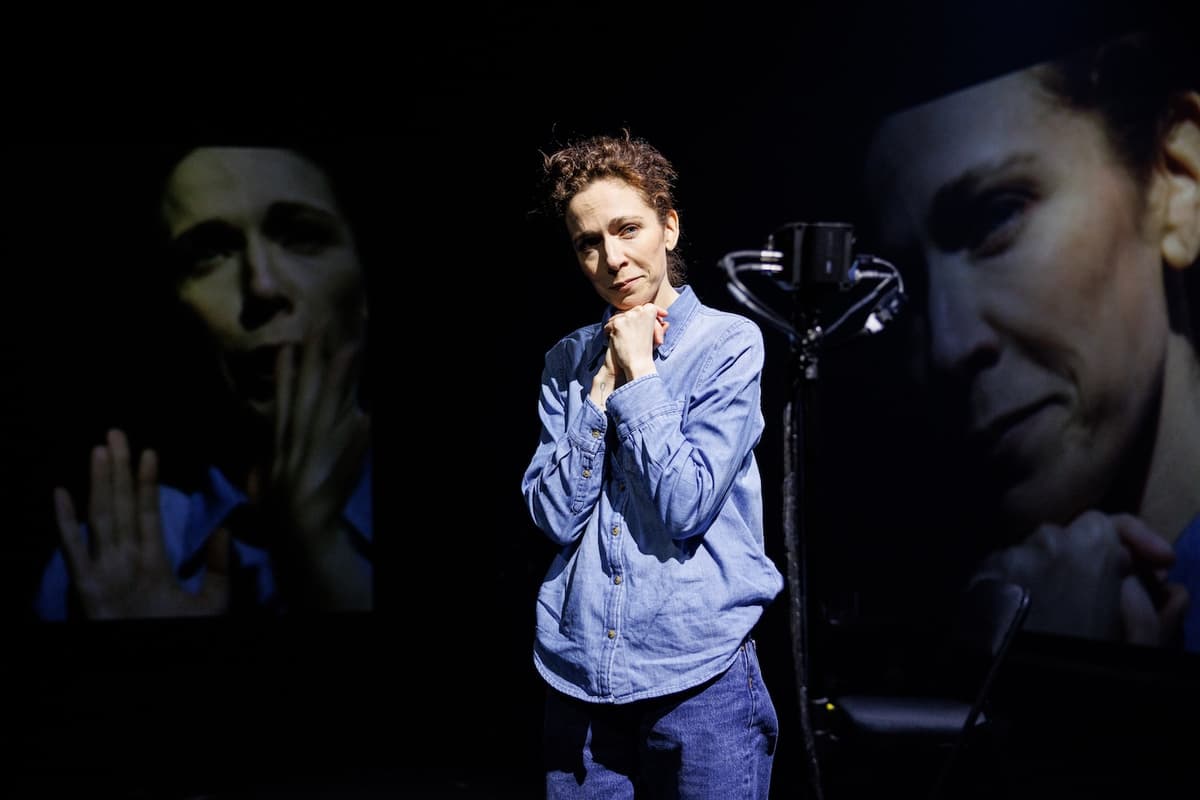
Jen Tullock, the co-writer and star of “Nothing Can Take You from the Hand of God,” a riveting one-person, one-act play now having its world premiere off-Broadway, is best known for her work in another acclaimed series, Apple TV+’s “Severance.” Like Ms. Snook, though, she’s also an accomplished stage actress, and in this production, she pulls off a similar feat in a far more intimate setting.
“Hand of God,” which Ms. Tullock crafted with a longtime collaborator, Frank Winters, is a more concise piece than “Dorian Gray,” clocking in at roughly 70 minutes, and it features fewer characters. We meet 11 of them in person, all played by the actress, ranging from a young Polish boy to a middle-aged Irish church worker to a Southern matron in her 60s.
Yet as those examples suggest, this play requires just as much dexterity. It’s also a more personal work, inspired by Ms. Tullock’s devout Christian upbringing in Kentucky. The character who is essentially the protagonist, Frances Reinhardt, shares that background, and like Ms. Tullock she is a writer and a gay woman.

The play opens at a promotional event for Frances’s latest book, where the host, a smooth-voiced, self-satisfied literary critic — imagine an affectionate sendup of NPR’s Terry Gross — introduces her subject, citing a review that describes Frances as “a searing and unapologetic adversary to a buttoned-up, God-centric America; an elegant and, yes, feminine addition to the male-dominated ranks of Pinker, Weinberg, and Hitchens.”
If the fictional quote confirms that Ms. Tullock and Mr. Winters can at least acknowledge progressive preciousness with a sense of humor, their main target here lies, predictably, on the other end of the political and cultural spectrum: “Hand of God” is a biting takedown of evangelical extremism, depicting male and female believers whose behavior ranges from chilling to flat-out abusive.
There’s Frances’s mom, Raelynn, a smiling good ole girl who chokes her daughter and splits her back open. Kenny, the Irish mission worker at Louisville’s Northeast Missions Church, where Frances’s family worships, threatens a Polish woman named Agnieszka, who figures prominently in Frances’s book and in the play. Jeremy, the church’s charismatic senior pastor, cheerfully assures our heroine that he doesn’t want to sue her for defamation — then asks Frances, regarding her unsettling recollections, “Do you ever worry if you made any of it up?”
Under Jared Mezzocchi’s piercing direction, which makes heavy use of Stefania Bulbarella’s vivid, hypnotic projection and video design, Ms. Tullock crisply segues from one character to the next; six cameras capture her shifting expressions, often closing in to capture figures in freeze-frame as they, or others, continue to address one another or the audience.
The script cleverly uses Frances’s promotional appearances — primarily the critic’s questions and those of fans she enlists in a Q&A session, but later a consequential television interview — to thread together different events and people who have shaped Frances’s life and work. These also include Agnieszka’s pre-adolescent son, whom Frances assumes is queer, largely because of his obsession with “Evita,” the Andrew Lloyd Webber musical, and Frances’s breathless literary agent, who according to the stage directions “chews gum in place of the cocaine she’s recently given up.”
When an admirer asks Frances how she has managed to find humor in the painful episodes documented in her book, she responds, “I think that’s a survival tactic a lot of people cultivate over time. Who aren’t, who don’t necessarily feel safe.” Regardless of whether this has been true for Ms. Tullock, “Hand of God” can be as funny as it is bleak; with her spry body language and richly expressive face, the playwright and actress is as effective in the more comedic moments as she is in harrowing sequences such as a botched exorcism.
It should be noted that the title of this play is not really ironic: Frances admits, eventually, that leaving religion behind — the subtitle of her new book is “Losing God and Finding Myself” — was difficult for her, and not merely because it represented home for so long. “Everybody thinks I left because I didn’t want it,” she says at one point. “That isn’t why I left. It’s because I didn’t want it that way.”
“Nothing Can Take You from the Hand of God” concludes, in fact, with Ms. Tullock, as Frances, joining an a cappella choir in a recorded hymn. By neither ridiculing nor refuting faith itself, the play leaves open the notion that redemption is possible for all of us; perhaps even more importantly at this juncture, it reminds us that what we do or don’t believe, or whom we love, doesn’t make anyone less eligible.