

An Uneasy Concept, Restorative Justice, Arrives on Broadway Via ‘Punch’

A movement encouraging dialogue between victims of crime and the offenders, the term and the ethos are the subject of a high-profile play that received heady acclaim across the pond.
©Matthew Murphy
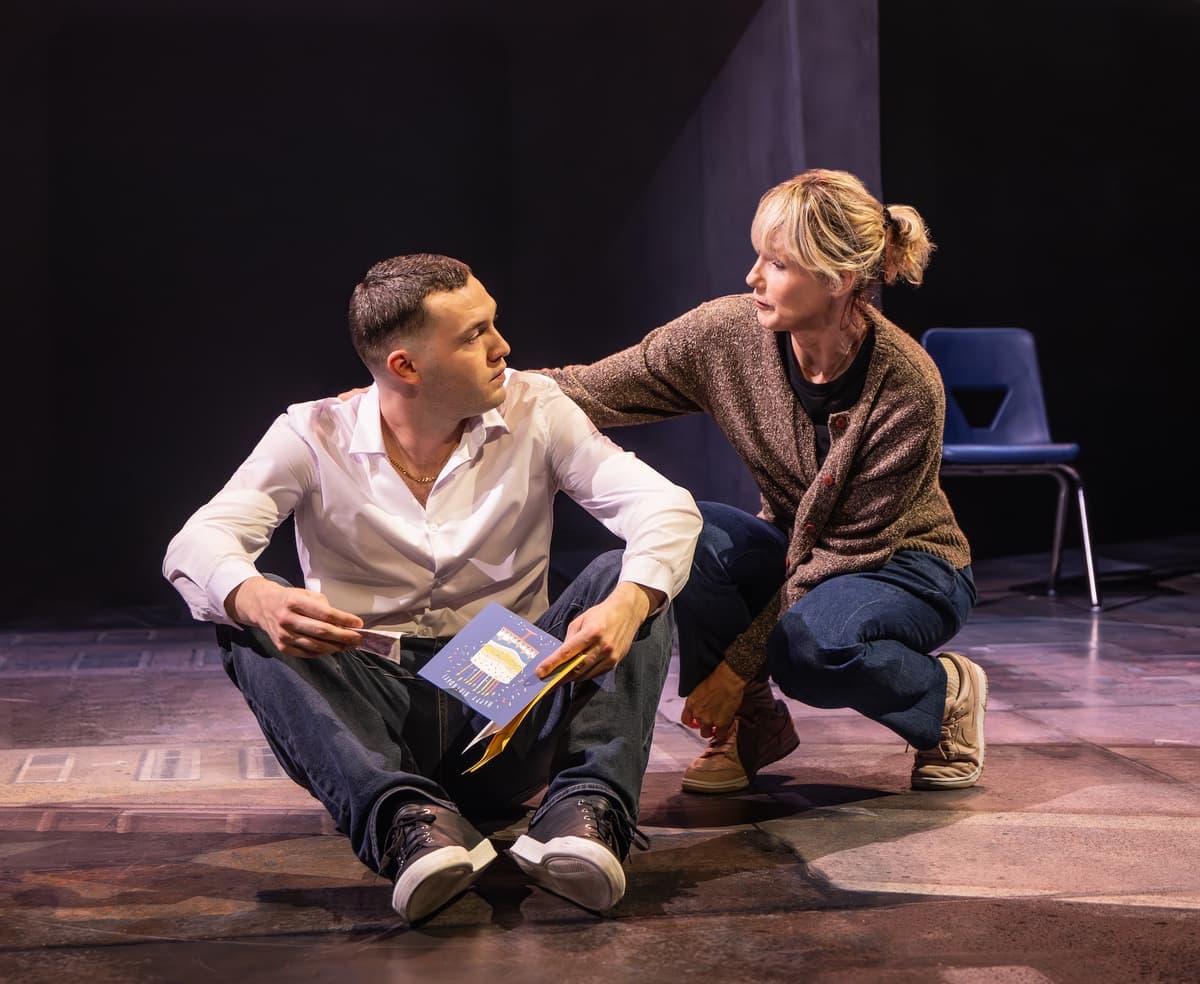
Will Harrison and Lucy Taylor in 'Punch.' ©Matthew Murphy

It goes without saying that no tragedy is more profound than losing a child. When that loss comes as the result of violence, it’s hard to imagine a parent ever recovering — let alone forgiving the perpetrator, or arriving at any form of reconciliation.

Yet this is the concept behind restorative justice, a movement encouraging dialogue between victims of crime, including relatives of murdered people, and the offenders. The term and the ethos began earning more attention in the late 20th century, and now they are the subject of a high-profile play, “Punch,” which arrives on Broadway after receiving heady acclaim across the pond.

Written by James Graham, whose previous works include the Olivier Award-winning “Dear England” and the Tony-nominated “Ink,” both based on true stories, “Punch” was adapted from Jacob Dunne’s “Right from Wrong,” a memoir tracing the author’s journey from crime and incarceration to redemption. 

In the case of Mr. Dunne, who inadvertently killed another young man with a single punch (hence the title) when he was 19, then served 14 months for manslaughter, that path led to a degree in criminology and a career as an activist, author, presenter, and podcast host. And as “Punch” relays it, none of this would have been possible without restorative justice — specifically without the relationship he developed with the parents of James Hodgkinson, the 28-year-old paramedic who received that fatal punch. 

Cody Kostro and Will Harrison in ‘Punch.’ ©Matthew Murphy

A photo of Hodgkinson is printed in the playbill, just below the cast listings, with a dedication that concludes, “We hope to honor and do justice to the man James was.” Of course, “Punch” is about Jacob; while James’s parents have key roles, and are portrayed with deep, genuine sympathy — his mother, Joan, played by the great Victoria Clark, comes across as a saint — the killer is ultimately and unabashedly the hero, however flawed.

Having not read Mr. Dunne’s book — or any non-fictional account, save for a recent interview also featuring Hodgkinson’s parents, and Mr. Graham — I can’t say exactly how much creative license Mr. Graham took in his script. Clearly, Mr. Dunne did not intend to murder Hodgkinson, and I certainly don’t doubt his sincere regret over the incident, which involved a hard fall onto concrete, or his resolve to find some positive consequence.

Still, there’s something a little too neat about Jacob’s arc in the play, which acquires a disconcerting feel-good vibe, with our protagonist emerging as an underdog who slowly but triumphantly defies the odds. Much is made of Jacob having no father around — Lucy Taylor plays his adoring, harried mom — and of his being diagnosed with dyslexia, ADHD, and autism, then given pretty much no resources to deal with these conditions.    

Indeed, there are sneering references to the “aspirational working class” that young Jacob has been consigned to, and the failed social experiment that has made his housing estate at Nottingham, England, a breeding ground for drug dealers and other thugs. In Act One, Mr. Graham and director Adam Penford shift back and forth from the night of James’s death and its immediate aftermath to scenes of Jacob in court, behind bars, and, later, in a support group.

Act Two is devoted largely to Jacob’s progress, which in Graham’s telling seems as rote and inevitable as his downward spiral was, and to how Joan and James’s father, David, come to terms with their son’s death and the man responsible for it. Ms. Clark brings enormous grace and human grit to the ultra-virtuous Joan — she also doubles, briefly and winningly, as James’s grandmother — and Sam Robards is similarly sturdy and moving as David, who is less inclined to turn the other cheek, or turn the page.

A Broadway newcomer, Will Harrison, does a lovely job mining the challenges presented by Jacob: When the text demands it, he can shift on a dime from the troubled bad boy who nearly threw his life away to a more reflective, responsible man. And in the scene where Jacob meets Joan and David in person for the first time, his unease, shame, compassion, and flickers of relief are palpable and affecting.

There’s a lot of hugging in “Punch,” and, not surprisingly, some preaching as well: At one point, the rules and virtues of restorative justice are explained to the audience by a charity worker named Nicola, played with a careful balance of pep and earnestness by Camila Canó-Flaviá. Ms. Taylor, in addition to playing Jacob’s mom, turns up as his parole officer, who near the end laments cuts to the kind of social services that helped Jacob.

I don’t doubt the value of those services; nor would I deny Mr. Dunne the other blessings he has enjoyed. But both as theater and as a documentary of human frailty, “Punch” might have carried more sting with fewer platitudes and a keener sense of the unhappy ending at its source.


The New York Sun

© 2025 The New York Sun Company, LLC. All rights reserved.

Use of this site constitutes acceptance of our Terms of Use and Privacy Policy. The material on this site is protected by copyright law and may not be reproduced, distributed, transmitted, cached or otherwise used.

The New York Sun

Sign in or  create a free account

or
By continuing you agree to our Privacy Policy and Terms of Use