
AOL To Finally Wind Down Its Noisy Dial-Up Internet Service After Four Decades

Formerly the nation’s No. 1 internet service provider, AOL will still offer email and internet access, just not via modem or phone lines.

Justin Sullivan/Getty Images
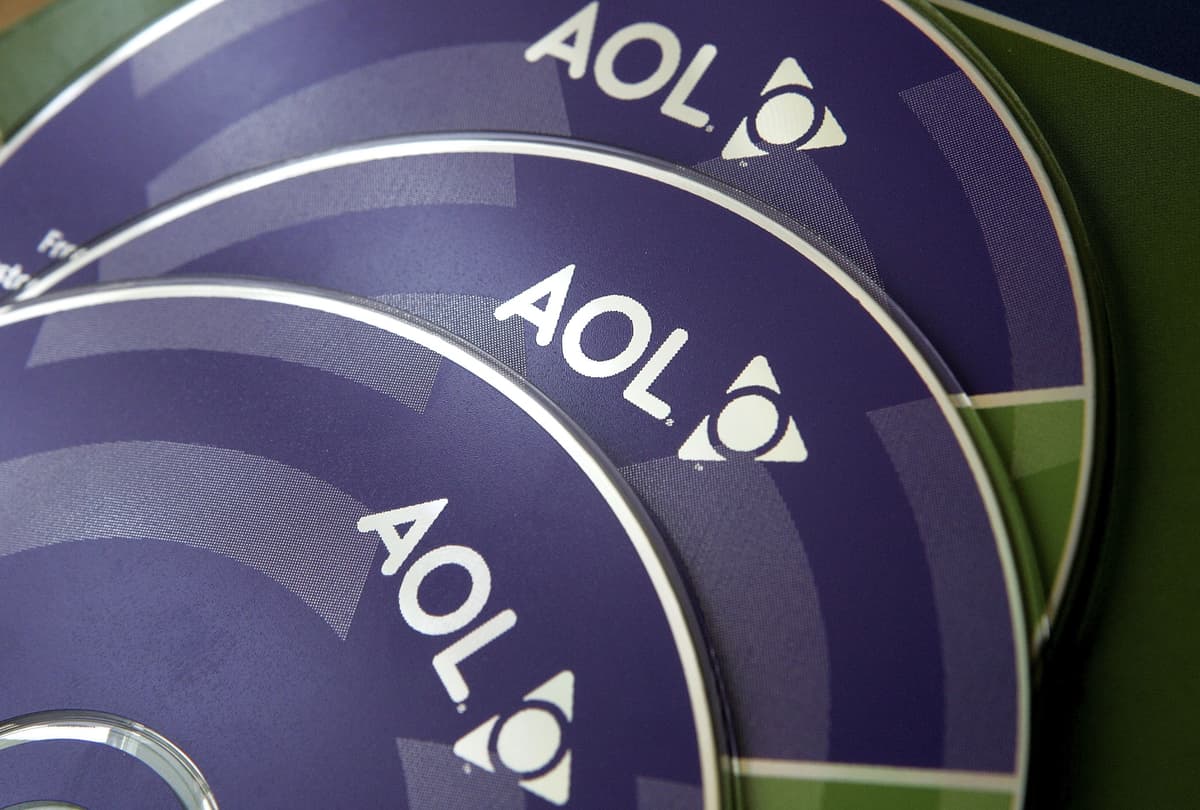
AOL software CDs are seen August 2, 2006. at San Rafael, California. Justin Sullivan/Getty Images

The electronic screeches and chimes of AOL’s dial-up internet service — instantly recognizable to anyone over the age of 50 in America — will soon go silent as one of the nation’s earliest public internet providers, AOL, ends its telephone hardline-based service after 40 years. 

“AOL routinely evaluates its products and services and has decided to discontinue Dial-up Internet. This service will no longer be available in AOL plans. As a result, on September 30, 2025 this service and the associated software, the AOL Dialer software and AOL Shield browser, which are optimized for older operating systems and dial-up internet connections, will be discontinued,” the company announced in a statement that took about a week to get noticed by tech media.

AOL, a subsidiary of Yahoo, will still offer email subscriptions and internet access as well as an array of products and services aimed at protecting identity and defending against malware.

Dial-up is still used in about 163,400 American households, according to the U.S. Census Bureau. AOL, with 1.5 million customers overall,  served dial-up to a “low thousands” number of customers as recently as 2021, according to a CNBC report. Many of those customers were assumed to be people who simply never got around to cancelling their subscriptions over the years.

While other dial-up services, like Juno, Earthlink, and NetZero, are still available in some areas, dial-up access, which uses a modem and phone lines to convert signals sent through phone lines into data and voice, is unable to support streaming or other high-speed activities common on broadband.

The average dial-up speed in the United States tops out at 56,000 bits per second. Many of today’s broadband plans offer services beginning at 100 million bits per second, or about 1,775 times faster than dial-up.

In an era of hacking and identity theft, dial-up also offers security by using a different IP address each time a user dials up. Prices average about $10 per month, less than most broadband plans, though some subscriptions may limit the number of hours users can slowly surf the web.

Dial-up internet is one of the earliest entries into widespread use of the world wide web.  AOL, also known as America Online, was launched in May 1985 as Quantum Computer Services. It was originally meant to function as a bulletin board for Compuserve users in academia and users were sent a disc in the mail to update its proprietary operating system. By 1993, AOL opened itself to a hungry public, quickly becoming the top provider of internet services in America. 

It was so popular that in 1998, the famous “You’ve Got Mail” notice became the title of a film starring Tom Hanks and Meg Ryan. The voice behind the sound effect, Elwood Edwards, was fêted after his death in 2024.

With a valuation of $125 billion in 2000, AOL was gobbled up by Time Warner in what is widely considered one of the worst corporate marriages in American history. The union didn’t last and after getting bounced around, Verizon eventually bought AOL and Yahoo. It discontinued one of AOL’s most notable services — Instant Messenger — in 2017. Verizon eventually divested itself from Yahoo, selling to Apollo Global Management, which took the AOL brand with it.

The announcement of AOL’s dial-up demise sparked a wave of nostalgia as well as surprise by some who did not know dial-up was still an option. “Thanks for the memories. #RIP,” wrote AOL’s founder Steve Case

“AOL is discontinuing dial-up internet as of Sep 30, 2025. I told you we shouldn’t let those AOL bastards take over Compuserve. Now look where we are,” joked one X user, Dr. Insensitive Jerk.


The New York Sun

© 2025 The New York Sun Company, LLC. All rights reserved.

Use of this site constitutes acceptance of our Terms of Use and Privacy Policy. The material on this site is protected by copyright law and may not be reproduced, distributed, transmitted, cached or otherwise used.

The New York Sun

Sign in or  create a free account

or
By continuing you agree to our Privacy Policy and Terms of Use