Botched Subway Sandwich Case Could Be Warning Sign for Trump’s Plans To Prosecute Letitia James, Adam Schiff, and Lisa Cook 

A trend is taking shape whereby grand juries in Democratic districts are refusing to authorize indictments requested by the Department of Justice.

Getty Images / Getty Images
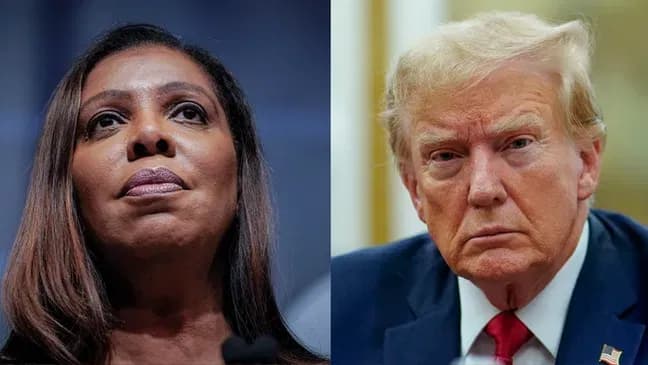
New York's attorney general, Letitia James, and President Trump. Getty Images / Getty Images

President Trump could face an emerging obstacle to his efforts to legally pursue high-profile foes like New York’s attorney general, Letitia James, Senator Adam Schiff, and a Federal Reserve governor, Lisa Cook — grand juries that refuse to issue criminal indictments.

The Department of Justice received a taste of that recalcitrance when a District of Columbia grand jury refused to indict a man — a DOJ employee, Sean Charles Dunn — who threw a Subway sandwich at a federal law enforcement agent. The grand jury rejected the government’s pursuit of a charge for felony assault. Mr. Dunn has instead been charged with a misdemeanor.

Last month, also in the District of Columbia, the DOJ also failed to secure an indictment against a woman, Sydney Reid, for forcefully pushing an FBI agent’s hand against a cement wall during an operation with Immigration and Customs Enforcement agents. Both Mr. Dunn and Ms. Reid were ultimately charged with misdemeanors using an “information,” which is prepared by the prosecutor rather than a grand jury.

Refusals of grand juries to indict are extraordinarily rare. Surveys of the rate at which grand juries bring in indictments suggest that prosecutors succeed some 99 percent of the time. 

The Fifth Amendment to the Constitution ordains that “No person shall be held to answer for a capital, or otherwise infamous crime, unless on a presentment or indictment of a Grand Jury,” with exceptions made for the Armed Forces. New York’s chief judge, Sol Wachter at the time, observed in 1985 that a “grand jury would indict a ham sandwich.” 

That tilt could be ascribable to the practice of allowing only prosecutors to make their case before grand juries — defense attorneys are barred from the proceedings. The grand jury is framed as a right enjoyed by the accused.

While institutions resembling a grand jury are reported as far back as ancient Athens, the modern incarnation of those bodies is likely traceable to the issuance of the Assize of Clarendon by King Henry II in 1166, just a century after the subduing of England by William the Conqueror. The Supreme Court has called a grand jury, whose proceedings are held in secret, the “sword and the shield of justice.”

Mr. Trump is familiar with the work of grand juries in the District of Columbia — which is 76 percent Democratic — from the criminal cases against him. A D.C. grand jury, at Special Counsel Jack Smith’s request, handed up two indictments against the 47th president for election interference related to January 6. The second one was necessary after the Supreme Court ruled in Trump v. United States that official presidential acts are presumptively immune from prosecution.

Mr. Smith also secured an indictment from a South Florida grand jury in connection with his case against Mr. Trump for storing reams of classified and top secret documents at Mar-a-Lago. A magistrate judge in the case authorized the warrant that was used to search the premises of Mar-a-Lago, including the private quarters of Mr. Trump’s wife and his son, Barron. Both the January 6 and Mar-a-Lago cases were dropped after Mr. Trump was re-elected.

Mr. Trump was also set upon by state grand juries, who brought in criminal indictments sought by the district attorneys of Fulton County, Fani Willis, and Manhattan, Alvin Bragg. Ms. Willis’s racketeering case was upended by the disclosure that she was engaging in a secret romance with her handpicked special prosecutor, Nathan Wade. Mr. Bragg secured 34 convictions, though Mr. Trump is appealing.

Mr. Trump is now atop the DOJ rather than a subject of its prosecutions. Grand juries have already authorized the issuance of subpoenas against Ms. James and Ms. Cook, who are both accused, via criminal referrals from the director of the Federal Housing Finance Agency, Bill Pulte, of mortgage fraud. Mr. Schiff faces accusations, also from Mr. Pulte, that he committed similar misrepresentations.

The DOJ’s practice manual holds that “a case should not be presented to a grand jury in a district unless venue for the offense lies in that district.” That is why Mr. Smith’s January 6 case — and Mr. Bragg’s hush money one — looped in grand juries in deep-blue districts. President Biden beat Mr. Trump among District of Columbia voters by some 90 percentage points.

The accusations against Ms. James touch on her properties at Brooklyn, New York, and Norfolk, Virginia. Both are solidly Democratic territories. Her alleged transgressions, though, were hardly hoagies.


The New York Sun

© 2025 The New York Sun Company, LLC. All rights reserved.

Use of this site constitutes acceptance of our Terms of Use and Privacy Policy. The material on this site is protected by copyright law and may not be reproduced, distributed, transmitted, cached or otherwise used.

The New York Sun

Sign in or  create a free account

or
By continuing you agree to our Privacy Policy and Terms of Use