Cash-Strapped San Francisco Considers Plan for Paying Out Slavery Reparations

The new plan does not put a price tag on payouts after a previous $5 million per person plan was rejected.

AP/Jeff Chiu
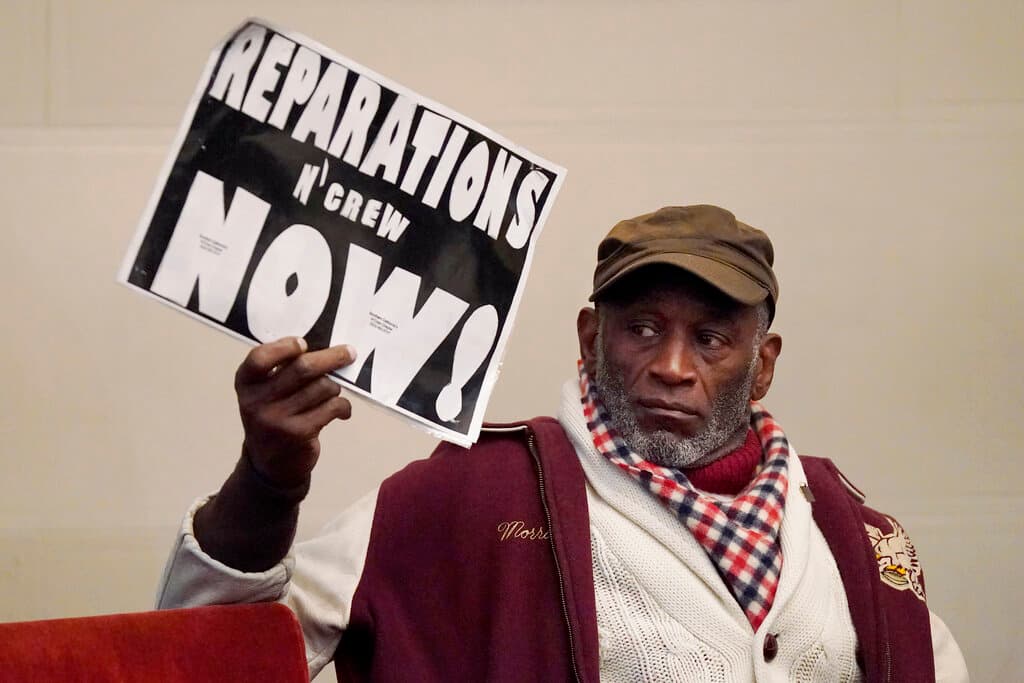
Morris Griffin holds up a sign during a meeting of the Task Force to Study and Develop Reparation Proposals for African Americans at Oakland, California. AP/Jeff Chiu

San Francisco faces a serious deficit but that isn’t stopping lawmakers from putting in motion a process to hand out costly reparations payments to black residents.

The city’s board of supervisors will debate an ordinance establishing a reparations fund after the board’s rules committee voted unanimously on Monday in favor of it, the Voice of San Francisco reports. The bill would set up a fund that could receive both city funds or private donations to be doled out as needed.

The bill is sponsored by supervisor Shamann Walton. “We are now at a pivotal and critical moment for black people here in San Francisco — a dramatically declining population, high concentrations of poverty and unemployment here in the city, coupled with disproportionate increases in the number of black people who are homeless in this city,” Mr. Walton said at the hearing.

“Now is the time we make good on some of the promises,” Mr. Walton continued.

In 2023, an advisory committee proposed $5 million payments to every eligible black adult as well as additional compensation. The plan sparked outrage after the Hoover Institution pegged the cost of the recommendations at nearly $600,000 per San Francisco taxpaying household.

Reparations committee members said the figure would be an accurate estimate to begin repairing the damage of slavery even though California was admitted to the Union in 1850 as a free state and never legally allowed slavery. The committee said it was not its obligation to figure out how to pay for the program.

“If the judge ruled in our favor, the judge would not turn to us and say, ‘Help them figure out how to make this work’,” committee chairman Eric McDonnell said at the time.

The Reason Foundation puts San Francisco at the top of its list of debtor local governments, with its liability topping  $37 billion, or around $43,000 per resident.

Then-mayor London Breed vetoed legislation to create a reparations office in 2024. Instead, he pressed forward with a smaller program funded with money diverted from the police budget.

That program — dubbed the Dream Keeper Initiative — was embroiled with its own claims of corruption. One scandal involved the director of the city’s human rights commission using Dream Keeper funds to pay for luxury travel. A man she shared a home with also received $7.5 million from the program, according to the Voice.

Mr. McDonnell remains the chair of the committee proposing the new reparations legislation. The current plan does not put a figure on proposed payments or a total price tag.

The current mayor, Daniel Lurie, hasn’t taken a public stance on the new legislation but has previously said that cash reparations are likely best handled at the federal or state levels.

The Chicago suburb of Evanston became the first American city to fund reparations. The $20 million program was designed to hand out $25,000 payments to black residents. It stopped making payments earlier this year after it ran into funding problems because a marijuana tax didn’t raise as much money as anticipated. It also is being sued because only black residents were allowed to apply for payments.

Boston, Chicago, Detroit, and St. Paul are in various stages of studying or implementing their own reparations programs. California and New York are considering reparations at the state level.

At the federal level, despite potentially costing trillions of dollars and having little or no chance of passing in the current Republican-led Congress, far-left Democrats looking to establish loyalty tests for their progressive colleagues on Capitol Hill have rolled out their own efforts to pass legislation requiring American taxpayers to pay reparations for the country’s legacy of slavery.


The New York Sun

© 2025 The New York Sun Company, LLC. All rights reserved.

Use of this site constitutes acceptance of our Terms of Use and Privacy Policy. The material on this site is protected by copyright law and may not be reproduced, distributed, transmitted, cached or otherwise used.

The New York Sun

Sign in or  create a free account

or
By continuing you agree to our Privacy Policy and Terms of Use