Fashionistas and Music Lovers Unite as Isaac Mizrahi ‘Survives Democracy’ at 54 Below
The world-renowned designer is also an exceptionally strong vocalist and a better-than-average stand-up comedian, with great timing and a vivid imagination.
‘Isaac Mizrahi Survives Democracy’
54 Below
Through August 9
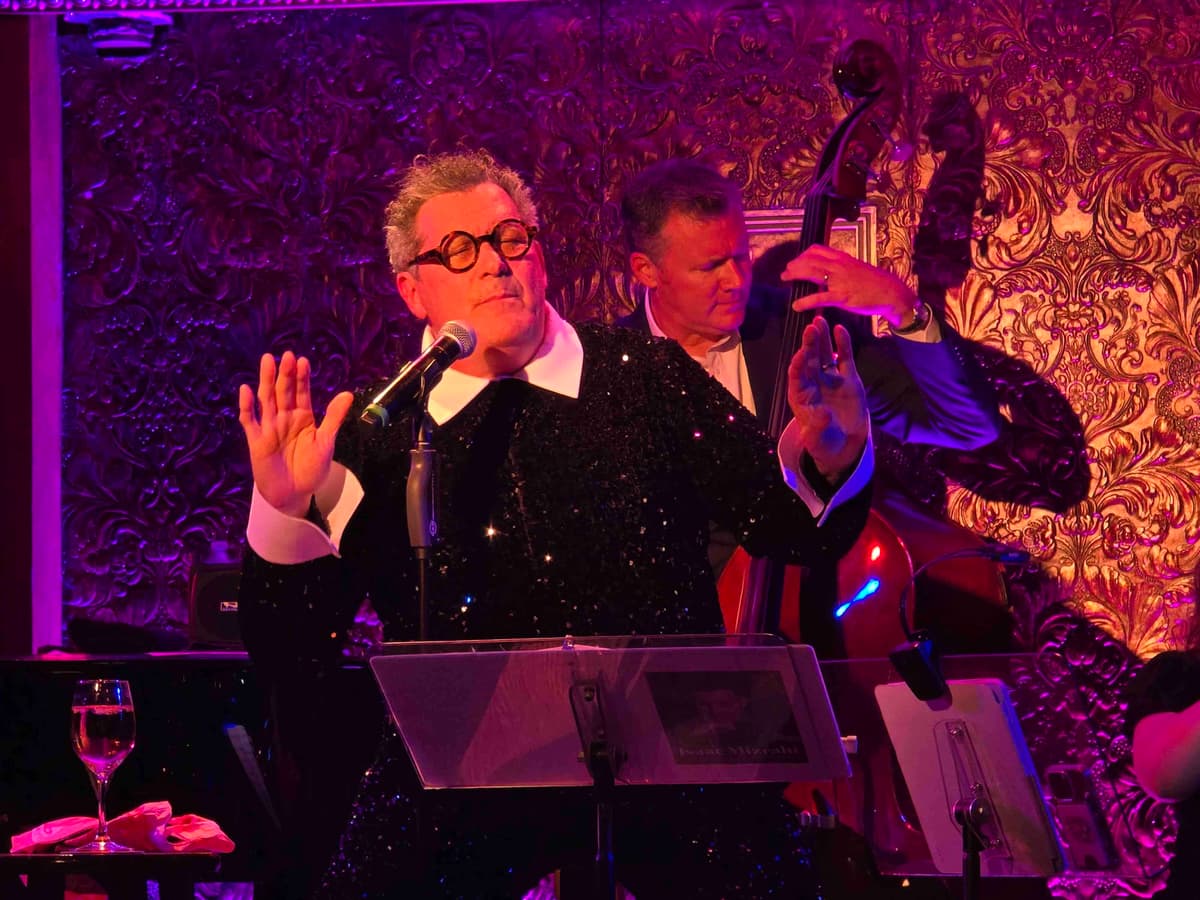
The audience was divided but at the same time united when Isaac Mizrahi took to the stage at 54 Below. By which I mean, at least half of the house was taking note of what he was wearing — it was a sequined jumpsuit that, to a non-fashion person such as myself, seemed worthy of a place in the wardrobe of either Judy Garland or Liza Minnelli. The rest of us were paying more attention to his intro, and even then he tricked us up.
As Mr. Mizrahi proceeded toward the stage from the house left, the quartet started to play what was clearly the intro to the Tom Jones hit “It’s Not Unusual.” Then, upon reaching the top of the stairs, he threw us a curve by launching into “Sing Happy,” an early John Kander-Fred Ebb show tune from their first production together, “Flora the Red Menace.”
As nearly everyone knows by now, Isaac Mizrahi is at least a double threat: a world-renowned designer who also has been singing in clubs like the Café Carlyle and 54 Below. Yet even on the performing side of his overall equation, Mr. Mizrahi has many strings to his bow: He is an exceptionally strong vocalist but also a better-than-average stand-up comedian, with great timing and a vivid imagination. Lately, he is also proving to be a credible songwriter and lyricist as well.
That opening gambit — giving us the well-known intro or counter melody to one song and then switching into another one is a device employed by such seasoned cabareteurs as Eric Comstock and even Mel Tormé.
Mr. Mizrahi’s presentation is essentially an 80-minute comedy monologue, certainly partially improvised — or at least delivered with highly credible spontaneity. It is periodically interrupted or illuminated, we might say, by about 10 songs. In these, he’s assisted exponentially by the musical director and pianist, Ben Waltzer, a veteran bassist and a drummer, Neal Miner and Joe Strasser, and a relative newcomer, 22-year-old trumpeter Kellin Hanas. The latter is already an expert player, who delivers a particularly juicy muted obligato, but is so young that Mr. Mizrahi makes a point to affectionately shame her in front of the whole room for not being able to identify Wilma Flintstone.
For the majority of the show, Mr. Mizrahi rants about the current state of things, and despite the title, there’s relatively little about politics. There is much highly humorous kvetching, as he would say, about the harmful effects of social media, spam calls, offensive ringtones, and the 21st century obsession with omnipresent screens. There’s also no shortage of outrageous quotes from his Jewish mother: “Her whole life was one long question: ‘That’s what you’re wearing?’ ‘That’s what you’re eating?’”
Like Marilyn Maye, Mr. Mizrahi has a gift for re-tooling and personalizing iconic lyrics in a way that doesn’t seem forced. His second number, “My Baby Just Cares For Me,” in an arrangement learned from Nina Simone, includes the line, “Liza Minnelli is not his style, and even Sandra Bernhart’s toothy smile, is something that he can’t see.”
His expected tour-de-force, which he updates with every show, is Cole Porter’s emblematic list song, “You’re the Top,” in which one of the bridges is rewritten as “You’re Democrats wielding baseball bats en masse / You’re the Lincoln Project, you’re safety glass.”
He’s also written some clever words and music, such as it is, for a piece he calls “What Fresh Hell” — the title is from Dorothy Parker — that turns out to be one of his screeds cast in the strict form of a haiku and recited to a specific beat.
There are also a few jazz and Broadway standards, like “I’m Through With Love,” Cole Porter’s lesser-heard “It’s Bad For Me” — check out the version by Rosemary Clooney and Benny Goodman — and the inspirational “I Whistle a Happy Tune,” which are all delivered in a straightforward fashion. He ends with an understated and touching “Crazy World.”
Perhaps even more impressively, he goes out with two radical reinterpretations of contemporary pop songs — granted, one is 40 years old — that to me, at least, are marked improvements on the originals. Madonna’s “Borderline” swings in kind of a stop-and-start staccato rhythm, which he extends to include solos from all of the quartet. Billie Eilish’s “Everything I Wanted” becomes a credible ballad about desire and regret, with especially sensitive accompaniment from Mr. Waltzer, and Mr. Strasser mainly pounding his bass drum.
There is also shtick galore. Mr. Mizrahi reaches into a goodie bag and re-gifts a bunch of swag items he’s picked up, almost involuntarily, from attending various gala events. He hands them out to random members of the house, showing that this seemingly spontaneous interaction is his stock-in-trade. That and “Gypsy” references: Every few minutes he detoured into a lyric line or a quote from the dialogue.
I may be unique among Isaac Mizrahi’s fans in that I know him primarily as a performer rather than a designer — and there was a whole table next to me of substantial fashionistas, among whom I recognized Iman, known to me for her philanthropy and her late husband. Still, if Mr. Mizrahi ever were to design a cool bow tie or Hawaiian shirt for me, I’d be overjoyed to wear it.