Federal Judge Blocks Texas From Enforcing Law Giving the First Amendment a ‘Bedtime’ by Banning Overnight Protest Encampments
‘The First Amendment protects their freedom of speech on campus, every hour of the day, every week of the year,’ a lawyer for the plaintiffs says.
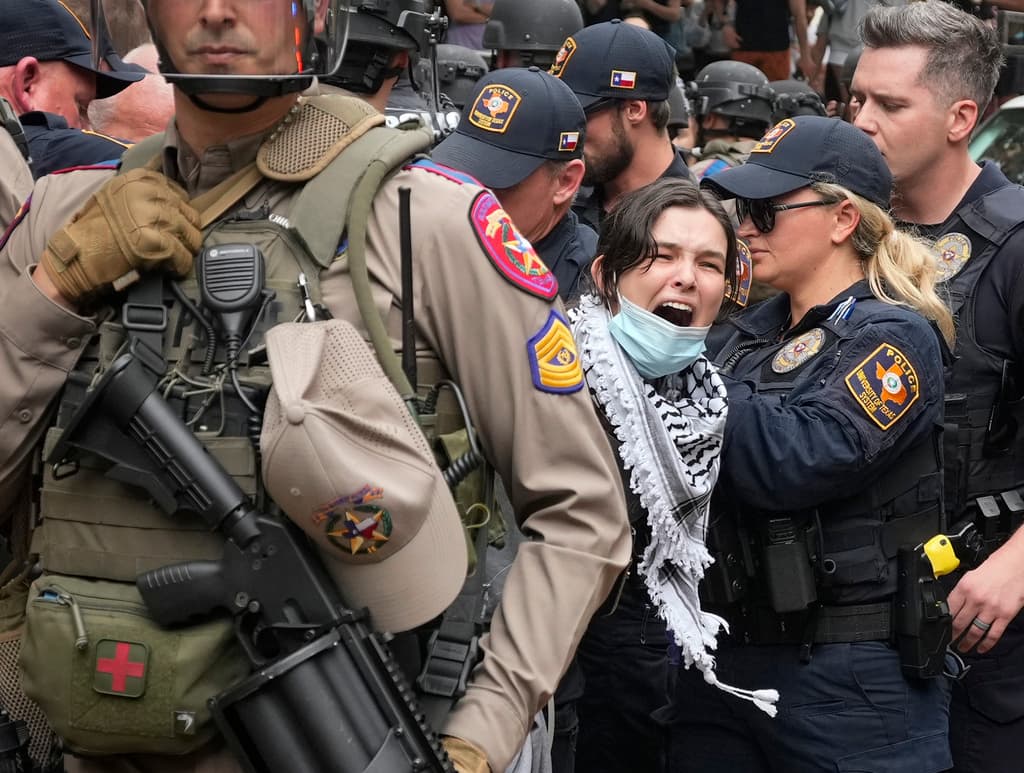

A federal judge is preventing Texas from enforcing a law that critics said could lead to universities punishing students for “chatting with friends” late at night.
The law, Senate Bill 2972, prohibits “any speech or expressive conduct protected by the First Amendment to the United States Constitution,” which includes “assemblies, protests, speeches, the distribution of written material, the carrying of signs, and the circulation of petitions” at public universities between 10 p.m. and 8 a.m. It also prohibits “expressive activities” during the last two weeks of a semester.
The law was passed in response to anti-Israel protests during the Israel-Hamas war and is aimed squarely at the overnight encampments that popped up on campuses across the country to protest the war. It limited the protections offered by a law passed in 2019 requiring that outdoor spaces on public universities be considered open forums for free speech.
A federal judge at Austin, David Ezra, temporarily blocked the enforcement of the law, saying the plaintiffs who challenged it are likely to succeed on the merits of their case. He noted that the legislature included a provision stating universities must uphold the First Amendment, but said it “does not change the fact that the statute then requires universities to adopt policies that violate those very constitutional protections.”
“The Court cannot trust the universities to enforce their policies in a constitutional way while plaintiffs are left in a state of uncertainty, chilling their speech for fear that their expressive conduct may violate the law or university policies,” Judge Ezra said.
The jurist added, “The First Amendment does not have a bedtime of 10 p.m.”
“The burden is on the government to prove that its actions are narrowly tailored to achieve a compelling governmental interest. It has not done so,” he said.
The Foundation for Individual Rights and Expression filed a federal lawsuit against the University of Texas system to block the new law. FIRE took issue with the broad language of S.B. 2972 that restricts when expressive activities can take place, suggesting that under the law, “Universities now have the power to discipline students at nighttime for wearing a hat with a political message, playing music, writing an op-ed, attending candlelight vigils — even just chatting with friends.”
The organization also notes that the law has exemptions for its prohibition for “commercial speech,” which it says means that students “are free to advertise t-shirts featuring the First Amendment after hours … but could face discipline for wearing them.”
A supervising attorney at FIRE, JT Morris, said in a statement about Judge Ezra’s ruling, “Today’s ruling is a victory not only for our plaintiffs, but all of those who express themselves on college campuses across Texas.”
“The First Amendment protects their freedom of speech on campus, every hour of the day, every week of the year,” he added.