Focusing on the Issues of the Vietnam Era Gives ‘Rolling Thunder’ More Depth Than the Typical Jukebox Musical
Director Kenneth Ferrone has recruited a cast of gifted and appealing young performers who, for the most part, beautifully serve up songs from the era, among them hits made famous by the Rolling Stones, the Animals, and Jimi Hendrix.
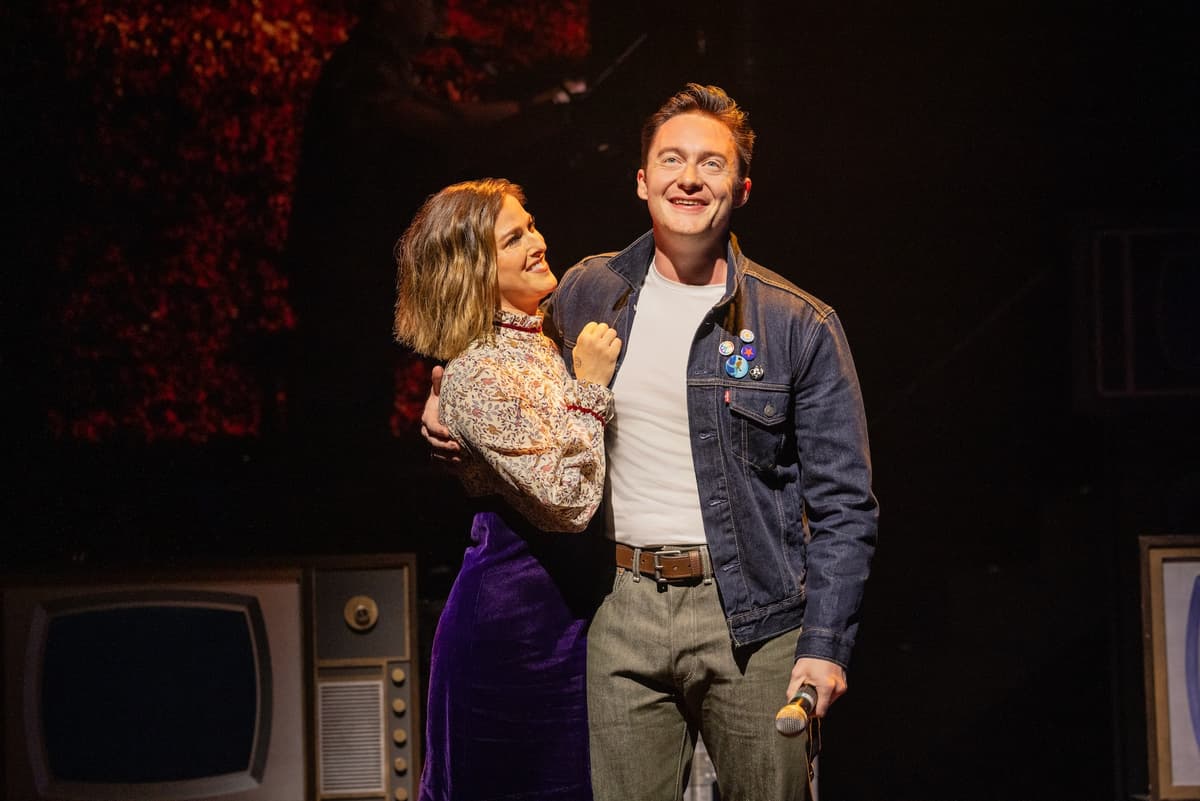
By nature, jukebox musicals prey on nostalgia. Yet the sentimental journey offered by “Rolling Thunder” isn’t just a musical one: The show, which arrives at New York after enjoying critical and commercial success in Australia, traces the lives of young soldiers during the war in Vietnam.
For anyone already skeptical of the notion that musical theater should be a vehicle for stringing together familiar tunes, the premise of adding a tragedy of epic proportions for extra emotional punch might seem an extremely cynical enterprise. But librettist Bryce Hallett, who has done time as a journalist — including a stint as a theater critic — has drawn on interviews with veterans and their families to create a show that, however simple and maudlin at points, feels heartfelt.
Better still, for this production, director Kenneth Ferrone has recruited a cast of gifted and appealing young performers who, for the most part, beautifully serve up songs from the era, among them hits made famous by the Rolling Stones, the Animals, Jimi Hendrix, Roberta Flack, and Simon and Garfunkel.
These numbers, performed by a band that surrounds the cast members and sometimes interacts with them, are woven into a story following four young Americans who find themselves fighting for their country in a foreign land. Thomas and Johnny volunteer to serve, driven by naïve notions of duty and valor; Andy, who is Black, is drafted, and receives a warning letter from a friend, Mike, assigned to the same camp.

The struggle for civil rights is referenced, as are other events that unfolded during that fraught period; Caite Hevner’s projection design, displayed both on screens hanging over the stage and facsimiles of TV sets scattered through Wilson Chin’s set, features archival footage of soldiers and politicians, interspersed with images of letters and military planes. Psychedelic patterns also pop up, as “Thunder” acknowledges how, once public opinion started turning against the war, young men who had suffered through it became scapegoats.
But the musical’s emphasis, not surprisingly, is on the soldiers’ relationships — with each other and with their loved ones back home. Johnny, sweetly played and radiantly sung by Drew Becker, writes to his family and his sweetheart, Linda; Cassadee Pope brings an exquisitely pure, clear voice to the latter role, offering a lovely, folky reading of Kris Kristofferson’s “Help Me Make It Through the Night.”
Deon’te Goodman and Daniel Yearwood also sing gorgeously as, respectively, Mike and Andy, delivering between them lyrical, soaring takes on Curtis Mayfield’s “People Get Ready,” P.F. Sloan’s “Eve of Destruction” (popularized by Barry McGuire), and Bob Dylan’s “A Hard Rain’s a-Gonna Fall.” Courtnee Carter, playing Andy’s mother and a military nurse, contributes to potent renditions of “Nowhere to Run” and “Killing Me Softly with His Song.”
“Killing Me Softly” is one of a few entries that feel oddly inserted, as some numbers inevitably do in jukebox affairs. (For the record, a press release describes “Thunder” as “part rock concert, part documentary.”) There’s also, predictably, some overzealous singing: Justin Matthew Sargent is the guiltiest in this respect, growling and bellowing through “The House of the Rising Sun” and “Born to Be Wild” as though he’s competing on “American Idol.”
This could be in part a dramatic choice, as Mr. Sargent’s character, Thomas, is the most cocksure of the bunch — at least until he is humbled, to put it mildly, by his experiences in battle. Another character meets an even less fortunate fate, one you will likely see coming before the curtain goes down on the first act.
At the preview I attended, Mr. Becker stepped forward after the curtain call and asked audience members who were themselves veterans to stand, and their fellow attendees, along with the actors and musicians, applauded heartily. It was a fitting sendoff for a production that, however predictable the musical’s aims or modest its merits, comes across as genuine and endearing in performance.