Fresh and Darkly Funny, ‘Archduke’ Reimagines the Events Leading Up to World War I
Under Darko Tresnjak’s robust, witty direction of an impeccable cast, “Archduke,” now having its New York premiere, is deeply poignant and, in the end, unexpectedly uplifting.
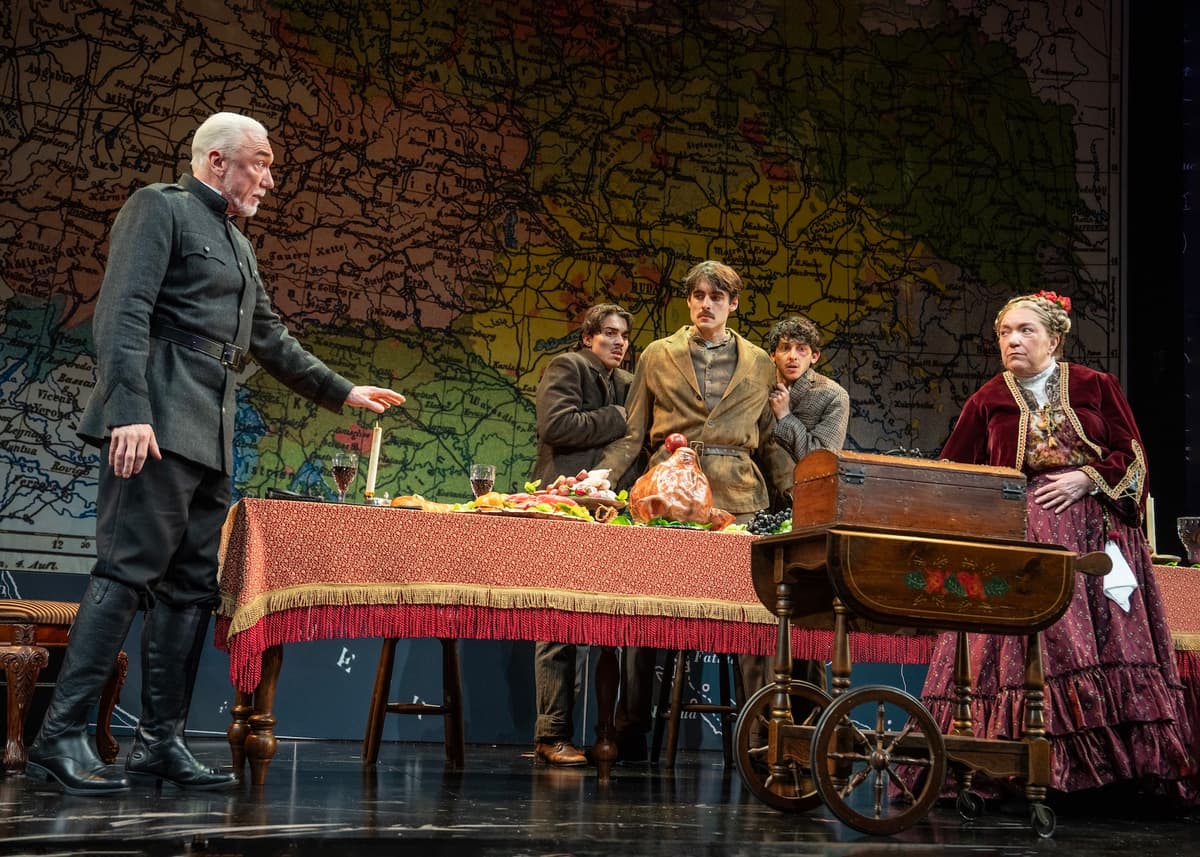
Three starving, naïve young men, plied with food and promises of glory — with a little jingoism and misogyny thrown into the mix — are recruited to be key players in an act of political violence. It’s a scenario that could unfold today, in any number of places and under a variety of circumstances, and that’s precisely what makes Rajiv Joseph’s “Archduke,” an absurdist comedy reimagining events leading up to World War I, feel as fresh as it is darkly funny.
Under Darko Tresnjak’s robust, witty direction of an impeccable cast, “Archduke,” now having its New York premiere, is also deeply poignant and, in the end, unexpectedly uplifting. As much as anything Mr. Joseph has written — including “Bengal Tiger at the Baghdad Zoo,” which made the playwright a Pulitzer Prize finalist and became a Broadway vehicle for the late Robin Williams — the play sustains a thrilling sense of tension and imagination, which accommodates various structural and historical twists.
We’re reintroduced to Gavrilo Princip, the Bosnian-born Serb who assassinated Austria-Hungary’s Archduke Ferdinand in 1914, precipitating what was then called the Great War, as he lingers outside an abandoned warehouse. Gavrilo, only 19, is slight and sickly, as Princip was, but as played by Jake Berne, one of three actors making riveting off-Broadway debuts here, he possesses a magnetism that burns through his delicate frame.
In the play, Gavrilo is teamed with Nedeljko, also his age, and Trifko, just a year older, who share with him not only poverty and social alienation but tuberculosis, the then-fatal disease that made it impossible for Princip to survive in prison. This makes the trio ideal prey for Dragutin “Apis” Dimitrijevic, another real-life figure, a Serbian military leader and intelligence chief believed to have played a key role in the plot leading to Franz Ferdinand’s murder.

It’s hard to imagine someone better equipped to embody Apis dramatically than Patrick Page, a basso-voiced, blazingly charismatic actor who has earned acclaim in roles ranging from musical-theater heavies to classical antagonists, including characters he recently wove into “All the Devils Are Here: How Shakespeare Invented the Villain,” a virtuosic one-man show.
Once Gavrilo and Nedeljko are lured into Apis’s lair by Trifko’s reference to a “lady cook,” the droll Sladjana, played by the equally estimable and well-cast Kristine Nielsen, seats them at a banquet table, made comically lavish in Alexander Dodge’s handsome, clever set design. As the lads chomp and slurp to their hearts’ content, Apis regales them with accounts of his own exploits, prominent among them the disemboweling of a royal couple, appealing to their Serbian pride.
When Gavrilo is put off by the notion of killing a woman — his task would be taking out both Ferdinand and his duchess — but nonetheless demonstrates he has more of a stomach for brutality than the others, Apis decides he has found his ringleader; the older man sets about trying to poison the youth with warnings of what happens “when a woman gets into a man’s head … witchcraft.”
Apis’s ramblings, and less vile, more curious exchanges that occur later with Nedeljko and Trifko — respectively played by Jason Sanchez and Adrien Rolet, both commanding and comedically adroit — invite comparisons to fringe movements that have stoked the frustrations of lonely, disenfranchised young men in recent years. If Gavrilo and his peers plainly don’t harbor the rancor of the involuntarily celibate, as extreme proponents of this phenomenon have been called, Apis has no qualms about leading them in this direction to serve his agenda.
It’s no accident, then, that quirky Sladjana, the sole woman in “Archduke,” emerges as the play’s unlikely voice of moral authority. “Recognize evil when it cross your path,” she tells Nedeljko and Trifko in one scene, using the artfully coarse, stilted language Mr. Joseph assigns her and the younger men. Ms. Nielsen, not surprisingly, makes the admonition as piercing as Sladjana’s generally more buffoonish antics are hilarious.
Mr. Page’s Apis is, just as predictably, a fascinating and often seductive monster. Drawing Gavrilo in after he identifies the teenager as the perfect patsy, he exudes paternal warmth with an ease that merely confirms his sociopathic leanings. “Most men run away every day of their lives,” he tells Gavrilo. “But you are not that kind of man.”
In the end, however, “Archduke” asks us to envision a world in which men like Apis have less sway, and the basic instinct to live and let live triumphs over darker, deadlier impulses. The play may not convince you this is plausible, but it offers an exhilarating and ultimately moving couple of hours.