
Government Officially Re-Opens After House Passes Spending Bill, Though Key Issues Remain as Senators Allow Themselves To Sue Jack Smith
Johnson tells the Sun that he wants to repeal a section of an appropriations bill that would allow a small group of senators to sue the Justice Department for millions.
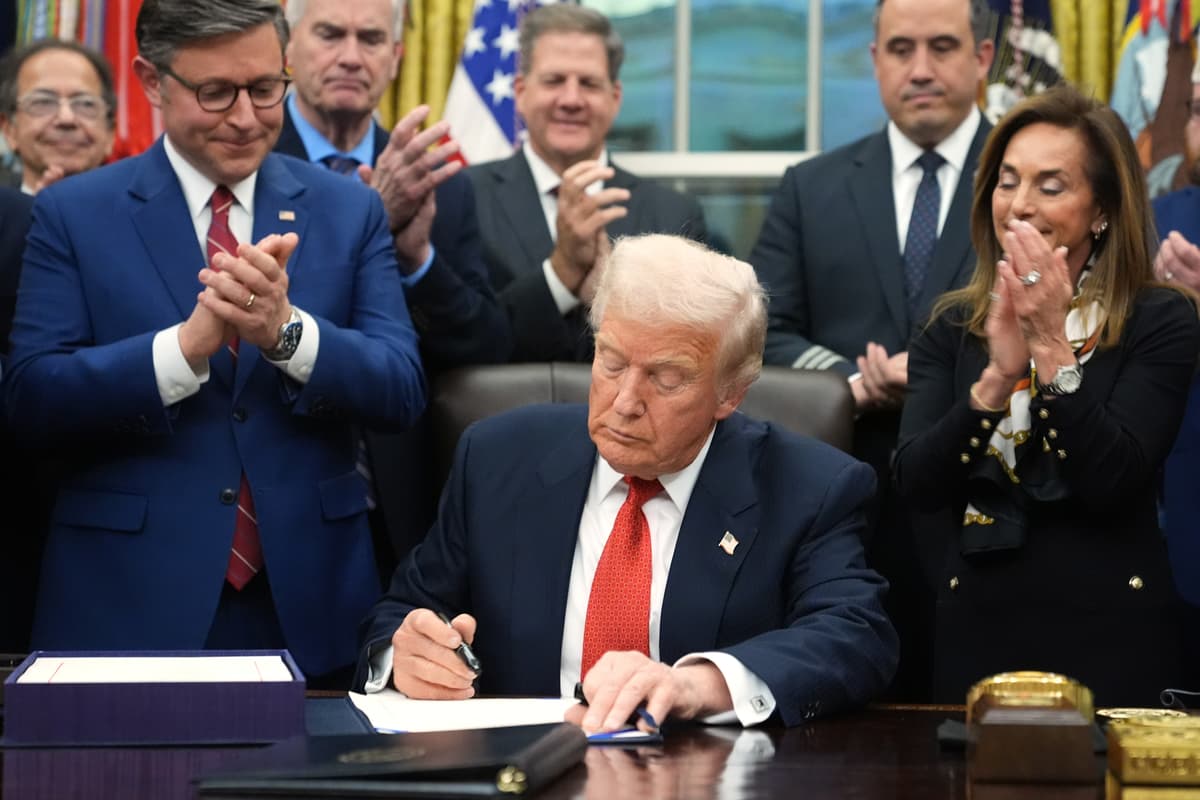

The longest shutdown in American history has officially ended after President Trump signed a spending bill Wednesday night shortly after the House passed the legislation. There will be little reprieve for lawmakers, however, as Speaker Mike Johnson tells The New York Sun that he is getting to work on repealing a provision in the spending bill which would allow a small band of senators to sue the Justice Department for millions of dollars.
A group of eight Senate Democrats paved the way for this agreement to take hold over the weekend after they spent nearly seven weeks blocking the Republicans’ clean funding bill. The new legislation, which the Senate passed on Monday, will fund certain parts of the government for the rest of the fiscal year which ends next September, while other issues must be hammered out before the next funding deadline on January 30.
On Wednesday night, the House passed the bill by a margin of 222 to 209. In total, six Democrats voted for it, while two Republicans voted against it. Mr. Trump signed the legislation shortly after.
One of the key issues that put the spending bill in peril over the last 24 hours was a provision in one of the appropriations bills adopted by the Senate on Monday night. That section of the legislative branch’s appropriations bill states that senators whose records were obtained as a result of subpoenas during the “Arctic Frost” investigation will now have the right to sue the government.
For each instance of the government obtaining senators’ data without their knowledge, lawmakers will be able to sue the Justice Department for $500,000. Among those eight senators who were caught up in the investigation, there is a potential that each lawmaker could rake in millions of dollars if they choose to sue the government.
At least one senator whose records were obtained by the FBI — Senator Lindsey Graham — has already said that he plans to sue the government once this provision holds the force of law.
Mr. Graham told reporters in South Carolina on Wednesday night that he knows that both his personal phone records and his government phone records were subpoenaed by Special Counsel Jack Smith, meaning that if he does sue and succeed at trial, Mr. Graham would be entitled to a $1 million payout.
“I’m gonna push back really hard,” Mr. Graham said Wednesday. “If you think I’m gonna settle this thing for a million dollars — no. I want to make it so painful no one ever does this again.”
The speaker, however, says that such a provision allowing senators to sue is unacceptable to him and his colleagues. He tells the New York Sun that he plans to support legislation to repeal that private cause of action for senators.
“I talked to Leader Thune today,” Mr. Johnson told the Sun on Wednesday night, referring to the majority leader, Senator John Thune. “I was surprised by the addition of that provision in the bill and I’m certainly not happy about it.” He says he supports a separate measure to repeal that language, though he does not yet have assurances from the Senate leaders that his bill would be passed.
“I talked to him early this morning and we had not yet produced our legislation, so I haven’t talked to him since then,” Mr. Johnson said of Mr. Thune. “The House has a strong opinion about it.”
One GOP lawmaker, Congressman John Rose, has introduced a bill to simply repeal the final section of that legislative branch appropriations bill signed by the president on Wednesday night. Mr. Johnson announced on X that the bill will receive a vote under suspension of House rules, meaning that it will come to the floor directly rather than going through any kind of committee process so that lawmakers can vote as soon as possible.
The speaker says that that vote will take place next week.
The only House member whose phone records were subpoenaed as a result of the Arctic Frost investigation, Congressman Mike Kelly, says even he does not want senators to be able to sue the Justice Department.
“We’ll see if we can change that because I think it’s kind of odd,” Mr. Kelly told Lilly Broadcasting in an interview on Wednesday. “Do I have concerns about it? Absolutely … I’m very alarmed by it.”
The shutdown had significant impacts on air travel, nutrition programs, federal employees, and the American economy as a whole. Flight delays and cancellations piled up over the weekend, and the president of the National Air Traffic Controllers Association says it could take weeks for flight schedules to return to normal.
Hundreds of thousands of federal employees were furloughed, while thousands more were permanently dismissed. Senate Democrats were able to undo those firings, however, as part of a deal to win their votes to re-open the government.
The Supplemental Nutrition Assistance Program, more commonly known as food stamps, temporarily ran out of money at the beginning of November before the Department of Agriculture was ordered to disburse funds to the states following a judge’s order. The legal battle over SNAP was still playing out when the Senate passed the bill on Monday, though the spending agreement Mr. Trump is now set to sign will fund SNAP for the entirety of the fiscal year, which ends on September 30, 2026.
The economic impacts will be significant, according to the White House. According to an estimate by the Congressional Budget Office, fourth quarter GDP is now expected to be between 1.5 percent and two percent lower than it would have been had the shutdown not taken place. That same estimate says the total cost to the economy will be somewhere between $28 billion and $39 billion.
One of the Senate Democrats who folded and allowed the funding measure to pass his chamber, Senator Tim Kaine, said in a New York Times opinion piece on Wednesday that he could not stomach any more pain for his home state of Virginia, which is home to around 150,000 federal employees.
“People suffered. Food banks across the country ran out of supplies, and Americans went hungry after the Trump administration cruelly withheld SNAP benefits, previously known as food stamps,” Mr. Kaine wrote.
The Virginia senator further warned that his Republican colleagues could have gone so far to kill the Senate filibuster, which is the 60-vote threshold which allowed Senate Democrats to block the funding bill back in September. Mr. Trump had been demanding that GOP senators end the filibuster, and some lawmakers were starting to warm to the idea.
“The chaos of continuing the shutdown would have led them to eliminate the Senate filibuster so they could pass a government funding bill with no Democratic votes, a dangerous consolidation of one-party rule,” Mr. Kaine argued.
The funding agreement marks the completion of three of the government’s 12 annual appropriations bills. The other nine pieces of legislation will have to be completed between now and January 30.