
‘I’m Not Very Big’: Luigi Mangione Was Curious Why So Many Police Vehicles Were Coming to His McDonald’s Arrest, Police Officer Testifies
The prosecution plans to call 26 witnesses in their effort to head off a judge tossing crucial evidence gathered when Mangione was arrested by a passel of local, Altoona, Pennsylvania law enforcement officers.
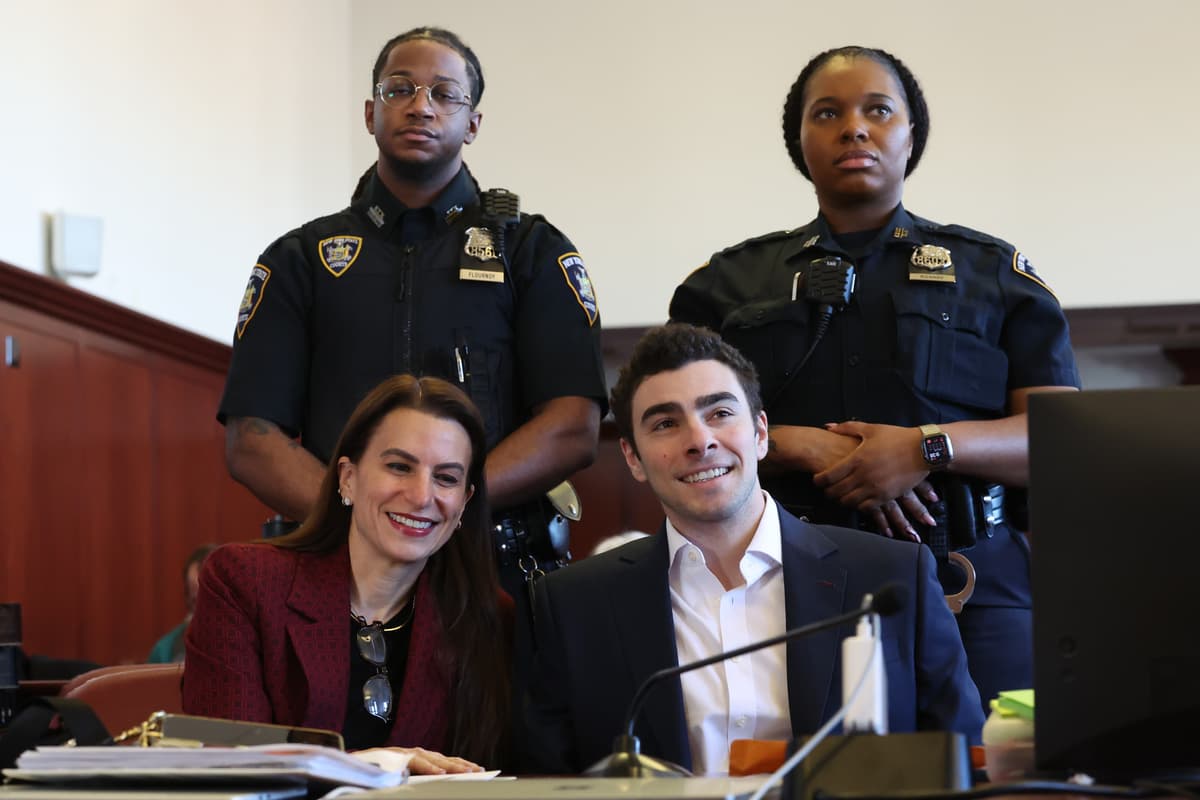
Defense attorneys for Luigi Mangione, who is charged with murdering the CEO of UnitedHealthcare, Brian Thompson, scored a few points on Friday during their cross-examination of a police officer, who was involved with Mr. Mangione’s arrest, which they argue was conducted unlawfully.
“You weren’t friends with him?” Defense attorney Jacob Kaplan asked Altoona police officer Samuel McCoy at Manhattan criminal court on Friday, referring to Mr. Mangione. “You were asking to get information?”
“Correct,” Officer McCopy replied.
But when Officer McCoy was questioning Mr. Mangione, no one had read the suspect his Miranda warnings yet.

Defense attorneys for Mr. Mangione are asking the judge presiding over his New York case to suppress statements their client made before he was informed of his rights from the upcoming trial. Furthermore, they want to dismiss evidence that was seized from his backpack, which the attorneys say was searched without a proper warrant when he was arrested last year.
Five days after Thompson, a father of two, was fatally shot on a Midtown Manhattan street, Mr. Mangione was arrested at a McDonald’s in the heart of Altoona, a small Pennsylvania town about 300 miles west of New York. After a customer alerted the manager of the fast food restaurant that a man resembled the suspected shooter from New York, she called 911.
Ultimately, thirteen local police officers were involved in the arrest plus additional officers at the stationhouse. Eight of these thirteen officers have testified during the suppression hearings, which began on December 1.
In these types of hearings, prosecutors bear the burden of proof, meaning the Manhattan District Attorney’s office that brought the charges against Mr. Mangione has to prove that evidence and statements were gathered lawfully and should be admissible at trial. Judges tend, however, to give prosecutors the benefit of the doubt. But nevertheless, perhaps in an attempt to dot all their i’s and cross all their t’s, prosecutors – who were surprised when the judge threw out the terrorism charges against Mr. Mangione – are planning to call 26 witnesses.

On Friday, Officer McCoy took the stand. He has been working for the Altoona police department for six and half years, and he was at the police station with a younger officer, whom he was training, on December 9, 2024, when he saw Lieutenant William Hanelly, who testified on Thursday, leaving the station, wearing a vest.
“Lieutenant Hanelly was exiting the station,” Officer McCoy testified, “he had on his vest… That means something is happening… I had a very brief conversation with him in passing,” the officer went on. “He mentioned to me that there was a homicide suspect… I believe that he referred to a NY shooter…”
Officer McCoy said “I grabbed my training officer and we responded directly to that location to assist.”
Defense attorney Kaplan clarified that Officer McCoy acted on his own accord, his own initiative when he decided to head to the McDonald’s and not because he had been called there. “For what information I had at that time, I would expect that almost every officer at the Altoona police department would respond,” Officer McCoy confirmed, due to the “severity of the situation.”

At first only two patrolmen had responded to the 911 call at the McDonald’s, but after Mr. Mangione provided them with a New Jersey driver’s license that turned out to be fake, the news that he could potentially be the suspect shooter wanted in New York spread like wildfire, and other officers began showing up at the McDonald’s.
Once Officer McCoy arrived, he walked up to Mr. Mangione, and immediately asked if he had any weapons.
“With the information I had that he was a homicide suspect, it’s very possible that he had weapons or [would] feel desperate which makes people do erratic things,” Officer McCoy testified.
Then the officer noticed a black backpack that was on the floor and asked Mr. Mangione if it was his.

“I asked him, ‘Is this your property?’ He indicated to me it was,” Officer McCoy testified. The court watched bodycam footage, where Officer McCoy is seen moving the backpack from the floor to a table. He said he moved the bag “so that if he (Mr. Mangione) decides he wants to make a dramatic exit, per se, he doesn’t have access to any weapons.”
Mr. Manione, who was in court and who has pleaded not guilty to all charges, was dressed in a dark blue suit and white button down shirt, was taking notes, mostly keeping his head down and writing during Officer McCoy’s testimony.
The officer said that he asked Mr. Mangione why there were so many officers at the Mcdonald’s.
“I asked him what all the nonsense is about,” the officer said, and an assistant district attorney, Joel Seidemann, played bodycam footage, where the officer can be heard asking, “What is all the nonsense about?” Mr. Mangione can be heard answering, “We’re gonna find out, I guess.”

“Through my experience, if somebody is being questioned and they’re not involved they’ll have one type of reaction and if they are involved, they’ll have a different type of reaction,” Officer McCoy told Mr. Seidemann on direct examination.
Mr. Mangione asked the officer, “Are you calling a couple of more cars?” He added. “I am not very big.”
The officer did not recall that statement but acknowledged it when the prosecutor played the bodycam footage. Officer McCoy said he tried to engage Mr. Mangione in conversation and to inquire how he arrived at the McDonald’s. “Did you walk here?” Officer McCoy inquired if he had gotten wet from the rain while walking. He said that Mr. Mangione did not want to engage in a conversation with him.
“I said, ‘That’s fine.’ I did not ask him any more questions,” Officer McCoy testified, and admitted under cross-examination that he had asked these questions to elicit information even though Mr. Mangione had not been detained and had not been read his Miranda warning yet.

“You asked if him (Mr. Mangione) if he was soaking wet?” Mr. Kaplan asked the witness. “You asked him if he walked there? … You asked him if he had a car? … You weren’t friends with him… You were asking to get information?”
“Correct,” McCoy responded. He also conceded that Mr. Mangione was largely compliant. “None of the actions he took that day were frightening, made me fear for my life,” Officer McCoy said.
The defense was also able to poke a few holes into the allegation that Mr. Mangione told the judge in Pennsylvania during his arraignment that he had less than a hundred dollars in his bag, when the officers had in fact found over $7,000 on him, in cash, mostly in one hundred dollar bills, as well as a very small amount of foreign currency, as the Sun reported.
The second witness of the day, a sergeant and detective at the Altoona Police Department, Eric Heuston, who oversaw much of the inventory and logging of the evidence at the police station, such as Mr. Mangione’s clothing, a passport and a handgun, testified that Mr. Mangione was carrying “a good bit of property” and “over $7,000” when he was arrested, including foreign currency.

According to the photographs of the evidence released by the court, Mr. Mangione seemed to have had four foreign bank notes on him. Detective Heuston listed this foreign currency as a total of $1620. But the value amounted to less than $16.
All of this evidence was turned over to the New York Police Department pursuant to a search warrant detective Sgt. Heuston personally drafted, “based on the fact that it could be of value to New York,” he testified.
When lead defense attorney Karen Friedman Agnifilo pointed out that the true value of the foreign currency is less than $16 and not $1,620, as Sgt. Heuston had noted, the detective explained that he used the dollar sign merely to indicate “monetary value” in general and not to specify a certain amount.
Ms. Agnifilo then asked the detective about a statement he allegedly heard her client make during his arraignment at the local Blair County courthouse on the evening of his arrest. According to detective, Mr. Mangione allegedly shouted at the judge that he was not carrying – as was being stated – more than $7,000 in cash on him but less than one hundred dollars.

The defense attorney now wondered if maybe her client had referred to the amount of foreign currency.
Under cross-examination, detective Heuston also admitted that he had read through some of Mr. Mangione’s writings and chosen parts that he believed were relevant for New York investigators. Body-camera footage also showed him reading Mr. Mangione’s “to do” list to a detective from New York over the phone, and suggesting that the suspect was “more likely than not” the gunman sought for Thompson’s murder.
Ms. Agnifilo questioned whether he had overstepped his boundaries. She kept pressing him about the inventory list of the evidence, until the Altoona detective smiled and said, “I think we’re getting confused here.
The judge will decide what evidence and what statements will be admissible at trial. The hearings will pause on Monday and resume next week, on Tuesday.