
In New York Concert, as on New Album, Paul Winter Consort Keeps Breaking Down Barriers

Recently, Mr. Winter has more consciously sought to erase the boundaries between the man-man world and the natural world.
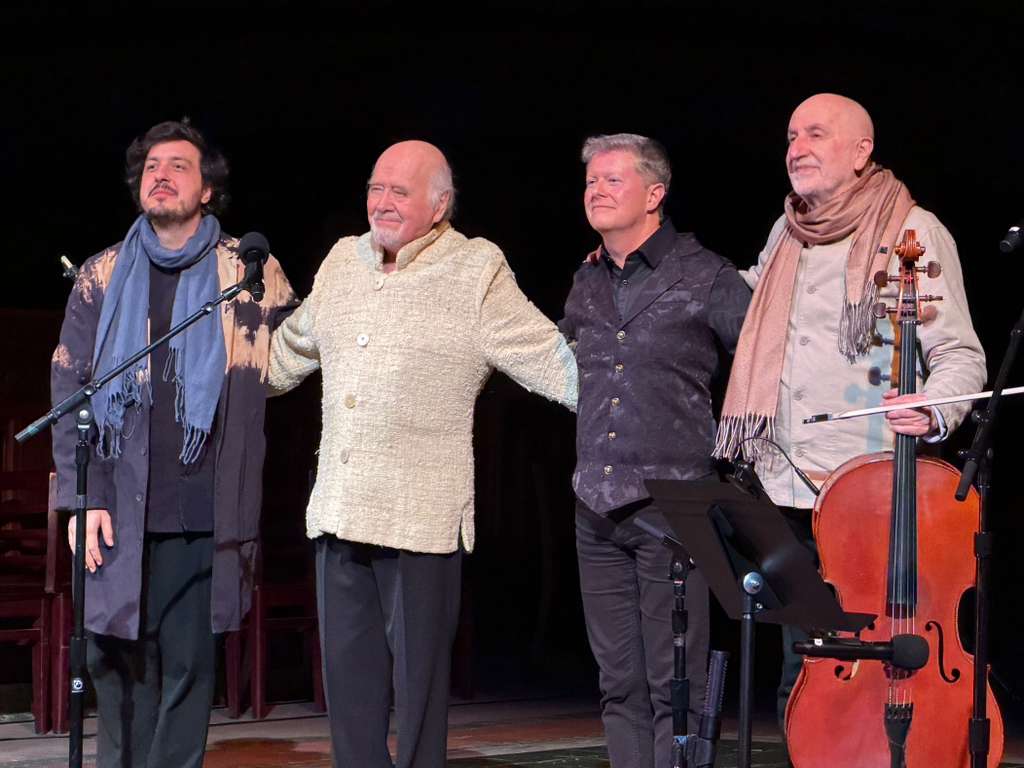
Credit: Tom Buckley
Paul Winter Consort members Henrique Eisenmann, Paul Winter, Tim Brumfield, Eugene Friesen at the Cathedral of St. John the Divine on November 29, 2025. Credit: Tom Buckley

Paul Winter was joined at his concert on Saturday evening by some rather unusual collaborators, who also appear with him on his new album, “Horn of Plenty.” Some of these musicians have wings. Others have fur and walk on four legs. And still others live in the ocean.

We have long been accustomed to Mr. Winter, the veteran 86-year-old saxophonist, composer, bandleader — not to mention musical philosopher — erasing what might be viewed as the artificial distinctions between different genres of music. Over almost 60 years, the Paul Winter Consort has perfected a music that’s equal parts American jazz, European classical, folk music and world music.

Recently, Mr. Winter has more consciously sought to erase the boundaries between the man-man world and the natural world, or between human so-called civilization and the animal kingdom.

We’ve all been to pop and rock concerts in stadiums — and even the Newport Jazz Festival — where the artists on stage are projected onto huge screens, so that even someone sitting way toward the back of the venue can see what’s going on.

Mr. Winter’s intentions are precisely the opposite. His familiar venue in New York is the Cathedral of St. John the Divine, which is a house of worship rather than a temple of music. At the cathedral — listed in some sources as the largest in the country and one of the biggest in the world — Mr. Winter doesn’t seem to care whether you look at him or not when he performs.

There is a spotlight on him, and he wears a white outfit that kind of makes him look like a Tibetan high lama standing on the top of a mountain in the darkness, playing his horn off into the valley below.

Paul Winter in concert at the Cathedral of St. John the Divine. Credit: Tom Buckley

You can see his cellist, Eugene Friesen, who has been with the ensemble for 45 years, but there are two keyboardists, Henrique Eisenmann playing a grand piano and Tim Brumfield on the cathedral’s massive pipe organ, who are out of the sightlines of most of the audience.

The visuals are only a part of how Mr. Winter re-imagines the act of listening to live music; the big open space of the cathedral becomes a highly resonant cave or a canyon full of echoes. In fact, one piece is titled “Grand Canyon Sunrise” and uses the pipe organ to express that endless expanse.

After a while, you pay less attention to what your eyes are telling you and you literally start to see with your ears.  This is some of the most well-designed audio I have ever experienced, and represents a rare example of a composer-performer, a sound system, and a performance space itself where everything fits together perfectly — each element seems perfectly designed for the others.

For example, the tempos are mostly slow, because excessive reverberation on a fast number would sound chaotic and jumbled and probably give the listener a headache — whereas this music has precisely the opposite effect. In playing the album, I recommend listening with the lights out so there’s nothing to distract you.

The use of animal sounds fits into this scenario. Since they are piped into the live performance on pre-recorded tracks,you don’t see the birds or the whales, but as with the organ, the important thing is to hear them.  

One piece, “The Well-Tempered Wood Thrush” is so named because Mr. Winter happened to notice that this particular bird’s call was harmonically similar to Bach’s “Well-Tempered Clavier.” Another piece, “Song for Roger,” is a dedication to the late biologist Roger Payne, who was the first to prove that humpback whales create sounds that amount to genuine music.

“Wolf Eyes” finds Mr. Winter using his soprano saxophone to go back and forth with the pre-taped sounds of a wolf pack. At the concert, as on the album, after a while it became difficult to tell which sounds were being made by Mr. Winter and which were the actual wolves. This particular piece also goes a long way toward reforming our preconceived notions of these critters, which are perpetually cast as villains in fairy tales.

Other pieces utilize actual human voices, though not words, at least not any that would be recognizable to Western listeners. “Caravan at Dawn” features the Armenian percussionist Arto Tuncboyaciyan chanting what sounds like a Mohammedan call to the faithful.  “Garden of the Earth” utilizes the Dmitri Pokrovsky Singers, a Russian choir whose members here sound like a children’s chorus, singing a melody reminiscent of “Make Our Garden Grow,” the finale from Leonard Bernstein’s “Candide.”

Perhaps the last boundary that Paul Winter breaks down is the distinction between the everyday and the divine — making a church the perfect setting for his music — and reminding me of Duke Senior’s observation in “As You Like It” regarding the sanctity and even holiness of the forest primeval: Here, one “finds tongues in trees, books in the running brooks, Sermons in stones, and good in everything.”


The New York Sun

© 2025 The New York Sun Company, LLC. All rights reserved.

Use of this site constitutes acceptance of our Terms of Use and Privacy Policy. The material on this site is protected by copyright law and may not be reproduced, distributed, transmitted, cached or otherwise used.

The New York Sun

Sign in or  create a free account

or
By continuing you agree to our Privacy Policy and Terms of Use