Jazz at Lincoln Center Dedicates Its New Season to the Musical Inspiration of ‘Mother Africa’

Africa is roughly three times the size of Europe, and has a proportionate number of different languages and different approaches to making music.

Gilberto Tadday/Jazz at Lincoln Center
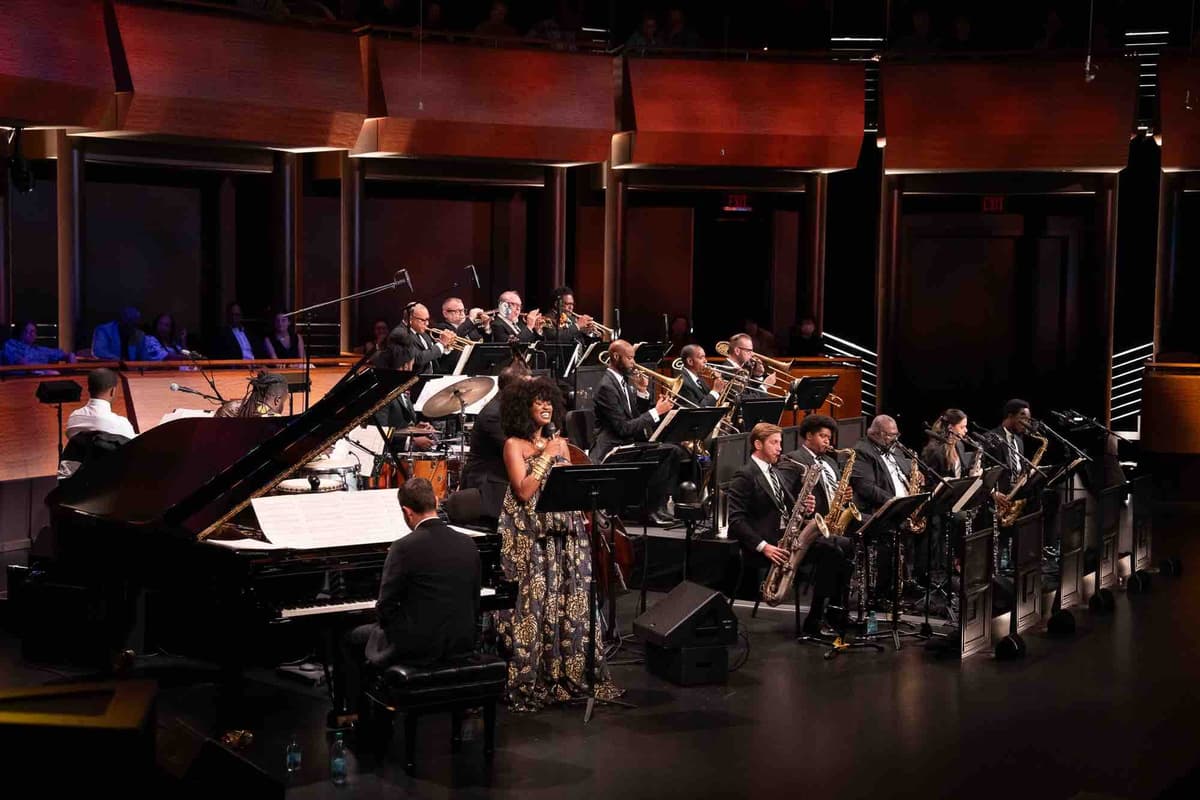
Shenel Johns with the Jazz at Lincoln Center Orchestra. Gilberto Tadday/Jazz at Lincoln Center

Wynton Marsalis’s ‘Afro!’
The Jazz at Lincoln Center Orchestra With Wynton Marsalis
Through September 20
Streaming Through September 27

When Seton Hawkins, director of Jazz at Lincoln Center’s Swing University, speaks about African music, he always starts by making one point clear. Born and raised at Johannesburg, he lets us know first and foremost that Africa is not just one place, one people, one kind of musical culture.  

Africa is roughly three times the size of Europe, and has a proportionate number of different languages and different approaches to making music; it’s one of the more diverse, least homogenous populations in the world, and the music made there reflects that.

This season, Jazz at Lincoln Center is dedicating its entire season to the inspiration of “Mother Africa,” and it promises to be a fairly spectacular series.

Opening night brought us what will surely prove to be one of the more ambitious works of the season, a full-length extended work by the artistic director, Wynton Marsalis, titled “Afro!” It often seemed like a direct illustration of the diversity of which Mr. Hawkins spoke. The work as it now stands, consists of six moments that filled an entire evening, with an intermission, over two full sets. “Afro,” as the program notes, was commissioned through Arnhold Innovation Initiative. 

In addition to the current Jazz at Lincoln Orchestra — with pianist Joe Block substituting for Dan Nimmer — the piece featured three guest stars, starting with the remarkable young vocalist Shenel Johns, and the percussionist Brian Richburg joining JALC drummer Obed Calvaire. Mr. Marsalis also acknowledged Weedie Braimah, who played the djembe, an African drum, and served as a general consultant and a co-composer.

 Weedie Braimah. Gilberto Tadday/Jazz at Lincoln Center

In the classical tradition, a work in distinct movements such as this is usually characterized as a “suite.” While “Afro” is certainly that, it’s more: It’s not like each movement keeps to one tempo or one time signature or one groove throughout its length, but rather the work was continually shifting from one rhythm to another.  

As trombonist Vincent Gardner said in the pre-concert talk, there are at least 20 different grooves in “Afro,” and that certainly was an underestimate. Each movement starts with a brief, fortune cookie-like aphorism recited by Mr. Marsalis, as an example of folkloric wisdom.  

The first piece, “Mother Africa,” was introduced with the notion that “to get lost is to learn the way.” It starts with dark, vibrant harmonies and Ms. Johns announcing herself, “Here I am,” followed by a barrage of percussion in which the three drummers sound like 30.  As Ms. John’s continued, the horns played low, sustaining chords, and Mr. Marsalis played an obligato in between her lyric lines.

After this introduction, the collective lunges into something more like 4/4 swingtime. There are echoes of Duke Ellington’s “jungle music,” as well as of those two composer-instrumentalists born a year apart at Brooklyn, Ahmed Abdul-Malik and Randy Weston, who did so much to fuse African and Middle Eastern traditions with American modern jazz.   

Mr. Marsalis takes the first real solo of the evening, playing mostly over a standard rhythm section, when the rest of the horns come roaring back in like a mighty river, carrying Ms. Johns along with them.

The words aren’t necessarily full lyrics but fragments of notions, philosophies, thoughts, and prayers that are chanted as well as sung, as when Ms. Johns chants “I am, we are” over and over, like a mantra. She also seems to be channeling Abbey Lincoln throughout, an appropriate influence considering that Lincoln, who adopted the African name Aminata Moseka, was the most Afro-centric of the great jazz singers.

Likewise, this distinctively percussive piece doesn’t include typical drum solos — like Ellington’s “Skin Deep” or Count Basie’s “Whirlybird” — but percussion interludes; the drummers become a section unto themselves, like the trombones.

Each piece seems to stay in one rhythmic mode for a few minutes before switching to something different. The second movement is more reed-centric, and features saxophone writing reminiscent of Benny Carter; there’s an extended chase chorus between two of the newer, younger members of the sax section, Chris Lewis on tenor and Alexa Tarantino on flute and alto.   

A later movement even has a passage in 3/4 time, albeit faster and with a very different feeling from Cannonball Adderley’s famous “African Waltz” of 1961. 

“Afro” is an exciting work that, like a fast-paced travelogue, never stays in the same place long enough to get repetitive or tiresome: If anything, it’s just as overwhelming and full of surprises at the ending. Mr. Marsalis dropped a hint that he might add still another movement for the eventual recording, which would bring the total length to about two hours. If this were a movie, it would be an epic and not a short subject. It’s a long piece, but then, as we have seen, Africa is a big place.

Correction: Director of Jazz at Lincoln Center’s Swing University is Seton Hawkins’s title. The title was misstated in an earlier version.


The New York Sun

© 2025 The New York Sun Company, LLC. All rights reserved.

Use of this site constitutes acceptance of our Terms of Use and Privacy Policy. The material on this site is protected by copyright law and may not be reproduced, distributed, transmitted, cached or otherwise used.

The New York Sun

Sign in or  create a free account

or
By continuing you agree to our Privacy Policy and Terms of Use