

Katonah Museum of Art Offers a Welcome Introduction to a Notable Surrealist Painter, Leonora Carrington

If Surrealist painting tends toward slick sensationalism (Salvador Dalí) or drab illustration (Rene Magritte), Carrington brought scruffy means and a diffuse light to her storybook miniaturism.
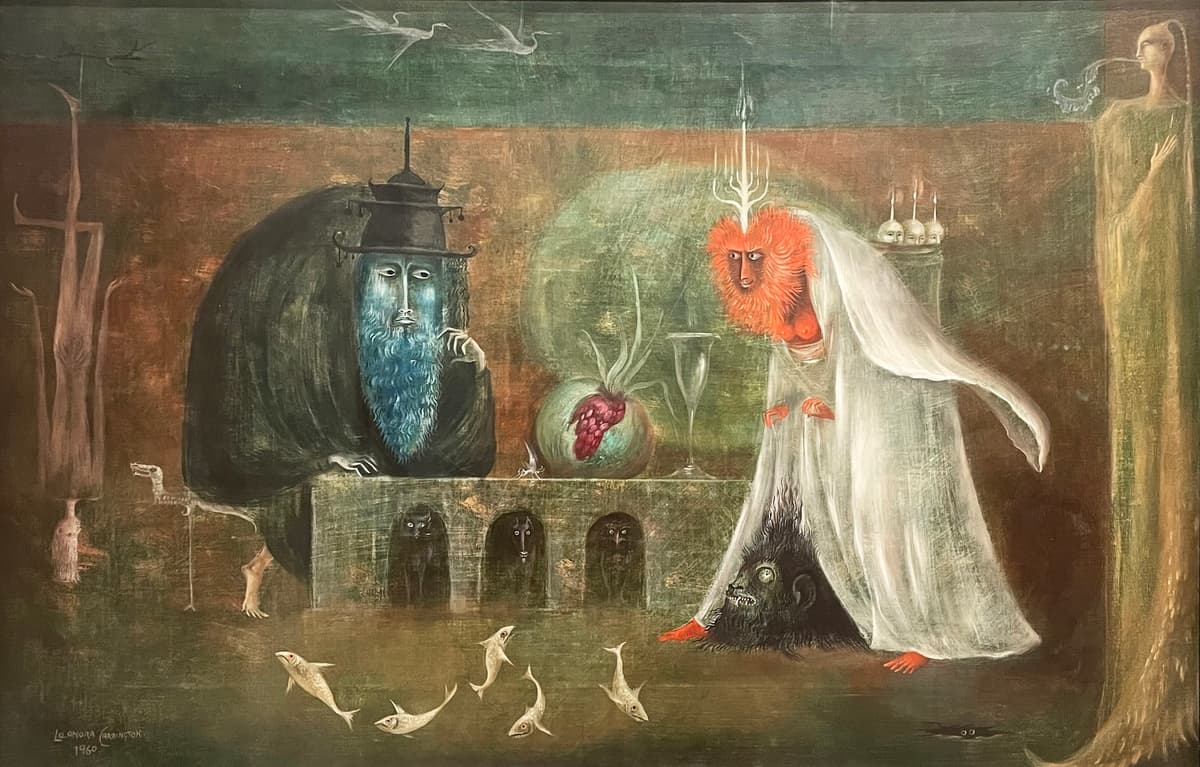
© Leonora Carrington, Arts Rights Society, New York
Leonora Carrington, 'Rabinos (the Rabbis),' (1960). © Leonora Carrington, Arts Rights Society, New York

The last time the Surrealist painter Leonora Carrington (1917-2011) was mentioned in these pages was in conjunction with María Félix, the Mexican movie star known to fans as La Doña after her breakout role in a 1943 film, “Doña Bárbara.” 

As was the case with many who came within Félix’s orbit, Carrington was taken with the actress’s beauty and, when the opportunity came to paint La Doña’s portrait, made the requisite preparatory drawings. The finished canvas, “La maja del tarot” (1965), is in private hands, but a finely rendered study for the picture is on display at “Leonora Carrington: Dream Weaver,” an exhibition at the Katonah Museum of Art.

Organized by a chief curator at the Rose Art Museum, Gannit Ankori, “Dream Weaver” is a modestly appointed but diverting exhibition — particularly for those who prefer to tread lightly through the ickier byways of Surrealism. The human imagination is more limited than is often supposed, and self-indulgence in the service of psychological frisson is not unheard of. Both complaints pertain to Carrington’s phantasmagoric imagery. But who knew that she was adept — that is to say, nervy and varied — as a paint-handler?

Mary Leonora Carrington was “born under mysterious circumstances.” Her mother, Carrington insisted, was absent from the proceedings. Dad, an inveterate golfer, was too busy inventing the perfect sandtrap. The only company Leonora had upon entering the world was “an x-ray apparatus used for sterilizing cows” and the family’s fox terrier. Another self-styled origin story did place mom at the scene, but also included truffles, animal semen, and another unlikely mechanical apparatus.

Leonora Carrington, ‘The Chair, Daghda Tuatha de Danann’ (1955). © Leonora Carrington, Arts Rights Society, New York

When Carrington wasn’t engaging in absurdist caprice, she might have admitted to being a child of privilege, the daughter of a dutiful Irish housewife and a textile magnate based at Lancashire, England. A rebellious streak was evident early on: Young Leonora was booted out of several schools for bad behavior. When Carrington discovered Surrealism, all bets were off. 

She met the artist Max Ernst at a London soiree, found him a simpatico soul, and moved with him to France — Ernst’s wife of the time was summarily shunted aside. When the Nazis corralled Ernst, Carrington suffered a mental breakdown, underwent dubious medical treatments, and ultimately landed in Mexico, where she found relative peace for the better part of her adult life. 

Carrington married the photographer Chiki Weisz, had two sons, and worked on behalf of women’s rights in her adopted country. The rest of the time she was preoccupied by limning the furthest reaches of a kaleidoscopic netherworld that is an admixture of Heironymous Bosch, upscale cartoons, and half-remembered fairy tales.

What’s engaging about Carrington’s canvases is the character of her surfaces, a sense of give-and-take that is, if somewhat fussy in its particulars, then nimble all the same. If Surrealist painting tends toward slick sensationalism (Salvador Dalí) or drab illustration (Rene Magritte), Carrington brought scruffy means and a diffuse light to her storybook miniaturism.

There’s humor as well, particularly in the more expansive compositions in which sundry hobgoblins, bit players, and mystical forces play peek-a-boo with each other and, at moments, with us. “Nunscape at Manzanillo” (1956) has a buoyancy of form that survives the skepticism inherent in its run of caricatures. Katonah’s sampling of Carrington’s paintings and drawings is a welcome how-do-you-do to a visionary for whom art was “magic which makes the hours melt away and even days dissolve into seconds.”

Directly across the museum’s hallway is an array of artworks very different in type, “Sublime Geometries: Selections from the William Louis-Dreyfus Foundation.” The late businessman and collector, father to actress Julia Louis-Dreyfus, had a catholic eye and little taste for fashion. Although big names pepper his holdings, Louis-Dreyfus favored quality over hype; idiosyncrasy, too. A keen attention to craft was a guiding principle, as is evident from the five artists culled from the Foundation’s collection.

Hester Simpson, ‘Blue’ (2001). Via the William Louis-Dreyfus Foundation

The sculptor Alison Wilding, though feted with honors in her native Britain, is little known on these shores: Her post-Minimalist reimaginings of elemental forms hearken back to progenitors like Constantin Brancusi and Christopher Wilmarth. Dannielle Tegeder’s diagrammatic pictures simultaneously pay homage to and make light of High Modernist precedent, while Claudia Wieser is at her most engaging when putting colored pencil to paper, investing hieratic forms with a fleeting, gently stated tenderness. 

Alison Hall’s pictures are composed of meticulously distributed fields of marks, process-oriented pictures that admit to non-Western influences and beggar the eye with furtive elisions of light and surface. And then there’s Hester Simpson, whose diminutive canvases are infused with a stringent sense of purpose and powered by an intensive chromatic sensuality. Paintings like “Blue” (2001) and “Angel Baby” (2000) radiate an otherworldly calm with surfaces that have the depth of amber and the density of marzipan.

A trip to Katonah should be in the cards for those with a taste for art that hews to a hard-won independence of spirit and does so in terms that are true to its own peculiar initiatives.


The New York Sun

© 2025 The New York Sun Company, LLC. All rights reserved.

Use of this site constitutes acceptance of our Terms of Use and Privacy Policy. The material on this site is protected by copyright law and may not be reproduced, distributed, transmitted, cached or otherwise used.

The New York Sun

Sign in or  create a free account

or
By continuing you agree to our Privacy Policy and Terms of Use