‘Krapp’s Last Tape’ Offers a Blast of Beckett and the Ghost of His Master, James Joyce

A strange and moving staging of the Nobel laureate’s journey to regions of regret.
Photograph by Greg Kessler

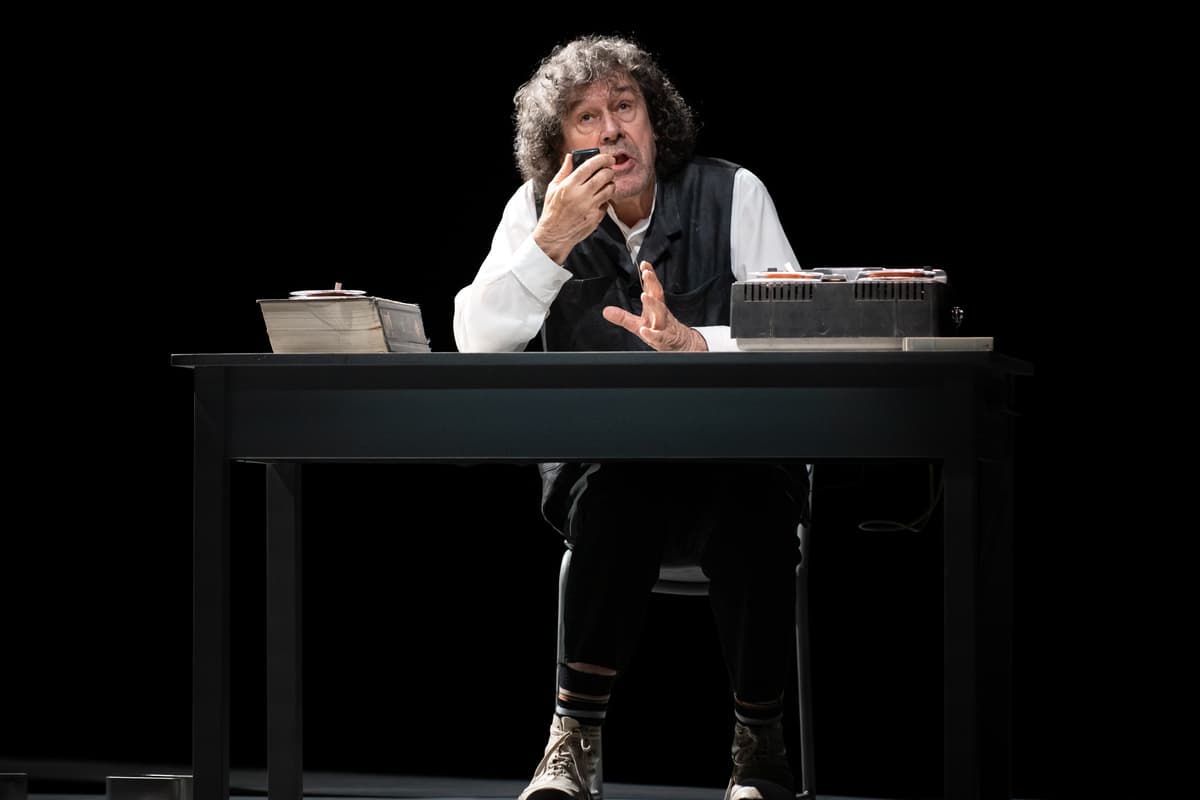
“Krapp’s Last Tape,” playing now at NYU’s Skirball Center, runs just 55 minutes but could haunt the viewer for much longer than that. Written by Irish playwright Samuel Beckett in 1958, it shares with “Waiting for Godot” a commitment to dark comedy, unrelenting minimalism, and affinity for absurdity. Becket was awarded the Nobel Prize for Literature in 1969 for writing that “transformed the destitution of modern man into his exaltation.”

“Krapp” is a one-man play, here starring the esteemed Irish actor Stephen Rea, who was nominated for an Academy Award in 1992. The play centers on an old man sitting at a spare steel desk playing, on a tape recorder, monologues he captured decades before. Mr. Rea’s Krapp is finicky and fusty. A nervous comic relief is delivered by Krapp methodically eating a banana or three — and almost slipping on a discarded peel. Beckett’s laughs can feel like shivers.

Actually, it’s not quite right to call “Krapp” a one-man play. The younger Krapp captured on spools of tape is a character in his own right, one who taunts and stirs the diminished man we see on stage. The play plies its bleak trade over the alienation that separates the current self from its past editions. The soliloquy, innovated by Christopher Marlowe and perfected by William Shakespeare, here is captured on the tracks of a sputtering recorder.

Beckett’s spare style belies the richness of his inheritances. Beckett was a Parisian for decades and was awarded the Croix de Guerre for his service in the Resistance during World War II. Along the Seine he imbibed the existentialism of Jean-Paul Sartre and Albert Camus. Beckett also served as a research assistant for James Joyce at the City of Light. From the author of “Ulysses” Beckett learned the power of dunking in the stream of consciousness.

Beckett also took from Joyce an attachment to the power of memory. Krapp recalls that “I lay down across her with my face in her breasts and my hand on her. We lay there without moving. But under us all moved, and moved us, gently, up and down.” Here is Joyce’s Molly Bloom: “I put my arms around him yes and drew him down to me so he could feel my breasts all perfume yes and his heart was going like mad and yes I said yes I will Yes.”

The exploration of the past in “Krapp” is what gives it a poignancy that “Waiting for Godot,” with its perpetual present, lacks. Krapp ruminates, “Perhaps my best years are gone. When there was a chance of happiness. But I wouldn’t want them back. Not with the fire in me now. No, I wouldn’t want them back.” The viewer is entitled to skepticism given that Krapp’s present is confined to his desk, the tape recorder, and a bushel of bananas.

The voice on the tape, in a remarkable twist, is Mr. Rea’s from 13 years ago. The actor, hedging against the day when he might play this role, recorded the monologue of the young Krapp. Mr. Rea in a statement discloses, “I had no certainty that one day I might play Krapp, but I thought it a good idea to pre-record the early tapes.” The voice that bursts forth “Thirty-nine today, sound as a bell” is Mr. Rea’s, noticeably more robust than the whisper that emanates from the 69-year-old Krapp on stage.

Adding to the sense of a past that is present is that Mr. Rea shared a rehearsal room with Beckett during a 1976 Royal Court production of “Endgame,” another play that will soon be staged at New York during this autumn of Beckett. “Krapp,” unlike “Godot” and “Endgame,” was first written in English, which could explain its intimate pitch. We laugh with Krapp when he reflects: “Just been listening to that stupid bastard I took myself for 30 years ago.”


The New York Sun

© 2025 The New York Sun Company, LLC. All rights reserved.

Use of this site constitutes acceptance of our Terms of Use and Privacy Policy. The material on this site is protected by copyright law and may not be reproduced, distributed, transmitted, cached or otherwise used.

The New York Sun

Sign in or  create a free account

or
By continuing you agree to our Privacy Policy and Terms of Use