Luigi Mangione’s Defense Seeks To Ban Use of Word ‘Manifesto,’ Block Evidence from McDonald’s Arrest, as Accused CEO-Killer Returns to Court
The defense is also seeking to have the arresting officers barred from identifying Mangione as the person in surveillance images from New York City.
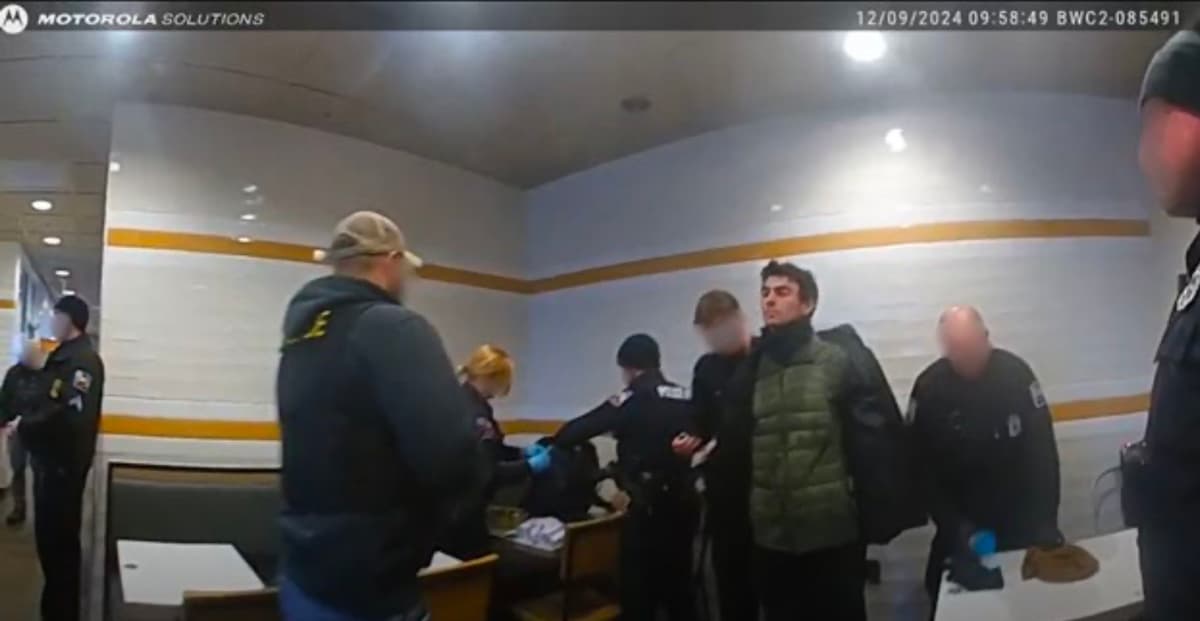

Defense attorneys will attempt to pull the rug out from the State of New York’s case against Luigi Mangione – the Ivy League graduate accused of killing the CEO of UnitedHealthcare, Brian Thompson – in a series of “suppression” hearings starting Monday morning, by asking the jude to block key evidence from being admitted at the upcoming trial. Around 20 witnesses are expected to be called over the coming days.
The defense will also seek to bar the Altoona, Pennsylvania police officers, who arrested Mr. Mangione, from identifying him as the suspect depicted in New York CIty surveillance footage and photographs detectives collected during their investigation after the shooting.
Almost exactly one year ago, on December 4, 2024, Thompson, a father of two and the CEO of UnitedHealthcare, a major business division of United Health Group, which is widely considered the largest health insurance company in the world, was on his way to an annual investor conference at midtown Manhattan’s Hilton Hotel. At approximately 6:45 a.m, he was shot from behind on the sidewalk. Thompson died 30 minutes later at the hospital from the gunshot wounds.
Five days after the shooting Mr. Mangione, then 26 years old, born into an influential family outside Baltimore, a high school valedictorian and graduate of the prestigious University of Pennsylvania, was arrested at an Altoona, Pennsylvania McDonald’s.

Mr. Mangione is being prosecuted in three separate jurisdictions for crimes relating to Thompson’s murder: in Pennsylvania, where he was arrested, in New York state court, and in federal court at the Southern District of New York, where prosecutors intend to seek the death penalty.
Monday’s hearings will be held at Manhattan criminal court, where the presiding judge recently dismissed two counts of terrorsim from the eleven-count indictment brought by the Manhattan district attorney, Alvin Bragg, as the Sun reported. In state court, Mr. Mangione is still being charged with second-degree murder, for which he faces a sentence of 25 years to life, among nine other counts. He has pleaded not guilty to all state and federal charges.
At first, the high-profile case appeared to be a cake-walk for prosecutors, with overwhelming evidence tying Mr. Mangione to the shooting. But the defense team, led by Karen Friedman Agnifilo, who spent over two decades as a prosecutor at the Manhattan district’s office working her way up to become the Chief Assistant District Attorney under DA Cyrus Vance Jr. is now arguing to that most of the evidence was obtained unlawfully and is thus inadmissible at trial.
The coldhearted murder was caught on surveillance cameras. Video footage shows a man, dressed in a black hooded sweatshirt, wearing a black ski mask and a backpack, as he emerges between two cars. He holds the gun in his right hand and shoots Thompson, who is walking toward the side entrance of the hotel, in the leg. Then the gunman’s firearm appears to be jammed, but the shooter manages to clear the malfunction and continue firing at Thompson, who falls to the ground. The killer then advances closer to his victim and shoots him again, firing a total of three shots. The killer flees the scene, triggering one of the biggest manhunts in recent history.

During their initial investigation, the detectives from the New York Police Department analyzed surveillance videos from street cameras to track the suspect’s movements throughout the city before and after the shooting. After reviewing hundreds of hours of footage, they shared several photographs of a suspect, who appeared to look like Mr. Mangione with law enforcement across the country, as well as on television and social media.
On December 9, at the Altoona McDonald’s, about 233 miles away from New York City, a customer noticed that a young man, who had removed his face mask to eat his breakfast, resembled the suspect wanted for Thompson’s killing. The customer immediately informed an employee at the fast food restaurant, who then called the police, who arrived on scene and arrested Mr. Mangione. When the officers searched his backpack – according to the defense, without a warrant – they found a 3-D printed handgun that would match the shell casing from the crime scene, a notebook with handwritten notes, and several electronic devices.
In a motion filed on May 1, the defense attorney asked the judge to bar the prosecution from calling “lay non-eyewitness,” specifically three of the arresting officers “to make an in-court identification of Mr. Mangione” at trial.
Prosecutors, the defense wrote, intended to call three Altoona police officers to the witness stand to confirm that Mr. Mangione is the same person as the suspect seen on surveillance video and photographs released by NYPD detectives in connection with Thompson’s murder.

Though the motion does not specify which photographs the prosecution intended to show, one can assume they would use the same pictures seen by the public. One of these images shows the suspect inside a taxi cab, wearing a surgical mask, another one shows him at the youth hostel, where he allegedly stayed before the shooting, without a mask, engaged in a flirtatious conversation with the receptionist, flaunting a distinctively toothy smile.
In their motion, defense attorneys argue that the arresting officers have no legal grounds to identify Mr. Mangione on any photographs or surveillance footage because they were not “eyeswitnesses to the crime.”
Further, the defense questions how the officers are qualified to identify Mr. Mangione on a video, if they had only met him at the McDonalds’ during his arrest.
“Moreover, the witnesses (the officers) had no interaction with Mr. Mangione, prior to the video surveillance to make them ‘sufficiently familiar’ with Mr. Mangione,” the defense attorneys wrote.

The jurors should decide for themselves, the defense argues, if Mr. Mangione resembles the man depicted in the photos and videos or not.
“Additionally, there is no allegation that Mr. Mangione altered his appearance after the alleged shooting and there is no reason to believe that the jury would need assistance in making its own assessment of the video surveillance footage.”
The prosecution could call these three officers to the stand this week in their attempt to dismantle the defense’s arguments. Other officers who may testify could be asked about their search of Mr. Mangione’s backpack and about the fact that they questioned him for close to 20 minutes before reading him his Miranda rights.
The defense seeks to ban any statements that Mr. Mangione before he was read his Miranda warnings, arguing that failing to provide them violated the Fifth Amendment.

The two officers, who were “fully armed,” the defense detailed in their motion, relying on footage obtained from the body-cameras the officers wore during the arrest, approached Mr. Mangione as he sat at a table in the back of the restaurant. The officers continued to interrogate Mr. Mangione, asking him to stand up and put his hands on his head. One of the officers then “went outside to call another officer and tell him that he was ‘100 percent sure’ that Mr. Mangione was the individual that law enforcement was looking for connected to the December 4, 2024, shooting in New York,” the motion states.
Soon afterward about half a dozen more officers arrived at the McDonalds, while the officer “continued his custodial, non-Mirandized interrogation of Mr. Mangione,” the motion alleges.
During this interrogation Mr. Mangione provided a fake ID, a New Jersey driver’s license in the name of Mark Rosario. The same license, New York investigators had previously confirmed, was used by the suspected shooter to check into a youth hostel in the uptown Manhattan neighborhood of Bloomingdale on November 30, four days before Thompson’s murder. If the defense succeeds in suppressing the statements that tie Mr. Mangione to the fake ID (and the youth hostel in New York), prosecutions would have to find another way to admit the driver’s license
During the interrogation, the defense further found, another officer searched Mr. Magione’s backpack “that law enforcement had placed on a table out of Mr. Mangione’s reach more than 17 minutes earlier.”

“The officers continued their warrantless search through Mr. Mangione’s backpack at McDonald’s even after he was removed from the restaurant by other officers and driven to the police precinct,” the motion details.
Here, the defense argues, the arresting officers violated Mr. Mangione’s rights under the Fourth Amendment which, as they wrote, “protects individuals from unreasonable searches and seizures by the government,” by failing to follow “basic police procedure” before searching the backpack.
Hence, they conclude, all evidence found in that backpack is inadmissible at trial, “Including but not limited to the gun, the silencer, Mr. Mangione’s alleged writings, electronic devices – and any evidence obtained as the fruit of the illegally obtained evidence.”
Besides the alleged murder weapon, the backpack also held a red notebook, which prosecutors and investigators have called a “manifesto,” a term, redolent of the late Unabomber Ted Kaczinsky, that the defense is challenging, because it implies a declaration of intentions and motives that could prejudice potential jurors.

Some of the notes found inside the notebook have been made public, such as “Frankly, these parasites simply had it coming,” and “A reminder: the US has the #1 most expensive healthcare system in the world, yet we rank roughly #42 in life expectancy.”
Another note, allegedly written by Mr. Mangione reads, “The investor conference is a true windfall. It embodies everything wrong with our health system. What do you do? You wack the CEO at the annual parasitic bean-counter convention. It’s targeted, precise, and doesn’t risk innocents. Most importantly—the message becomes self-evident.”
Defense attorneys have raised the same concerns to the judge overseeing the federal case. In October they filed a lengthy motion in federal court, also asking to suppress the evidence seized during the arrest. Federal prosecutors replied in November, acknowledging that the evidence was collected without a warrant and that the defendant was not read his rights. But they pushed back, writing that police officers were justified in searching the backpack to make sure it contained no dangerous items. His statements to officers, they said, were made voluntarily and before he was taken into police custody.
State prosecutors may raise similar arguments. But it appears that prosecutors may be reevaluating their strategy, especially after the two terrorism counts were unexpectedly dismissed by the judge in September.

In a letter, filed by the defense last Tuesday, the attorneys told the judge that prosecutors asked to hold off on a third suppression hearing that the defense had requested, because they “are unsure of their trial strategy.”
In the meantime, Mr. Mangione, who is raising money to cover his legal fees through an online fundraiser, has almost reached his goal of $ 1.5 million dollars. As of Sunday evening, his supporters have donated $1,357,293.
The outpouring of support for Mr. Mangione, an accused killer, has been unprecedented and may be attributable to frustration with the enormous power of private health insurers.