Morgan Bassichis, During a Solo Show at SoHo Playhouse, Declares an Intention ‘To Make Sure Everyone Knows the Name Frank Maya’
A groundbreaking gay comedian and performance artist, Maya was on the verge of moving beyond cult fame — a feat now sought by Bassichis — when he died of AIDS-related complications in 1995, at the age of 45.
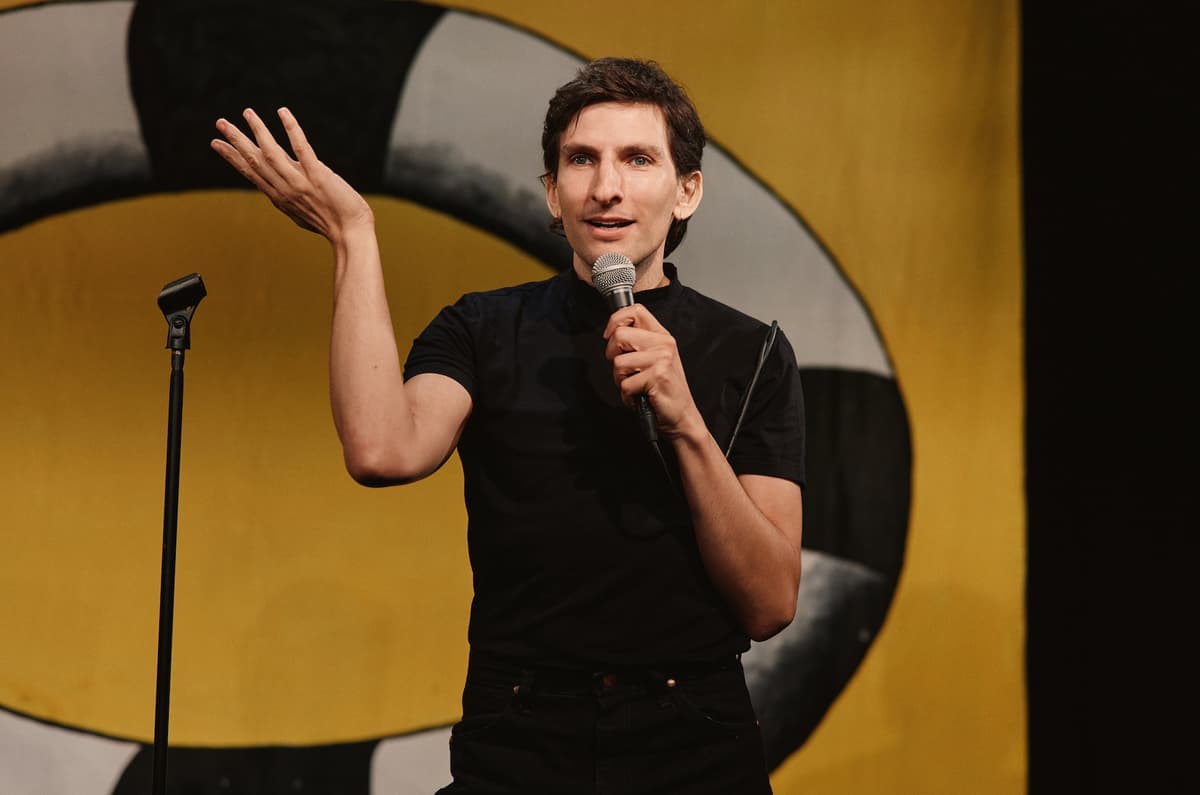
Ostensibly, “Can I Be Frank?” is an homage to the late Frank Maya, a groundbreaking gay comedian and performance artist, written and performed by a devoted follower. But it’s made immediately clear that the latter artist, Morgan Bassichis, who identifies as non-binary, is not merely an adoring acolyte.
“This show is my attempt to try to pass on my obsession to you, to make sure everyone knows the name Frank Maya,” Morgan Bassichis announces early in this solo piece, now running at SoHo Playhouse. “And if they have to learn my name too along the way, let go and let god.” (“God” is spelled in the script, notably, with a lowercase g.)
As Morgan Bassichis explains, Maya also sought something beyond cult fame, and was on the verge of achieving his goal when he died of AIDS-related complications in 1995, at the age of 45. Over the course of a mostly brisk 70 minutes, the creator and star of “Frank” — under the witty direction of Sam Pinkleton, fresh off his Tony Award win for “Oh, Mary!,” another irreverent comedy that transferred to Broadway after a successful run downtown — incorporates Maya’s material, audacious and forward-thinking in its time, into an act that feels distinctly contemporary.
At a recent preview, “Frank” was presented — as I imagine it will be post-opening — as “a work in progress”; repeatedly, Morgan Bassichis appealed to the stage manager, Gloria Gomez, by her first name, to address a technical issue or a question about content. “I may be the first gay person to speak about AIDS, at least in a play, at least in a one-person show,” the performer mused at one point. “Gloria, let’s check on that.”

Predictably, Morgan Bassichis’s self-congratulation and self-promotion are delivered with a wink, in a style that might be described as aggressively impish, physically enhanced by a long, skinny frame and slinky body language. Where “Frank was very traditionally handsome and butch, like what a gay man from the ’90s is supposed to look like,” we’re informed, “I look more like, maybe I just walked out of a folktale.”
There are more sobering moments, as one might expect. During a segment in which Morgan Bassichis asks audience members to read previously written questions, as Maya did, we learn that when Maya came out to his father, and his father pledged to “cure” him of his homosexuality, the late artist responded, “Dad, you know the only cure for being gay is fame.”
Morgan Bassichis admits that after first hearing that line, “I thought the joke was that we as gay people are bereft when we walk into a room and no one presents us with an award.” Then an ex-boyfriend of Maya’s revealed “that was a reference to how in those years, if you were gay and you got famous, you would go into the closet. That did not even occur to me! Because to me, in 2025, there are so many out people now, and I actually think some should go into the closet. … There’s a capacity issue.”
At times, “Frank” threatens to become preachy; Maya’s own approach, as demonstrated in the excerpts re-enacted here, was confrontational, and Morgan Bassichis clearly doesn’t have to stretch to summon that spirit. But the occasional sermonizing is mitigated by humor, whether the performer is ranting or singing — with more gusto than technical prowess, it must be said — to perky backing tracks.
“What do we do with the world we inherited from them?” Morgan Bassichis wonders toward the end, referring to earlier generations of gay artists. “And how do we get through our own nightmares? And how do we make the leap from like, SoHo Playhouse to a major streaming platform?”
Based on the talent and sheer force of will informing this show, I wouldn’t rule out the possibility of Morgan Bassichis seeing that last wish come true.