
New Film ‘Went Up the Hill’ Takes Jack and Jill Through the Horror Wringer
This portrayal of grief and loss hinges on a ghostly presence, with both protagonists alternately possessed by the deceased and each welcoming the chance to enact some sort of closure — as does the ghost.
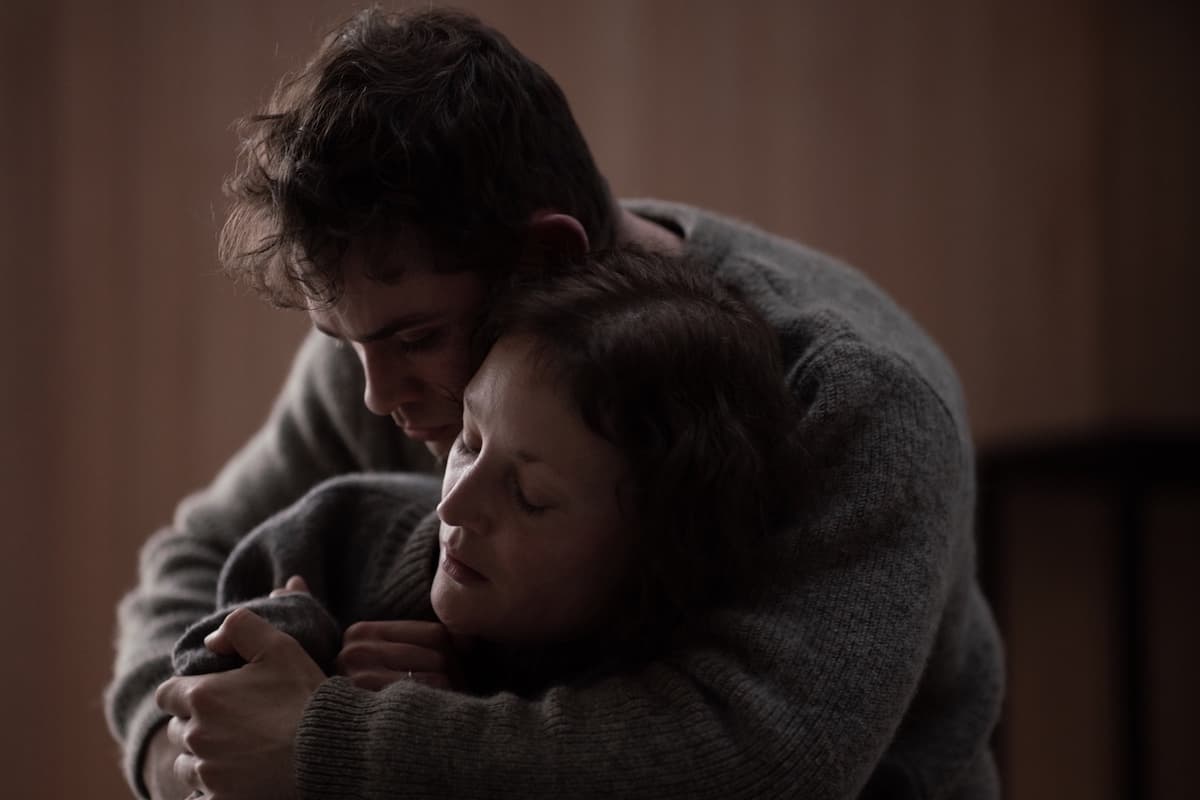
The new film “Went Up the Hill” deals with some serious subjects, yet its cinematic calling card isn’t realist drama but horror. Set in a wintry landscape on New Zealand’s South Island, the feature in its plainest form depicts the mourning process of the estranged son and widow of an architect who committed suicide. Yet the portrayal of grief and loss hinges on a ghostly presence, with both protagonists alternately possessed by the deceased and each welcoming the chance to enact some sort of closure. As one might expect, the ghost seeks its own type of closure.
Horror movies in the 21st century have tackled some tricky subjects, such as generational and familial trauma, as reflected in recent successes “Get Out” and “Hereditary.” The new film attempts to do the same with issues of abuse, though it does so with diminishing returns primarily due to its supernatural vagaries, slack pace, plot holes, and monotonous tone. Despite these failings, the picture does diffuse essential truths about sorrow and the effort to reconcile kindness and cruelty. It helps that the performances of its leads, Dacre Montgomery (“Stranger Things”) and Vicky Krieps (“Phantom Thread”), convincingly convey a weary naturalism and rationality within the horror movie trappings.
The main characters’ names are Jack and Jill, after the nursery rhyme hinted at in the film’s title. The first few scenes introduce us to the two and to Jack’s aunt and Jill’s sister-in-law, Helen, while they and others attend the wake for the departed, Elizabeth, in the minimalist/Brutalist house she designed. Despite Helen’s umbrage at Jack’s presence, Jill wishes him to be there, declaring she was unaware of his existence. The young man is invited to stay in the home and, during that night, has an encounter with Jill in which she seems to embody her dead wife’s spirit.
The next day, the strange episode of the previous night is chalked up to restlessness and exhaustion. Later that evening, though, it occurs once again, this time with both of them channeling the dead woman at different points, using their own voices. With this scene, the narrative arrives at its central conceit: that the ghost of Elizabeth requires the two of them in order to communicate and stay close, leading to awkward moments — though it also somewhat answers a few questions, such as why Elizabeth killed herself.
One might wonder how these dual possessions come about, with even Jack asking at one point, “How is this real?” The particulars are vague, but sleep plays a part in its taking hold in reality. One also guesses that the ominous home has something to do with it. The “haunted house” trope and other horror flourishes tie the movie closer to the spectral, while it generally exhibits tastefully tenebrous, distancing, and, at times, disorienting cinematography.
This visual tone aligns with the minimalist interiors, Jill’s somber and spare woven artwork, and Jack’s dark drawings of bodies. Curiously, director Samuel Van Grinsven misses the chance to explore how art binds Jack, Jill, and Elizabeth together — art as an outlet for unresolved emotions — though he does include a sweet moment in which Jack’s homosexuality is acknowledged as a family trait.
On the third night, Jack and Jill’s relationship turns sexual, with Jack, as his mother, making love to Jill. Viewers may titter during this scene, particularly due to its static, unpassionate presentation, but beside hinting at the fluidity of sexuality, it confirms that Jill and Elizabeth’s relationship involved sadomasochistic intimacy as well as physical and emotional abuse. The film then sets a more twisted, disturbing course as subsequent scenes delve into Jack’s childhood with his mother before Helen intervened, Jill’s inability to move on, and the increasing violence and self-injury between the two, mirroring Elizabeth’s tendencies.
In press notes, Mr. Van Grinsven discusses how he would like viewers to avoid considering the movie a genre film, to instead see it as “its own thing … a true original.” Hyperbole aside, the director is not entirely wrong in deeming his story’s uneasy mix of the uncanny and the unconscionable as distinctive, though other directors have crafted similar moods. Further incongruities emerge as well: the art film solemnity and the plainly ridiculous; the dialogue’s hesitations and half-formed sentences alongside editorializing declarations; the elegance of the imagery coupled with continuity lapses and confusing character transitions.
In terms of impact, one won’t soon forget Ms. Krieps’s wail near the movie’s midpoint, nor the actress’s haunting gestures as Elizabeth and how her eyebrows are tweezed to look like clipped birds’ wings. Mr. Montgomery has striking features, too, and uses them effectively to express sensitivity and hurt. Intimations that sometimes the pair are not “possessed” by Elizabeth prove tricky to parse or accept, but the two actors are superb throughout.
“Went Up the Hill” culminates in a scene on a nearby frozen lake, one alluded to earlier and involving the type of incident cynically required of such a locale. Yet this predictable, too neat climax and the film’s other weaknesses don’t take away from the raw, chilling power of Mr. Van Grinsven’s theme: that the long shadow of trauma is not easily sidestepped.