Stylish ‘Masquerade’ Takes Audiences Behind the Scenes of Andrew Lloyd Webber’s ‘The Phantom of the Opera’
Under the direction of Diane Paulus, ‘Masquerade’ provides an experience that will disarm skeptics — not only of ‘Phantom,’ but of immersive theater generally.

Several months ago, a prominent public relations agency began sending vaguely cryptic email messages to journalists that were signed by one “O.G.” — an acronym for Opera Ghost, though for some musical theater fans, “Original Gangster” also applied. The notes teased and eventually confirmed the development of a new project revisiting one of Broadway’s (and the West End’s) biggest box office hits of the past half century.
That project has now arrived: “Masquerade,” an immersive production clocking in at roughly two hours, promises, via the official site of composer Andrew Lloyd Webber, the O.G. behind the O.G., to “take audiences inside, behind-the-scenes, and closer than ever before to the strange affair of ‘The Phantom of the Opera’—a mystery never fully explained.”
This is no short order, given the bombast that fueled Mr. Lloyd Webber’s adaptation (with lyrics by Charles Hart and a book by Richard Kilgoe and Mr. Lloyd Webber) of Gaston Leroux’s early 20th century novel. That show descended on New York like a gaudy meteor in 1988, collected seven Tony Awards, including best musical, and enjoyed a run of nearly 14,000 performances.
This critic, frankly, was never a fan, for reasons I’ll disclose in the following paragraphs. Yet under the direction of Diane Paulus, whose numerous Broadway credits include imaginative and exhilarating revivals of “Pippin” and “Hair,” “Masquerade” provides an experience that will disarm skeptics — not only of “Phantom,” but of immersive theater generally.

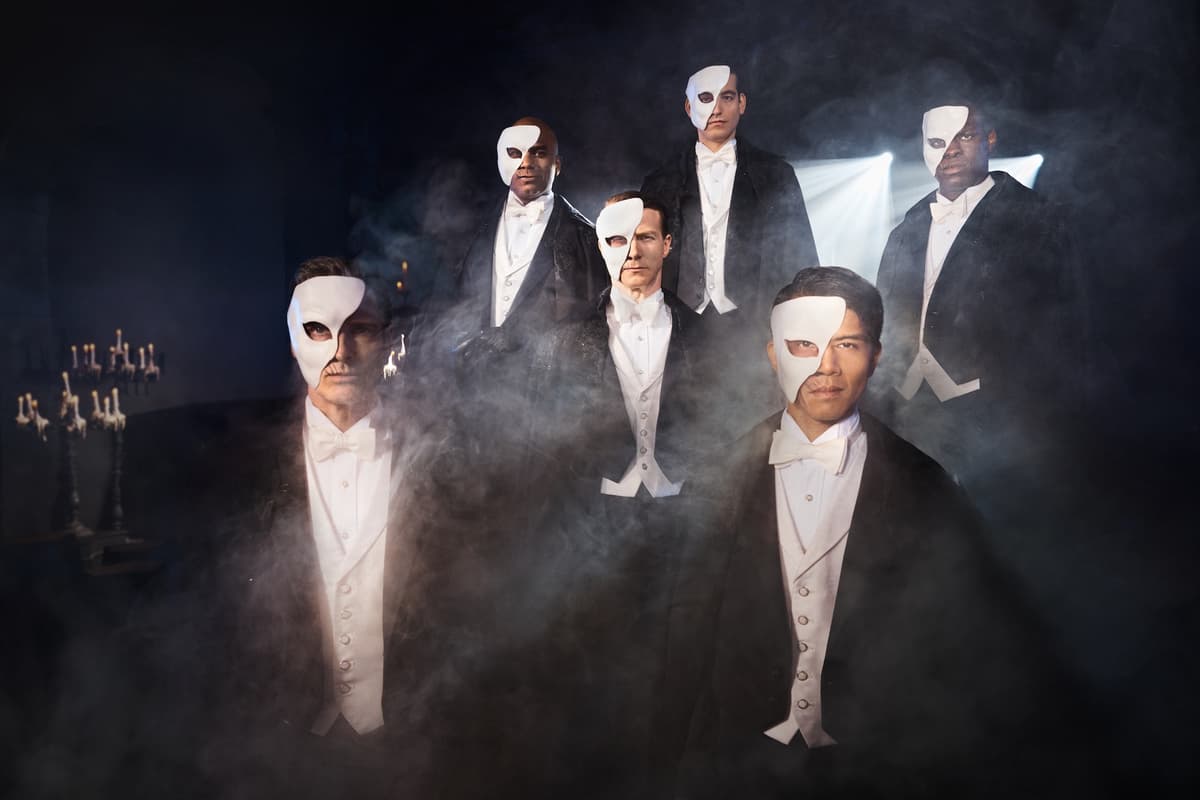
Audience members arrive at a multi-level venue, off-Broadway, at one of six entry times held each evening, with a half dozen actors accordingly cast in the leading roles of the Phantom — the forbidding, masked figure who haunts the Paris opera house — and Christine, the young chorus girl he is grooming, in every creepy aspect that word has acquired, for stardom, among other things.
There’s a dress code, requiring cocktail attire in black, white, or silver, with no stiletto heels permitted. Masks are also a must, though if you don’t have one handy a lacy black number is provided, modeled to fit over glasses. Once inside, visitors are guided through a succession of sets — fashioned with eerie flair by a team including creative director Shai Baitel and celebrated scenic designer Scott Pask — ranging from the Phantom’s creaky lair to a lush rooftop garden.
If those of you who caught downtown excursions such as “Sleep No More” and the more recent “Life and Trust” are starting to have flashbacks, rest assured that “Masquerade” is less fussy and chaotic and more content-driven. The lurid sexuality that informed those immersive productions is, of course, baked into the central relationship in “Phantom.”
You needn’t be a hardcore feminist, in fact, to find the Svengali/Trilby dynamic established between the brooding Phantom and the virginal Christine — who is literally hypnotized by her dark mentor, and carried off by him after fainting — a little cringey, as the kids say. (Sarah Brightman, who introduced Christine in London and on Broadway, performed in Mr. Lloyd Webber’s “Cats” before the composer decided her chirpy crossover soprano would fit the role; Ms. Brightman also became the second Mrs. Lloyd Webber.)
In “Phantom,” and thus in “Masquerade, this seduction — if it can be called that — is capped off with “The Music of the Night,” one of several soaring but syrupy tunes that aspire in vain to the melodic majesty of Puccini or Richard Rodgers, both of whom gave us far more substantial and interesting heroines.
Other familiar songs, among them “All I Ask of You” and “Think of Me,” are presented alongside new orchestrations by Mr. Lloyd Webber, and at the preview I attended they were exquisitely sung by a cast led by Nik Walker, whose booming baritenor has graced numerous Broadway productions, and the crystal-voiced Kaley Ann Voorhees, who played Christine at several points during the Broadway run of “Phantom.” (Other noted and rising performers who alternate in the leading roles include Telly Leung, Hugh Panaro, and Anna Zavelson.)
The Phantom’s back story, referenced in earlier versions, is spelled out in a new scene, set at an unruly carnival, where audience members may find themselves being offered popcorn, or getting lascivious stares from a barker. Here we meet the Boy in the Cage, or the Phantom as a young man, whose torment is documented in a new song, a sinister ditty called “Come and Marvel at the Freak.” (The Oscar-nominated “Learn to Be Lonely,” added to the score for the 2004 film adaptation of “Phantom,” is also featured here.)
Played at the preview I attended by Maxfield Haynes, a spry young man with yearning eyes, this new character encourages more sympathy for the Phantom, with whom he interacts at a few points, thus making the anti-hero’s final sacrifice — no spoilers for the uninitiated, but it involves another, guileless fellow pursuing Christine — a little more poignant.
But Ms. Paulus and her collaborators also embrace the menacing aura and sheer cheesiness of “Phantom,” in ways that will delight the faithful and amuse others. Candles flicker in dim rooms, and the Phantom alternately cackles and shushes observers, sometimes from a close distance; at one point I blinked and discovered he had sidled right up next to me.
And rest assured: Fans drawn by the opportunity to once again witness a dramatic sequence involving an enormous chandelier will not go away disappointed. But “Masquerade” at least serves the sentimentality and spectacle of “Phantom” with both commitment and a dash of piquance.