
Newly Released Photos Show Luigi Mangione’s USB Necklace, H&M Jeans and Mysterious Scrawled Notes as ‘Suppression Hearings’ Resume
The two officers who searched Mr. Mangione’s backpack without a warrant during his arrest will likely testify on Monday.
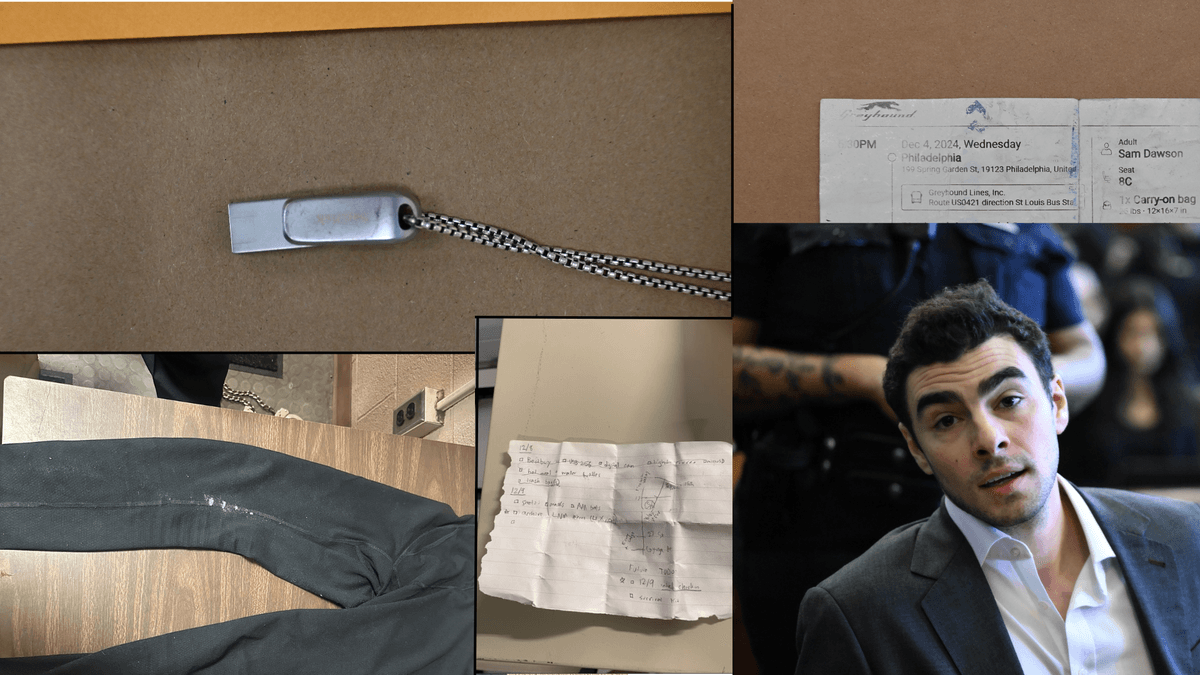
The contents of the backpack of Luigi Mangione – who is accused of gunning down the CEO of UnitedHealthcare, Brian Thompson, a year ago – are expected to be a major topic of dispute when pretrial “suppression hearings” resume on Monday.
This comes after new photos were released by the court this weekend showing more of Mr. Mangione’s possessions including hand scrawled notes about “intel” and a “survival kit.”
Prosecutors will likely address the backpack, which defense attorneys claim was searched without a proper warrant, and the moment his Miranda rights were read to him, which the defense argues occurred only about 20 minutes after officers began questioning him at an Altoona, Pennsylvania McDonald’s last December.
On Friday, the hearings were canceled because Mr. Mangione, who is incarcerated at the notorious Metropolitan Detention Center, Brooklyn, was sick. The presiding judge, Gregory Carro, did not specify the illness.

“Apparently the defendant is ill today,” Judge Carro said on Friday morning.
“Yes,” defense attorney Marc Agnifilo responded. Then the judge postponed the hearing to Monday.
Mr. Mangione’s defense team requested a series of suppression hearings in an effort to keep from the jury key evidence, such as the alleged murder weapon that was seized from the backpack he had on him the day he was arrested.
The fatal shooting of Thompson, 50, made headlines around the world. The CEO of one of the largest health insurance companies in the country, a Twin Cities-based father of two, was on his way to an annual investor conference at midtown Manhattan’s Hilton Hotel, when a man approached him from behind and shot him. Thompson died at the hospital about thirty minutes later. The shooter disappeared, triggering a nationwide manhunt.

Five days after the murder, Mr. Mangione, then 26-years old, was arrested at a McDonald’s on E. Plank Road outside Blair County’s Altoona, Pennsylvania. According to the defense, the arresting officers violated Mr. Mangione’s rights because they questioned him for about twenty minutes without reading him his Miranda warning, and later searched his backpack without a warrant. A 3-D printed handgun, found inside the backpack, matched the shell casings of the bullets from the crime scene.
The officers also seized a red notebook, filled with handwritten notes, where Mr. Mangione expressed his disdain for the healthcare system and in doing so, according to the prosecution, provided a motive for murder.
The defense is hoping to suppress this and other evidence and statements Mr. Mangione made to the officers before he was read his rights from the upcoming trial.
Mr. Mangione faces murder charges for Thompson’s murder in New York state court, and also in the Southern District, where federal prosecutors are seeking the death penalty. He has pleaded not guilty to all charges.

The suppression hearings at Manhattan criminal court began on Monday, December 1, and are expected to last several more days. It’s not unusual that defense attorneys seek to suppress evidence in pretrial motions and hearings in a murder case. What is rather unusual, however, is that these hearings are lasting for so many days.
The burden of proof lies with the prosecution. They must convince the judge that the evidence should be included. Prosecutors for the Manhattan District Attorney’s Office, who brought the charges, are expected to call more than 20 witnesses in their effort to do so.
Last week, seven witnesses testified. A New York Police Department sergeant in the public affairs office, Christopher McLaughlin, discussed how police released surveillance images of the suspect to news and social media to aid the search for the suspect. During his testimony, the footage recorded on surveillance cameras on the street, that depicts the shooting in real time, was shown in court.
An installation supervisor, Bernard Pyles, who helped New York investigators access surveillance footage from cameras installed at the Altoona McDonald’s, where Mr. Mangione was arrested, introduced videos which depict the defendant at the fast food restaurant, showing how he purchased his food, chose a table in a far corner by the bathrooms, and was eating his breakfast when the two patrol officers entered and began to question him. A manager had called the police because someone at the restaurant had noticed a man who, the customer said, looked like the shooter from New York.

The third witness, the 911 coordinator, Emily States, authenticated the 911 call that the manager made, where the manager told the operator, giggling in disbelief, that customers had approached her, concerned that the man, wearing a tan beanie, a hooded jacket and a medical mask may be the suspected shooter from New York.
On Thursday, Judge Carro released that call to the media, as well as the surveillance video from the street cameras and pictures taken of the evidence, as the Sun reported.
Prosecutors also called two corrections officers from the State Correctional Institution (SCI) at Huntingdon, the oldest prison in Pennsylvania, to the stand.
The close-security correctional facility is usually reserved for convicted felons, not for defendants still awaiting their trials, and specifically for inmates who require frequent, direct supervision due to history of escape, rule violations, or other patterns of dangerous behavior. Inmates are confined within a secure perimeter and have limited freedom of movement, with staff supervising their actions closely. They are often housed in single cells.

The first correction officer, Tomas Rivers testified, that he was assigned to watch Mr. Mangione and told that the facility did not want an “Epstein style situation,” meaning they did not want Mr. Mangione to die in his cell.
The second officer, Matthew Henry, testified that Mr. Mangione had told him he had carried a 3-D printed gun in his backpack, as well as foreign currency and that he was in fact a foreign spy.
Defense attorney Marc Agnifilo, who recently successfully defended the music producer Sean ”Diddy” Combs in his sex trafficking trial, asked why the officer had not reported such an important statement to his supervisors, nor made a note of it, since the assigned officers were required to observe Mr. Mangione and write down meticulously, almost every five minutes, what he was doing inside his cell. The officer said that he did not know why.
These first five witnesses all testified last Monday. Then, over the course of the following days, veteran assistant district attorney, Joel Seidemann, grilled two of the arresting officers, Joseph Detwiler, and his rookie colleague, Tyler Frye, who is 26 years old, and had only been with the Altoona Police Department for six months.

Showing body-worn camera footage from various officers, the prosecutor detailed the arrest. “He’s back there,” someone is heard on one of the body camera videos, played in court, when the officers entered the McDonald’s.
Patrolman Detwiler testified that he immediately knew who the suspicious man was because he was wearing a mask, and “We don’t wear masks,” he said. “We have antibodies.”
“No one wears masks,” around Altoona, officer Detwiler went on. “He had a mask on, so he had to be the person we were called there for.”
According to both Officer Detwiler and Officer Frye, they were first investigating whether or not Mr. Mangione was in fact the suspected shooter. They did not read him his Miranda warnings when they questioned him, because he wasn’t yet under arrest.

When asked to identify himself, Mr. Mangione provided a driver license from New Jersey with the name Mark Rosario. When the officers ran the ID number, it came back as fraudulent. They questioned him for about 20 minutes, while they waited for back-up to arrive, asking if he had been to New York lately and what he was doing in Altoona, and discussing the steak sandwich he was eating.
When more officers began to arrive, body-camera footage captured Mr. Mangione reacting to the growing police presence.
“Can I ask why there’re so many cops here?” he asks. An officer replies, “Just trying to figure it out.”
The officers informed Mr. Mangione that he was now under “official police investigation” and asked him for his real name, which he provided. Officer Frye is seen on video jotting down the name “Luigi Mangione” and adding his date of birth. At that point, Mr. Mangione is read his Miranda rights.

Last week, Mr. Seidemann also asked Officer Frye about Mr. Mangione’s backpack. “Where were you standing in relation to the backpack?” Mr. Seidemann asked.
Officer Frye answered, “Right near it.”
Mr. Seidemann then asked, “Were you aware of that backpack?” and officer Frye replied, “I was.”
When asked, “When did you become aware of it?” Officer Frye said, “About the time I walked in.”

Once Mr. Mangione was detained and handcuffed, videos showed, with around nine officers surrounding him, three of them started to search him.
Meanwhile, two other officers began looking through his backpack. During this search, according to the defense’s motion, patrolwoman Christy Wasser, who is also expected to testify, recovered the handgun. Whether or not she should have waited for a warrant, before she rummaged through the backpack, will likely be examined in the next few days.
Officer Frye told the court on Thursday that Mr. Mangione was detained under a Pennsylvania statute dealing with “a type of forgery,” referring to the false identification he had provided. Officer Frye added that Mr. Mangione spoke briefly to him and Officer Detwiler while being driven from the restaurant to the precinct.
“The defendant asked us for our names. I believe he also apologized for the inconvenience that was caused in the McDonalds,” Officer Frye testified. “I said that the fake ID was a bit ridiculous.”

After a preliminary search, officers informed Mr. Mangione at the police station, on camera, that he could only wear one layer of clothing. He chose to remove the long johns under his jeans.
The body-camera video then shows officers conducting what officer Frye termed an “in-depth” search, meaning the defendant must be fully undressed so they can be “searched more thoroughly.” The in-depth search was not shown on camera.
During cross-examination, defense attorney Jacob Kaplan questioned the decision to conduct a strip search, given that Mr. Mangione was being arrested for providing false identification.
“Ever been involved in a strip search for an arrest for a forgery?” Mr. Kaplan asked officer Frye.

“No,” the witness replied. “We don’t do them very often.”
During the search, officers also confiscated a silver necklace with a silver USB stick as a pendant. An image of the necklace, as well as images of Mr. Mangione’s clothing – including black, H&M jeans – was made public by the court on Saturday.
The court also released an image of a crumpled handwritten to-do list. Under Dec. 8 are the entries “BestBuy,” “USB 256,” “digital cam,” “hot meal and water bottles” and “trash bags.” Under Dec. 9: “survival kit.” It also shows a rough sketch resembling a street map.
Officer found a pocket knife in one of Mr. Mangione’s pockets, when they searched him at the McDonald’s.

“Is that pocketknife illegal?” The defense attorney asked officer Frye.
“It is not,” officer Frye replied.
Mr. Kaplan asked if Mr. Mangione had ever acted “belligerent,” which the officer denied. “He never attempted to open his backpack at the McDonald’s, did he?” The officer confirmed Mr. Mangione had not.
The defense noted that 13 Altoona officers ended up inside the McDonald’s, roughly half of those working that day’s shift.

“Less than 30 officers were working the shift that morning?” he asked. “And 13 of them were at the McDonald’s?”
“Yes,” Officer Frye said.
The defense has argued that the amount of officers, who eventually showed up at the McDonald’s, and the fact that Mr. Mangione was handcuffed and searched, indicate he was not merely being investigated for forgery but was in fact being arrested as a suspect in a murder case.
The officer, who eventually read Mr. Mangione his Miranda rights, patrolman Stephen Fox, is expected to be the first witness to testify on Monday.