


Nothing’s New Flagship Phone (3) Has a Price That Makes It a Harder Sell

The British tech brand has moved upmarket with their new $799 flagship phone, which has a full US release.
Courtesy of Nothing
Nothing Phone (3). Courtesy of Nothing

In 2013, Carl Pei co-founded the tech-nerd favorite, OnePlus: an Android phone manufacturer that offered close to high-end features for a fraction of the price, and paired it with a customizable Android software experience.

However, OnePlus was eventually bought by Oppo, and their phones became more like their competitors. Their high-end models became even more competitive on specs with Samsung, Google, and so forth, but so did their prices and design philosophy, dropping fan-favorite features — like the headphone jack and vibration slider — in favor of broad market appeal. The brand still makes excellent phones; the OnePlus Open is the best folding phone on the market. But it did lose a lot of its fans.

Then, in 2020, Carl Pei left and founded Nothing. In their initial pitch, Nothing was to be a brand built on the idea that technology should hide in the background. However, instead of creating a new paradigm of passive mobile computing, Nothing released some lightweight earbuds and a funky-looking phone with attention-control features.

It wasn’t a revolution but a repeat, with Pei running yet another brand that appealed to a core group of enthusiasts by offering a premium feel and unique features at a value price. The main difference from OnePlus was that Nothing was a design-focused brand, with all its tech sharing a premium semi-transparent, future-Bauhaus aesthetic. They even have a clothing line. But, as with OnePlus, it was only a matter of time before Nothing moved upmarket, chasing higher margins and more status; and that time has arrived.

Nothing Phone (3).
Nothing phone (3). Courtesy of Nothing

Last week, at an event in London, Nothing announced their phone (3) — along with their headphones (1) — and it’s their first “flagship” phone. It starts at $800 — or $900 if you want to bump the storage from 256GB to 512GB — and comes with the high-end Qualcomm Snapdragon 8S Gen 4 processor, a 6.67″ bright, 120Hz AMOLED display, a 5,150 mAh silicon-carbon battery, and three 50MP cameras, in main, ultrawide, and periscope zoom configurations. In short: the core parts you find in every phone over $800, albeit with a weaker chip than the flagship Snapdragon 8 Elite. The new battery tech is probably the most interesting part. That’s a big battery for a relatively normal phone, and it is capable of taking 65W from a wire, making for rapid recharges.

Where Nothing’s previous phones have been easy recommendations, the new premium price makes this a harder sell, and the compromises harder to forgive. When OnePlus and Oppo have 50 watt wireless charging, this is stuck at 15 watt — and isn’t Qi2, the Android equivalent of MagSafe. The display is also made out of the weaker Gorilla Glass 7i, rather than the top-of-the-range Gorilla Glass Victus, and it’s an LYTS panel, rather than using the more adaptive LTPO format. A lot of these decisions make sense from a value perspective — few customers will notice that the USB port is only capable of the USB 2.0 speeds — but Samsung phones, at the same price, don’t have these compromises.

The other question is about camera tuning. The phone (2) took usable but unremarkable photos, which was fine at it’s budget price. But at iPhone 16 and Pixel 9 prices, then phone (3)’s cameras ought to match their quality.

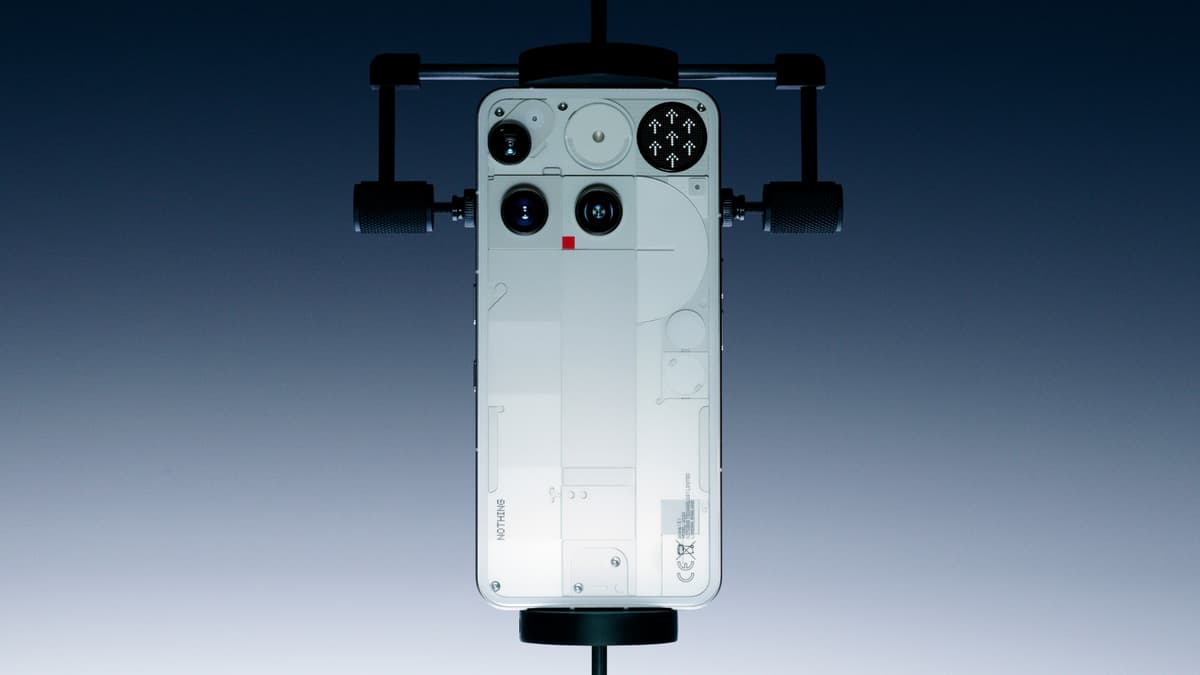
The other problem with the phone (3) is the way it looks; because, though it’s striking, it’s not stylish. The combination of lines and circles looks messy here, particularly given the misaligned periscope camera and offset circular dot-matrix screen.

This is Nothing’s new “Glyph Interface,” replacing the light matrix on the back of previous models. It’s more functional, displaying more information than the lights could do, but it’s also less interesting, and I hope Nothing brings back their light setup on future phones.

Thankfully their beautiful Android skin is still as stylish and functional as ever, and boosted with new features, such as their AI enabled “Essential Search.” The phone comes with five years of operating system updates, and seven years of security patches; which is fine, but behind the seven years offered by competitors from Google and Samsung.

This is all just on paper, and experience can change what you think of a phone; so keep an eye out for my review, coming next week.


The New York Sun

© 2025 The New York Sun Company, LLC. All rights reserved.

Use of this site constitutes acceptance of our Terms of Use and Privacy Policy. The material on this site is protected by copyright law and may not be reproduced, distributed, transmitted, cached or otherwise used.

The New York Sun

Sign in or  create a free account

or
By continuing you agree to our Privacy Policy and Terms of Use