NPR’s Top Editor Resigns Days After Congress Kills Funding: ‘Woke’ CEO Now Gets To Choose Network’s Top Two Editors
The departure might give the chief executive the chance to hire someone who will steer NPR even further left.
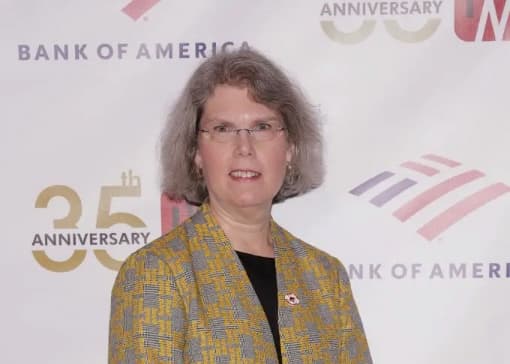

Less than a week after Congress voted to cut off federal funding for public broadcasters, NPR announced that its editor in chief and acting chief content officer, Edith Chapin, is resigning.
Ms. Chapin, a 10-year veteran of NPR who stepped into the top job in 2023, told NPR’s staff on Tuesday she decided to step down and that the decision had nothing to do with the Republicans’ move to cut off the federal funding. She said she told the far-left chief executive of NPR, Katherine Maher, of her decision two weeks ago.
She is expected to leave the network in September or October. Federal funding is supposed to stop on October 1.
Her departure will give Ms. Maher, who’s come under fire for racist and extremist comments she made prior to joining NPR last year, a chance to make her mark on NPR and its editorial voice, possibly dragging the outlet further to the left. In the days leading up to the final vote on funding cuts, Ms. Maher warned that the cuts would present a “real risk to the public safety of the country.”

She told the “Status” newsletter that NPR’s national news operation receives “less than half of one percent of all federal funds for public broadcasting” and “NPR will continue to operate.” She also said the cuts will affect local radio stations and lead to a “loss of universal coverage in hard-to-reach parts of the country.” While Ms. Maher said NPR was allowed to make independent editorial decisions, she implied that in the past the threat of losing the federal government’s funding restrained its editorial stance.
Now, however, she told “Status,” “We will no longer have the congressional funding Sword of Damocles over our heads.”
“It’s our opportunity to seize — 50 years after the passage of the Public Broadcasting Act, we have a strong national network, a proven public value, and the opportunity to leave behind the things that no longer serve our mission,” she said.
By that, Ms. Maher was almost certainly referring to NPR no longer having to deal with Republican members of Congress or President Trump, who pushed for defunding public broadcasting. Her comments suggest that Ms. Maher believes NPR’s national operation has an opportunity to dive deeper into the narratives that Republicans have long complained about as being “woke” or biased against conservatives.

Ms. Maher has a long history of the far-left views that have permeated the Democratic Party and its activists. Shortly after she was installed as the head of NPR, a conservative activist, Christopher Rufo, shared an interview in which Ms. Maher made racist comments, criticizing Wikipedia’s model — before taking her current job she was the CEO of Wikimedia — of being “free and open,” saying it was “recapitulating many of the same power structures and dynamics that existed offline prior to the advent of the internet.”
The “free and open ethos,” she said, had to go because it was based on a “white male Westernized construct” that led to “exclusion of communities and languages.”
She also said that the First Amendment is “the number one challenge” because it is “tricky” to limit “bad information” from “influence peddlers who have made a real market economy around it.”
Once ensconced at NPR — in a job that does not require Senate confirmation — Ms. Maher sought to back off from her racist comments and positions, claiming she had forgotten about them, never espoused them, or changed her mind.

She was confronted about some of her inflammatory tweets — made recently but before she started at NPR — during a House hearing in March focused on funding for public broadcasting. Congressman Brandon Gill of Texas used his time to confront Ms. Maher over several of her past tweets, including one in which she said she took a day off to read “The Case for Reparations,” a widely read article in the Atlantic magazine by an anti-Israel author, Ta-Nehisi Coates, arguing for direct payments to Black people as an apology for slavery and racism experienced by their ancestors — which the NPR executive said she did not remember reading.
When Mr. Gill asked if she believed white Americans should pay reparations, she insisted she had never said that. However, the congressman read a tweet of hers from January 2020, when she stated, “Yes, reparations.”
Ms. Maher insisted she was not calling for financial reparations but instead was saying that Americans “all owe much to the people who came before us,” which Mr. Gill called a “bizarre” representation of her comment.
Ms. Maher also said her thinking has “evolved” from five years ago when she tweeted that “America is addicted to white supremacy.”

During the George Floyd riots, she posted on social media, “It’s hard to be mad about protests not prioritizing the private property of a system of oppression founded on treating people’s ancestors as private property.”
She also declared that “white silence is complicity.”
In 2020, she posted about a dream she supposedly had, in which “Kamala and I were on a road trip in an unspecified location, sampling and comparing nuts and baklava from roadside stands.”
During Mr. Trump’s first term, she referred to the president as a “deranged racist sociopath.” And in 2016, she complained about people who fly in business class, who she said are “usually {>} 80% male, usually white.”

Ms. Maher, described as “woke” by the New York Post, has defended her tweets, saying that they were written before she became the chief executive of NPR and that “everyone is entitled to free speech as a private citizen.”
In her role as the head of NPR, she has fervently denied that the outlet is “woke,” but after Congress ended funding, she made another pejorative comment about white people, telling “Status” that “having non-white voices and perspectives on air does not make us woke. Covering the existence of disagreement and difference in our country does not make us biased.”
However, she did not discuss examples of “woke” content that were presented to her during the House hearing in March, such as an article about “the whole community of queer dinosaur enthusiasts,” or another one that suggested that civility is racist and doorways are representative of “latent fat-phobia.” Recently, NPR’s “Code Switch” podcast ran a story about the “culinary brownface” of Mexican food in America.
Ms. Maher answers to the nine-person board of the Corporation for Public Broadcasting. Four of the seats are empty. The Trump administration is currently in court, seeking to fire two of the sitting members who are liberals. While board members are appointed by the president for six-year terms and require Senate confirmation, it’s unclear who, if anyone, the board answers to.
So far, the board has backed Ms. Maher, whom it hired without checking her social media activities or endorsing her views.

With the federal funding cut off for the national NPR operations — and the government’s jurisdiction over the board of directors unclear — it is unclear what, if any, leverage the federal government would have to rein in liberal bias.
The Trump-appointed chairman of the commission, Brendan Carr, launched investigations into NPR and PBS — public broadcasting’s TV arm — for airing corporate underwriting spots that he said ran afoul of federal laws that prohibit them from running commercials. But, it is unclear what action the FCC could take against NPR, or PBS, as their national operations are not directly regulated by the FCC. Instead, the agency reviews the licenses of the hundreds of local stations that carry their content.