

Opinion: ‘F1’ Is How You Save the Movie Business
Big blockbuster experiences, with stories audiences care about, is how you get the public back to the cinema.
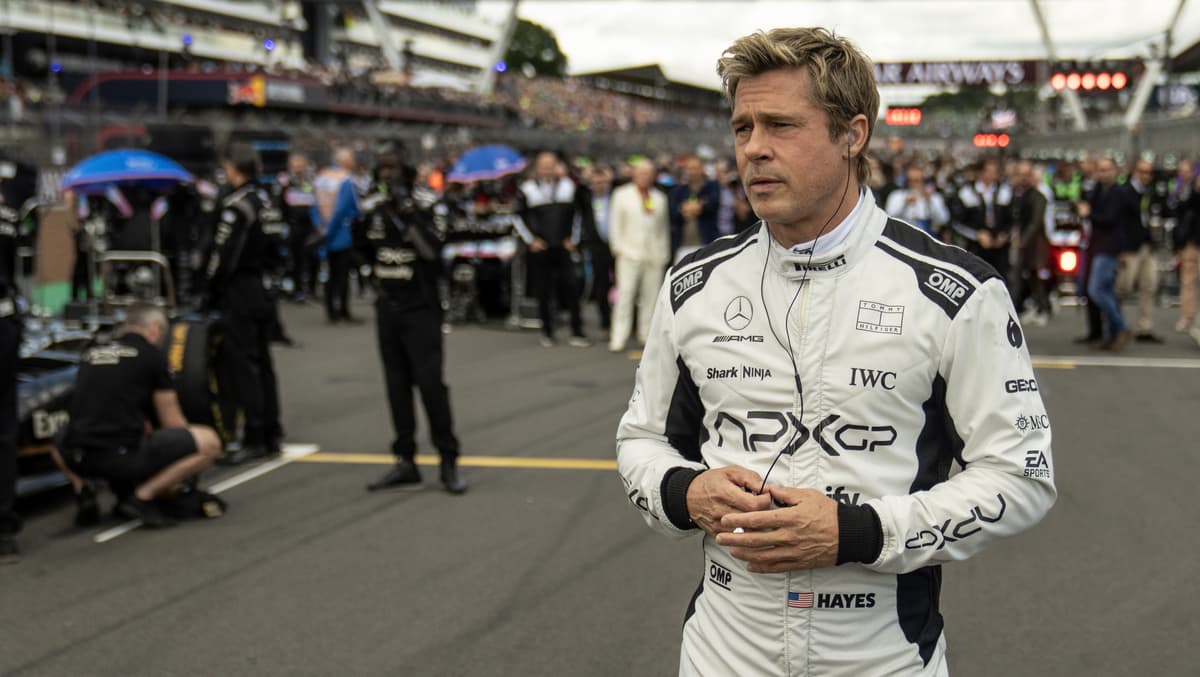
“F1” is not a smart movie. It’s actually quite a stupid movie. I don’t need to summarize the plot because, if you’ve seen any racing movie before, you know the plot. You know how each beat is going to work out, and all the tropes are here, with no surprises. You don’t even need to have seen a racing film to know what this film is like. It’s such a generic underdog action flick — of grizzled vet teaming up with rookie — that it has almost exactly the same plot as “Top Gun: Maverick,” director Joseph Kosinski’s previous film.
Instead of Tom Cruise using planes to bomb an unnamed but definitely Iranian nuclear base, now Brad Pitt is racing a Formula One car to save his friend’s team and his legacy. It’s “Top Gun: Maverick” but with cars.
Although critics praised the way the film was shot and the chemistry between the leads, many took issue with this basic story, and I know friends who are die-hard fans of the sport but couldn’t stand the film, pulling out of the experience because of its various plot contrivances.
But for me, all of this is irrelevant. Because, sitting in an IMAX cinema, watching Brad Pitt chase the racing line at top speed, with exhaust roaring around me and vibrating the seats, with the stakes at their highest, it felt incredible. It was a spectacle, an experience, everything that going to the movies was, is, and should be about. “F1” will release on Apple TV, which produced the film, but you can’t experience this film on streaming. Like the great blockbusters of yore, you haven’t seen the whole thing unless you’ve seen it on a giant screen, and part of the reason those cliches don’t matter is that it only makes it feel even closer to those great movies. As Porter Robinson’s robotized voice says about the drum progression that closes out his song, “Russian Roulette”:
“That’s the format we’re used to. Cliches like this are beautiful because they reflect us… it only became taboo because it was too powerful, that’s why you won’t forget it.”
I say all of this, in part, as a defense of the film, but also to make a point to studio executives that there are clear rules for creating a modern hit movie. The rise of streaming has brought a level of convenience to entertainment never before seen, but it has also left the industry unsure of what works and what doesn’t when considering adult-focused, broad audience films. However, the rules seem to be fairly clearly established now: there are films, and there are movies.
For low- and mid-budget films, build them around streaming, utilize smaller budgets and more creative freedom, and opt for a small but flexible cinema release. If word-of-mouth works, the cinema run can evolve into an awards campaign or become profitable in its own right, showing studios where they should go next. “Anyone But You” is an example of a studio doing it right, whereas “The Bikeriders” was released in cinemas too early, thereby preventing it from earning its money back and reducing its anticipation and reception when it was finally ready for streaming. This model also works for films that don’t find an audience in cinemas, as the big-screen run serves as a good marketing campaign for the streaming launch, which is necessary given the current oversaturation of online content.
On the other hand, if you spend more than $150 million on a movie, it needs to perform well in cinemas. It needs to be relevant to a modern audience and have the visual and auditory scale that demands a big screen. People didn’t see “Barbie” in cinemas because they loved Margot Robbie or “Oppenheimer” because they think Christopher Nolan is the best; they went because they needed to see them on the big screen. The same was true with “Dune” and the “John Wick” films, and will also be true of “The Odyssey” and Denis Villeneuve’s James Bond. There are underperformers in this camp — the last two “Mission: Impossible” films were the victim of poor release timing — but this approach generally produces hits.
Also, compare “F1” on the “spectacle plus relevancy” mark to films that underperformed. “F1” needs to be experienced on the big screen, and has a story that harkens back to classic racing movie tropes, but also is about Formula One, a sport with a growing, online, young audience. It’s no surprise to me that it’s overperforming and there are already talks about a sequel. By comparison, the new Marvel film “The Thunderbolts” was reviewed more favorably than “F1” and featured big stars, but it was a styleless, gray blob, centered on characters that audiences don’t care about, with no meaningful connection to those they do. Its disappointing performance shouldn’t have been a surprise.
I also want to bring up one other film that demonstrates this point: “Electric State.” You probably haven’t heard of that film, and you shouldn’t watch it, but it was a sci-fi film starring Millie Bobby Brown and Chris Pratt, which was released on Netflix this year. It looked cheap and was quite dull, but had a production budget of about $320 million, making it one of the most expensive films ever made.
Unless Netflix has a “Producers” situation going on, I have no idea why this film was commissioned or why it cost so much. If studios want to have hits again and bring audiences back to cinemas, they should follow the example set by Apple TV+ with “F1.”