
PBS Documentary ‘Hard Hat Riot’ Highlights a Little-Known 1970 Event With Major Political Implications

Filmmakers Marc Levin and Daphne Pinkerson’s focus on New York’s socio-economic conditions shows how the sometimes messy history of the city is often a precursor to developments in America at large.
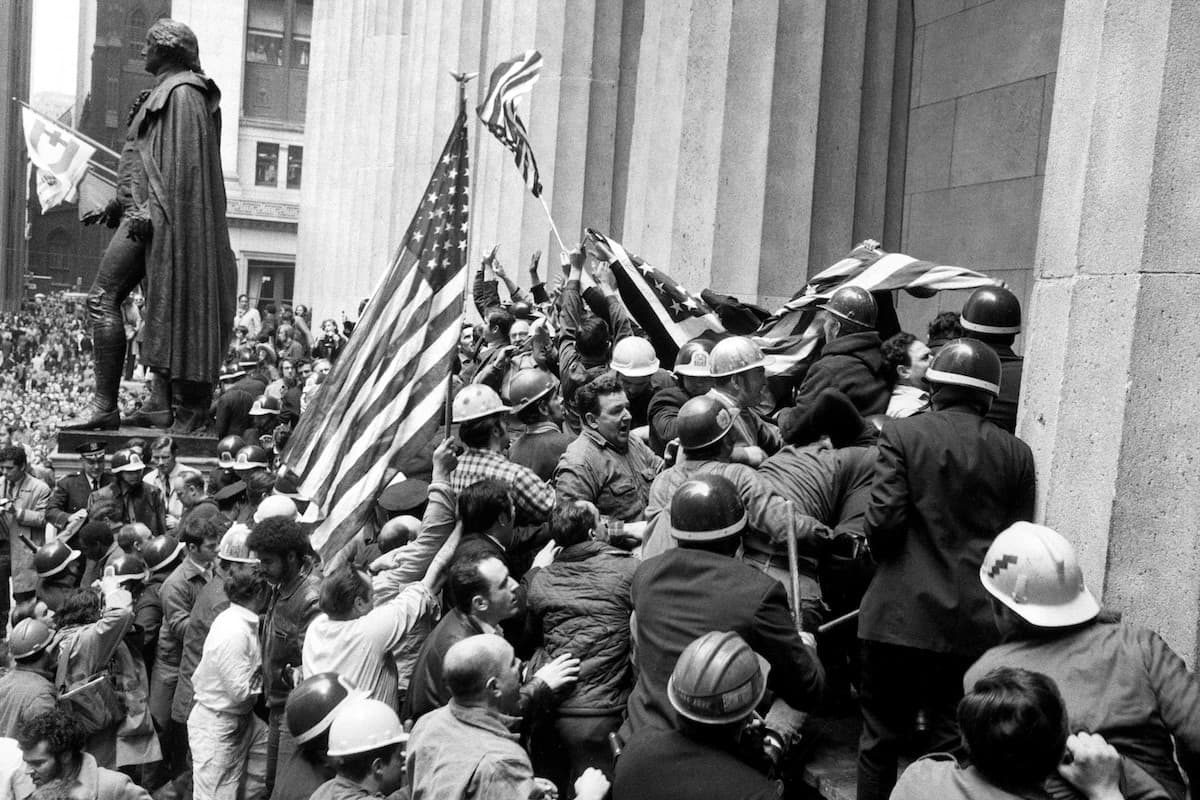
Carl T. Gossett/the New York Times/Redux
Hardhats take the steps on May 8, 1970, at New York. Carl T. Gossett/the New York Times/Redux

Many people remember, have studied, or have heard of the major events that occurred during the early days of May 1970, such as the Kent State killings and President Nixon’s impromptu dialogue with anti-war protesters at the Lincoln Memorial. 

Yet most don’t know about the demonstration that turned into a donnybrook between construction workers and young activists that took place at New York on May 8 of that year. A new PBS documentary, “Hard Hat Riot,” seeks to draw attention to this event by placing it within the historical context of a city in decline and a changing America. Airing Tuesday night, the engrossing broadcast also establishes how the incident would resonate politically through the last decades of the 20th century and until now.   

The documentary starts with a focus on the World Trade Center, which began construction in 1966 as American combat deployment escalated in Vietnam. Clips of the Twin Towers going up are mixed with insights from author David Paul Kuhn, who wrote the book on which the film is partly based, as well as comments from former ironworkers addressing the perils of construction work. 

These dangers parallel how many wage earners were the ones conscripted for the war while those from more affluent families could afford to go to college. An anecdote regarding the draft lottery televised in December 1969 reinforces the sense that many young men from disadvantaged backgrounds were dealt a raw deal. 

After Nixon declared on April 30, 1970, that the war would not be drawn down but expanded to include areas within Cambodia, the protest movement gained momentum, with the documentary showing not only the horrors of the war but footage of numerous marches and sit-ins. Outrageous displays of dissent, such as performance art pieces and the waving of the Vietcong flag, are contrasted with peace symbols and earnest demonstrators, some of whom we get to meet. A former NYU student, Harry Bolles, discusses how he was part of a collective disseminating information regarding the movement, and we’re given glimpses of a meeting involving teacher/advisor Martin Scorsese and Harvey Keitel.      

Once the documentary reaches the May 4 murders of four Kent State students, one of whom was a Jewish boy from Long Island, it interrupts its chronological presentation of events leading up to the Hard Hat Riot. Instead, it flashes back a few years in New York history to Mayor John Lindsay’s first four years in office — a tumultuous time of transit, sanitation, and teachers’ strikes, among other woes.

Filmmakers Marc Levin and Daphne Pinkerson’s focus on the city’s socio-economic conditions shows how the sometimes messy history of New York is often a precursor to developments in America at large. White-collar positions increased while manufacturing and skilled labor jobs were growing scarce. Those who were building the World Trade Center — its very name dedicated to international trade — would be left behind by globalization. 

Most of these workmen hailed from white, ethnic neighborhoods outside Manhattan, as did those who kept the city running, and their financial pressures were intensifying. These laborers and trade workers were also members of unions with ties to the Democratic Party who chafed at how they were being forced to integrate their local chapters.

Mr. Kuhn states that after 1968’s Tet Offensive, a majority of Americans, including blue collar workers, did not approve of the war. Yet we also hear how the desecration of the American flag by some anti-war protesters, to say nothing of the bombing of buildings by more radicalized factions, angered the city’s working class, many of whom had been soldiers or had family members who fought in World War II and the Korean war. The Kent State killings only inflamed the situation, and by May 8 — the same day on which the city had celebrated VE Day 25 years prior — the situation downtown exploded, beginning with a clash in front of the New York Stock Exchange.

Footage from the standoff and subsequent brawl between the hardhats and young anti-war activists proves chaotic and riveting, if upsetting. Just as distressing is some of the attendant commentary, which often feels like an apologia for violence. 

By the time the construction workers headed to City Hall, they had gathered with them Wall Street businessmen, office professionals, and others, a testament to the concept of a silent majority. That this group demanded the American flag be raised to full staff — it had been lowered in honor of the Kent State victims — illustrates the extreme emotions at the scene.

The filmmakers bungle the immediate aftermath of the riot, with viewers left uninformed of how many were injured and arrested, not to mention if there were any ramifications for the lax and paltry police response. Also uninvestigated is the suggestion that the event may not have been as organically inspired as described. 

The documentary does explore the riot’s long-term effects, with Nixon’s meeting a few weeks later with labor leaders marking a change in the Republican Party. No longer was it solely aligned with the interests of business and the privileged; now it sought to take on the plight of the common man as well. What began in New York led to a political transformation.


The New York Sun

© 2025 The New York Sun Company, LLC. All rights reserved.

Use of this site constitutes acceptance of our Terms of Use and Privacy Policy. The material on this site is protected by copyright law and may not be reproduced, distributed, transmitted, cached or otherwise used.

The New York Sun

Sign in or  create a free account

or
By continuing you agree to our Privacy Policy and Terms of Use