


Ohio Governor’s Race Tilts Toward Democrats After Ramaswamy’s Controversial Attack Ad
By JOSEPH CURL
|Within swirls of conceits, the poem presents a self-analysis, expressing something that believers are supposed to think today, on Good Friday.
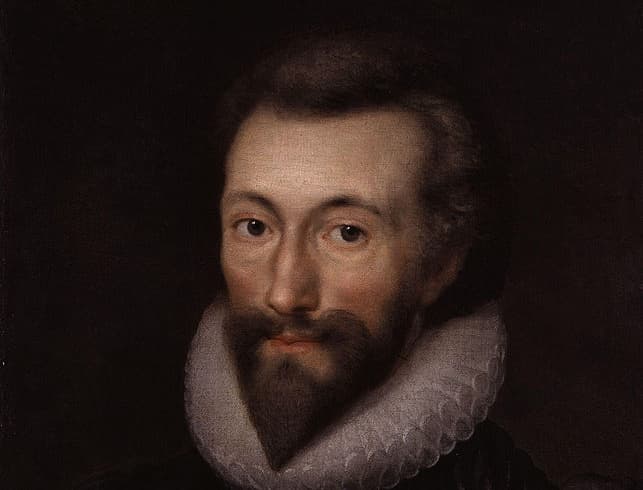
The Sun has offered as Poem of the Day two previous works by John Donne (1572–1631): “I Am a Little World Made Cunningly” and “Air and Angels” — both knotty, complex poems, and both examples of why he and some members of his post-Shakespeare generation were called the Metaphysical Poets. If anything, today’s poem, “Good Friday, 1613. Riding Westward,” is even more knotty and more complex. Even more metaphysical — as difficult a poem as the Sun has published. Yet within its swirls of conceits and figures for the speaker’s own failures, the poem presents a self-analysis, expressing something that believers are supposed to think today, on Good Friday.
Good Friday came on April 2 in 1613, and Donne was not forgoing travel in sympathy with Christ’s death, as he ought to have been. He was instead riding from London westward toward Wales. In rhymed pentameter couplets, Donne offers his excuses. He begins by blaming nature, suggesting that he is just like the planets: a natural sphere that is tugged along its elliptical path in “foreign motion.” He ought to be looking east, toward Golgotha, the place of Christ’s crucifixion in Jerusalem, but he is drawn to the west (past the gallows of Tyburn and toward the setting sun, a direction of death instead of the life that will rise in resurrection in the east).
His second excuse is the biblical idea that to see God directly is to be destroyed. “Who sees Gods face, that is selfe life, must dye; / What a death were it then to see God dye?” His third excuse is that he cannot bear to observe the suffering of Mary, who must watch her son die, while his fourth is that he really is seeing them, in a way, by thinking of them in memory. And his fifth is that he will submit to God’s punishment, which, in its way, will be a seeing of God.
The judgment of himself that Donne offers is brutal: He is without self-control, he is a coward, and he is a maker of weak excuses. He is a sinner who does not deserve the forgiveness for his fallenness that Christ’s death will repay. All of which is true, of course — but, then, who does deserve forgiveness? Such thoughts are, Donne thinks, the kind that everyone should have on Good Friday.
By JOSEPH CURL
|
By DAVID JONES
|
By A.R. HOFFMAN
|
By GEORGE WILLIS
|
By DAVID JONES
|
By JOSEPH CURL
|
By HOLLIE McKAY
|
By HOLLIE McKAY
|The Sun has offered as Poem of the Day two previous works by John Donne (1572–1631): “I Am a Little World Made Cunningly” and “Air and Angels” — both knotty, complex poems, and both examples of why he and some members of his post-Shakespeare generation were called the Metaphysical Poets. If anything, today’s poem, “Good Friday, 1613. Riding Westward,” is even more knotty and more complex. Even more metaphysical — as difficult a poem as the Sun has published. Yet within its swirls of conceits and figures for the speaker’s own failures, the poem presents a self-analysis, expressing something that believers are supposed to think today, on Good Friday.
Good Friday came on April 2 in 1613, and Donne was not forgoing travel in sympathy with Christ’s death, as he ought to have been. He was instead riding from London westward toward Wales. In rhymed pentameter couplets, Donne offers his excuses. He begins by blaming nature, suggesting that he is just like the planets: a natural sphere that is tugged along its elliptical path in “foreign motion.” He ought to be looking east, toward Golgotha, the place of Christ’s crucifixion in Jerusalem, but he is drawn to the west (past the gallows of Tyburn and toward the setting sun, a direction of death instead of the life that will rise in resurrection in the east).
His second excuse is the biblical idea that to see God directly is to be destroyed. “Who sees Gods face, that is selfe life, must dye; / What a death were it then to see God dye?” His third excuse is that he cannot bear to observe the suffering of Mary, who must watch her son die, while his fourth is that he really is seeing them, in a way, by thinking of them in memory. And his fifth is that he will submit to God’s punishment, which, in its way, will be a seeing of God.
The judgment of himself that Donne offers is brutal: He is without self-control, he is a coward, and he is a maker of weak excuses. He is a sinner who does not deserve the forgiveness for his fallenness that Christ’s death will repay. All of which is true, of course — but, then, who does deserve forgiveness? Such thoughts are, Donne thinks, the kind that everyone should have on Good Friday.
Already have a subscription? Sign in to continue reading
Cancel anytime
By continuing you agree to our Privacy Policy and Terms of Service.
Cancel anytime