

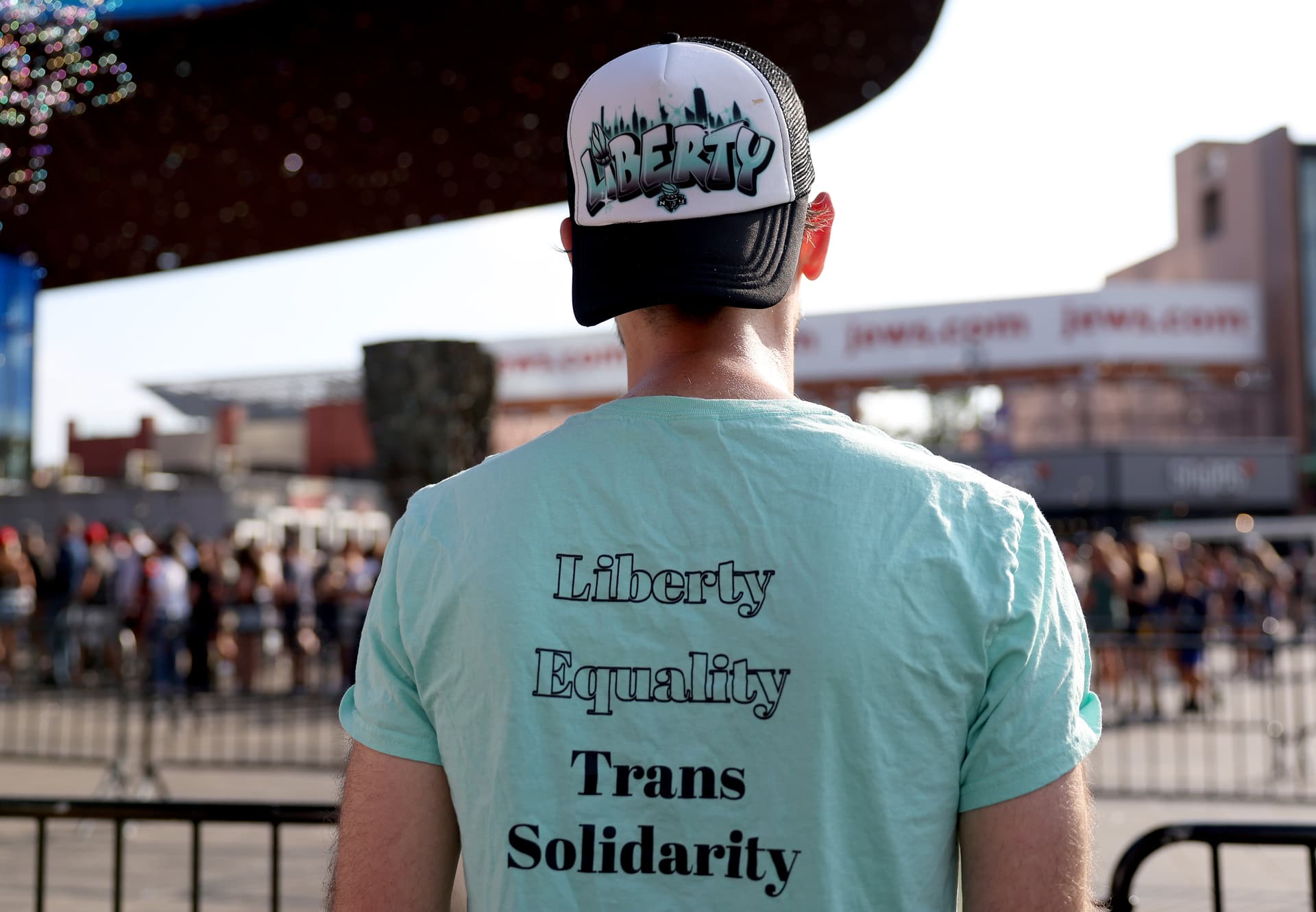
Trump’s Civil Rights Achievement Goes Unrecognized by Trans Activists
By DAVID MASTIO
|Coleridge called Robert Southey the complete man of letters — as he may have been, if ‘man of letters’ is a slightly sad title, given in courtesy to those who write widely and well without ever achieving greatness.

Robert Southey (1774–1843) could do almost anything with words, but he decided to do almost everything with words, and that kind of polymorphous squandering rarely allows a writer to leave behind a well-remembered body of work. His friend and fellow Romantic, Samuel Taylor Coleridge, called Southey the complete man of letters — as he may have been, if “man of letters” is a slightly sad title, given in courtesy to those who write widely and well without ever achieving greatness.
And so Southey wrote epic poems and love poems and story poems, along with poetic drama, ballads, sonnets, odes, and eclogues. Meanwhile, his torrent of prose volumes reached from histories and biographies to travelogues and polemics. And after his shift toward conservatism, he was appointed Britain’s poet laureate in 1813 — a little out of want of anyone else acceptable, but a distinct improvement on his predecessors Henry James Pye and Thomas Wharton, and a transition to the great Victorian poet laureates of Wordsworth and Tennyson.
Along the way he did write some lasting verse. His “My Days Among the Dead are Past,” a paean to reading, was Poem of the Day last summer here in The New York Sun, and we offer today “The Battle of Blenheim,” a comic poem with a sting. The poem references a real fight: the 1704 Battle of Blenheim in Germany. It was a major victory for the Duke of Marlborough in the War of the Spanish Succession, shifting momentum away from the French and toward the Grand Alliance in that pan-European war.
Quite how the Battle of Blenheim achieved all that is hard to explain, which is the point of Southey’s eleven six-line stanzas of tetrameter verse, rhymed abcbdd. The battle “’twas a famous victory,” the grandfather in the poem keeps telling his grandchildren, without being able to say why it was fought or what came of it — other than the suffering of the peasants overrun by war and the fields full of corpses.
By DAVID MASTIO
|
By DONALD KIRK
|
By HOLLIE McKAY
|
By CONRAD BLACK
|
By MICHAEL BARONE
|
By A.R. HOFFMAN
|
By HOLLIE McKAY
|
By HOLLIE McKAY
|Robert Southey (1774–1843) could do almost anything with words, but he decided to do almost everything with words, and that kind of polymorphous squandering rarely allows a writer to leave behind a well-remembered body of work. His friend and fellow Romantic, Samuel Taylor Coleridge, called Southey the complete man of letters — as he may have been, if “man of letters” is a slightly sad title, given in courtesy to those who write widely and well without ever achieving greatness.
And so Southey wrote epic poems and love poems and story poems, along with poetic drama, ballads, sonnets, odes, and eclogues. Meanwhile, his torrent of prose volumes reached from histories and biographies to travelogues and polemics. And after his shift toward conservatism, he was appointed Britain’s poet laureate in 1813 — a little out of want of anyone else acceptable, but a distinct improvement on his predecessors Henry James Pye and Thomas Wharton, and a transition to the great Victorian poet laureates of Wordsworth and Tennyson.
Along the way he did write some lasting verse. His “My Days Among the Dead are Past,” a paean to reading, was Poem of the Day last summer here in The New York Sun, and we offer today “The Battle of Blenheim,” a comic poem with a sting. The poem references a real fight: the 1704 Battle of Blenheim in Germany. It was a major victory for the Duke of Marlborough in the War of the Spanish Succession, shifting momentum away from the French and toward the Grand Alliance in that pan-European war.
Quite how the Battle of Blenheim achieved all that is hard to explain, which is the point of Southey’s eleven six-line stanzas of tetrameter verse, rhymed abcbdd. The battle “’twas a famous victory,” the grandfather in the poem keeps telling his grandchildren, without being able to say why it was fought or what came of it — other than the suffering of the peasants overrun by war and the fields full of corpses.
Cancel anytime
By continuing you agree to our Privacy Policy and Terms of Service.
Cancel anytime