


‘We Are So Far Behind’: Senators Probe Experts on Risks of ‘Rogue AI’
By MATTHEW RICE
|One of Blake’s opposition-pairings evokes the children of the poorhouses coming to St. Paul’s Cathedral at London as flowers or lambs, their singing of Holy Week hymns rising to heaven.
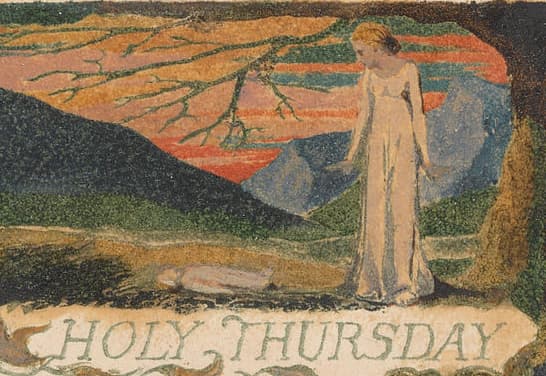
In 1789, William Blake (1757–1827) published his “Songs of Innocence,” and five years later, in 1794, he produced his “Songs of Experience” — binding them both together as “Songs of Innocence and of Experience Shewing the Two Contrary States of the Human Soul.” Last September, the Sun offered Blake’s “London” as a Poem of the Day, one of the few Songs of Experience without a counterpart among the Songs of Innocence.
A famous opposition-pairing, in “Contrary States,” is Blake’s “The Lamb” matched with “The Tyger.” But the pairing Blake most invites us to examine is the contrary states presented in his two Holy Thursday poems — both set on the day of the Last Supper in Holy Week, the day before Good Friday. In quatrains of 7-foot lines (in truth, a strongly hinted ballad meter of 4 feet and then 3 feet), the Song of Innocence poem pictures the children of the poorhouses coming to St. Paul’s Cathedral at London as flowers or lambs. Their singing of the Holy Week hymns rises to heaven, reminding the listener to “cherish pity, lest you drive an angel from your door.”
Meanwhile, in tetrameter quatrains (the 4-by-4 square stanza that Blake so often employed), the Song of Experience poem for Holy Thursday rages against London’s poverty: “Babes reduced to misery / Fed with cold and usurous hand.” Instead of praising their singing, Blake asks, “Is that trembling cry a song?” And he ends not with the spring that the coming Easter promises but with the cold declaration of “eternal winter” for those children.
By MATTHEW RICE
|
By LAWRENCE KUDLOW
|
By THE NEW YORK SUN
|
By JENNIFER DOHERTY
|
By BENNY AVNI
|
By JOSEPH CURL
|
By MATTHEW RICE
|
By THE NEW YORK SUN
|In 1789, William Blake (1757–1827) published his “Songs of Innocence,” and five years later, in 1794, he produced his “Songs of Experience” — binding them both together as “Songs of Innocence and of Experience Shewing the Two Contrary States of the Human Soul.” Last September, the Sun offered Blake’s “London” as a Poem of the Day, one of the few Songs of Experience without a counterpart among the Songs of Innocence.
A famous opposition-pairing, in “Contrary States,” is Blake’s “The Lamb” matched with “The Tyger.” But the pairing Blake most invites us to examine is the contrary states presented in his two Holy Thursday poems — both set on the day of the Last Supper in Holy Week, the day before Good Friday. In quatrains of 7-foot lines (in truth, a strongly hinted ballad meter of 4 feet and then 3 feet), the Song of Innocence poem pictures the children of the poorhouses coming to St. Paul’s Cathedral at London as flowers or lambs. Their singing of the Holy Week hymns rises to heaven, reminding the listener to “cherish pity, lest you drive an angel from your door.”
Meanwhile, in tetrameter quatrains (the 4-by-4 square stanza that Blake so often employed), the Song of Experience poem for Holy Thursday rages against London’s poverty: “Babes reduced to misery / Fed with cold and usurous hand.” Instead of praising their singing, Blake asks, “Is that trembling cry a song?” And he ends not with the spring that the coming Easter promises but with the cold declaration of “eternal winter” for those children.
Cancel anytime
By continuing you agree to our Privacy Policy and Terms of Service.
Cancel anytime