


Rare Early American Animated Films Being Screened at Film Forum
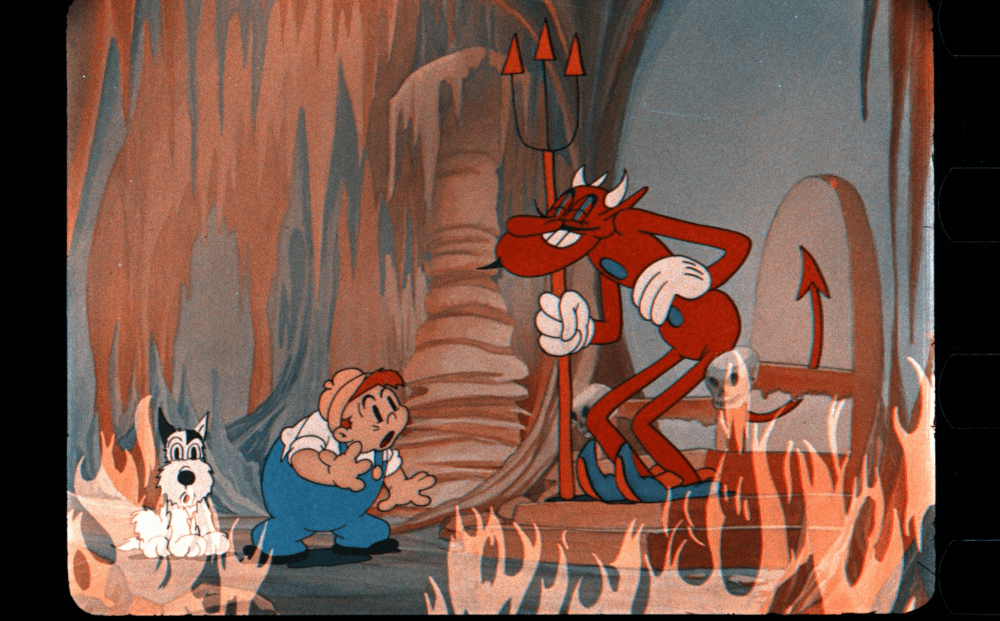
One entry, ‘Hell’s Fire,’ may be the damnedest thing you’ll ever see. It’s a madcap, zany, jolly musical frolic set in hell, with dancing devils and a swinging Satan.
‘Cartoons Lost and Found’
Film Forum
August 10
‘Musical Cartoons Before the Code’
Film Forum
August 11
A 1934 cartoon released by MGM, “Hell’s Fire,” may be the damnedest thing you’ll ever see. It’s a madcap, zany, jolly musical frolic set in hell, with dancing devils and a swinging Satan. The star is a corpulent character of film’s early sound period, Willie Whopper, so named because all of his short films take the form of tall tales that he tells the audience.
In this entry, Willie stumbles upon the gates of hell at the top of a volcano, and is pulled down — with his unnamed dog — after he annoys the devil himself by mindlessly tossing a boulder on his demonic noggin.
“Hell’s Fire,” produced by a once and future Walt Disney collaborator, Ub Iwerks, is among about two dozen rare examples of early American animated films being shown this Sunday afternoon and Monday evening at Film Forum. Curated by a cartoon historian supreme, Jerry Beck, the playlist includes some shorts that have never been screened or have not been seen in 90 years, as well as many others shown for the first time in gorgeous new restorations.
“Hell’s Fire” gets even weirder when Willie and pooch arrive in the inferno: Beelezubub summons up a parade of villains, some historical, like a diminutive Napoleon, Nemo — shown fiddling “Turkey in the Straw” even as hell burns — Rasputin, and Cleopatra. Somehow I never thought of her as a villain, but it gives the artists the opportunity to render her in a translucent gown. The parade also includes fictional bad guys, namely Simon Legree from “Uncle Tom’s Cabin” and both Dr. Jekyll and Mr. Hyde.
The figure who receives the most punishment by far, however, is allegorical or symbolic. We see a sickly figure with a nauseating blue pallor named “Prohibition” being ridden on a rail by a group of sinister-looking devils. For most of the rest of the film, Satan and his minions and Willie himself take turns on beating up on this guy, though it’s not clear why a tween boy would have an interest in ending prohibition.
By the mid-1930s, Walt Disney would establish the cartoon medium as a vehicle for logical storytelling and believable, relatable characters, but in the early days of sound it was anything goes. The brothers Max and Dave Fleischer were the ultimate specialists in animated anarchy, and the major entry included here that could be considered a well-known cartoon classic is their 1928 “Koko’s Earth Control,” in which the brothers’ zany randomness actually leads to an animated apocalypse.
As late as 1938, the brothers were trying something new. Their “Hold It” pivots around a catchy melody by songwriters Tot Seymour and Vee Lawnhurst, and features cartoon cats dancing with clever pauses and holds. Still, by 1940, even the Fleischers had traded in their patented pandemonium to produce a first-rate, Disney-style musical in the best-ever film adaptation of “Raggedy Ann and Raggedy Andy (1941),” a stunning two-reel featurette.
The show also offers a rare trailer for the Fleischers’ original animated “Superman” series, which proves that Max and Dave were innovators to the end. There’s also “A Hatful of Dreams” (1945), one of George Pal’s highly entertaining “Puppetoons.” It involves a magic hat that anticipates Harry Potter and features another Superman cameo, which is highly topical for this superhero summer.
Although the Fleischers were the patron saints of cartoon chaos, many other studios also got into the act, such as the Van Buren studio, whose Tom and Jerry series includes some of the most bizarre antics ever animated. There’s also the independent director/producer Ted Eschbaugh, who, among other things, gave us the first talking picture version of “The Wizard of Oz,” an unsatisfying but fascinating seven-minute mini-adaptation that seems to have devised the conceit of presenting the Land of Oz in vivid Technicolor and the Kansas scenes in monochrome.
Those are almost as many entries as I can comment about — most of the others are so rare that I’ll be seeing them for the first time along with most everybody except Jerry Beck.
I can’t conclude without a mention of Eschbaugh’s 1935 “Sunshine Makers.” This gonzo masterpiece — originally sponsored by a dairy corporation — portrays good little gnomes who subdue rather creepy-looking goblins, all dressed like undertakers, and then force-feed them on bottled sunshine, which transforms them into pasty-faced pixies who cheerfully chant, “I want to be gay!” Make of that what you will.