
‘Real Women Have Curves’ Adds to the Relatively Small List of Broadway Shows Based on Latin Music
Songwriters Joy Huerta and Benjamin Velez have given us a vibrant score that’s loaded with memorable and hummable tunes, which are preserved on the original cast album.
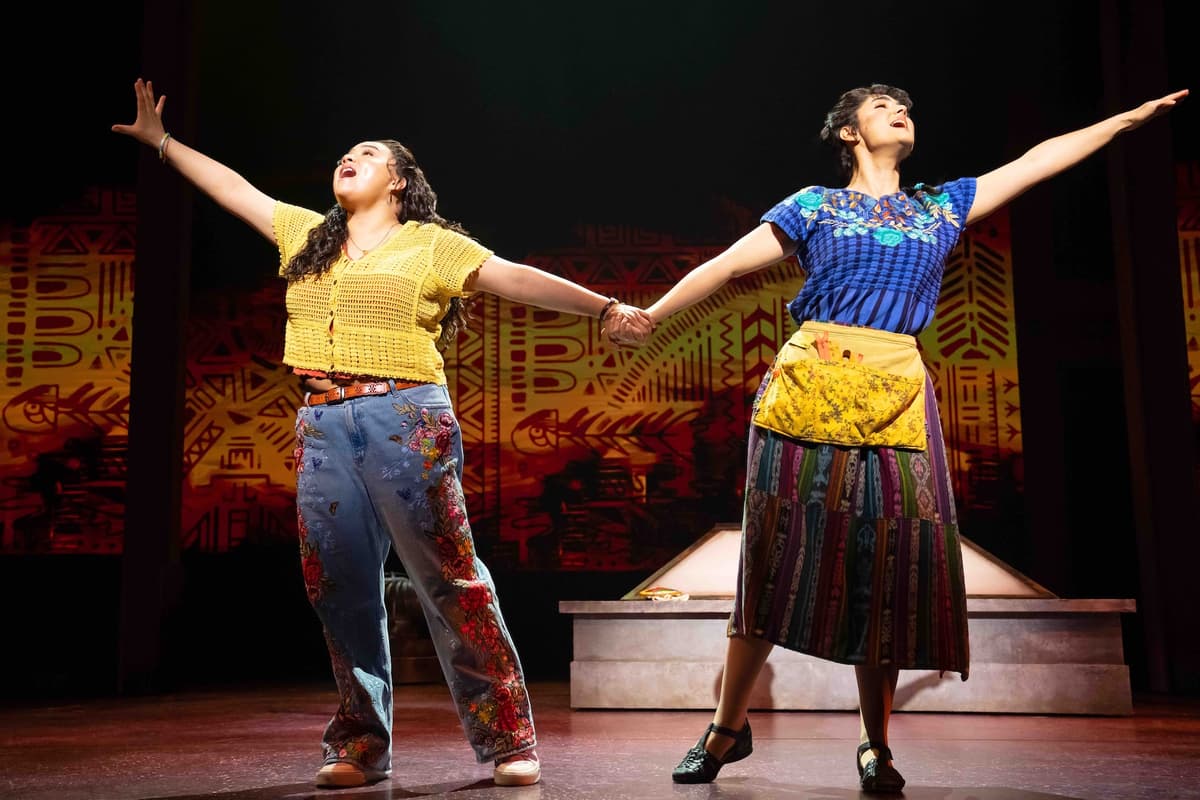
‘Real Women Have Curves’
Original Cast Album
Ghostlight Records
Music and Lyrics by Joy Huerta and Benjamin Velez
Listening to the recently released cast album of “Real Women Have Curves” reminds me that talking about musical theater as a kind of music — in the same way we talk about jazz, rock, or country music as music — is often problematic, in that there are possibly even more kinds of theater music than there are subgenres of jazz or rock.
The contemporary Broadway musical was created from so many different perspectives and starting points that even the most Broadway-hostile individual would have to acknowledge that few shows sound like each other. Some shows are more like rock opera, others are more like opera opera, and relatively few 21st century productions sound like what we think of as classic show tunes, such as those of Rodgers and Hammerstein or Frank Loesser. Even when we consider the works of a single composer, say Jason Robert Brown, we have to concede that “The Last Five Years,” “Honeymoon in Vegas,” and “Bridges of Madison County” don’t sound anything like each other.
There have been relatively few shows based on Latin music — famously “West Side Story” and “In the Heights.” These were inspired, respectively, by Puerto Rican and Dominican music traditions, though the first was by a pair of Jewish songwriters who so effectively captured the authentic idiom that many actual Hispanic performers have embraced their score. “Real Women Have Curves” tells the story of a group of Mexican immigrant workers and first-generation, native-born Americans in 1987, and the score’s roots are in contemporary Mexican music.
The result is that songwriters Joy Huerta and Benjamin Velez have given us a vibrant score that’s loaded with memorable and hummable tunes, which are preserved on the original cast album. In fact, like the best of these genre-specific scores, the songs are noteworthy on two levels, either as show music or Latin American music.
The opening number, “Make It Work,” shows how musical theater is uniquely equipped to borrow from the cinema — which is perhaps appropriate, as “Real Women Have Curves” is itself based on a 1993 play and a 2002 film. “Make It Work” is the stage equivalent of a movie montage, depicting the primary characters at work as seamstresses in the self-owned Garcia Sewing Factory.
As they labor, we hear very brief, deliberately random-sounding snippets of their conversation: “Ay the heat!” / “Think of it as a sauna”; “My [sewing] machine [is] always vibrating.” / “Enjoy it”; “You need lipstick to sew?” / “I need lipstick to live!” The number serves multiple purposes: It could be representative of a single moment in the “factory” or it could be a montage of typical bits of dialog from over a period of many days or weeks. It presents both a general moment and a specific moment.
In Act 2, there’s another such scene, “Finishing the Dresses Montage,” which this time uses what is essentially the musical equivalent of cinematic cross-cutting to convey mounting tension and the ramping up of suspense to build to a satisfying finale.
Other songs delineate character as well as move the story; “De Nada” has the mother telling her daughters who she is and where she comes from, both geographically and philosophically, and the young ladies respond cheerfully and somewhat ironically, “De nada” (“You’re welcome”) at the end of every line.
The individual numbers are mostly for the character Ana, played by Tatianna Córdoba. She’s the one who gets to have a first romance: “Doin’ It Anyway” is a warm, sweet, and funny depiction of two virgins trying to figure out what goes where. It’s her story arc that’s the primary one here — trying to convince the rest of her family to let her go to school on the other side of the country rather than work in the family business — but this is primarily an ensemble production rather than a star turn.
The ladies of the ensemble range from the very young to the middle aged, as well as from those who are way too subservient to husbands and boyfriends to those who clearly have no interest in men whatsoever. And it’s the ensemble numbers that get most of the attention here, like “Adiós Andres,” a wry and bittersweet ode to the arrival of menopause, sung by the winning Justina Machado.
The title of the work — and its biggest show-stopper of a number — is a life-affirming celebration of body positivity.
It starts with the seamstresses plowing full steam ahead to finish an order against an impossible deadline. As they sew frantically in the extreme heat, they gradually start to shed their outer garments even as they keep stitching away. They then do most of the number in their skivvies. It’s kind of a cliche in millennial speak to describe something sexy as being “empowering” for women — sometimes it is, many times it isn’t — but this number is genuinely empowering as well as a real turn-on, at least for some of us.
Sadly, “Real Women Have Curves” gave its last performance at the James Earl Jones Theater on June 29. This is especially unfortunate in that its pro-immigration, pro-birthright citizenship message is very topical in the current political climate. In 1960, Jerry Herman famously told us in 2/4, “There is No Tune Like a Show Tune”; well, “Real Women” proves there’s also no tune like a show tune in clavé or even a true Afro-Latin-style 6/8.