

‘Revisal’ of ‘Damn Yankees’ Comes With the Soul and Heart of the Original
One glory of the current production is its theater-in-the-round setting, which makes it easier to give the venue the feeling of a sports stadium.
‘Damn Yankees’
Arena Stage, Washington, D.C.
Through November 9
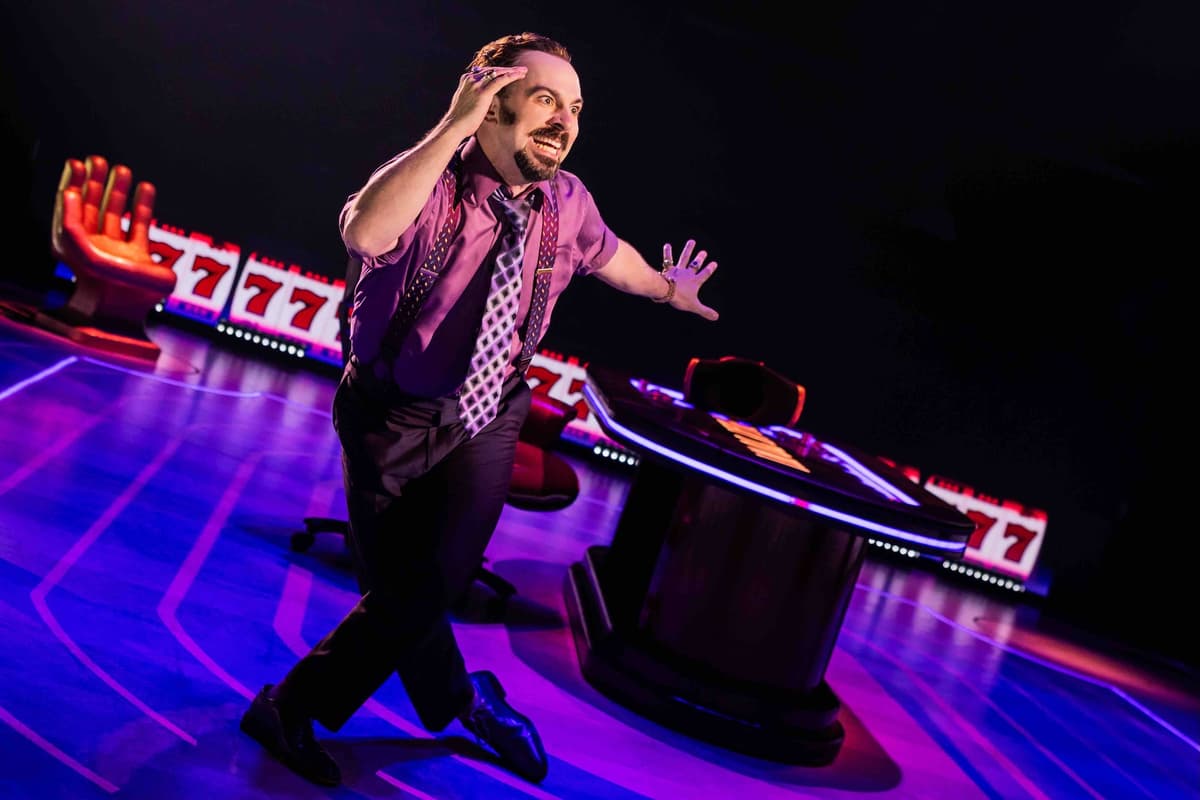
When is a musical comedy like a baseball game? The answer comes about halfway through Act One of “Damn Yankees,” a superlative new production of which is now playing at Washington, D.C.’s Arena Stage.
The morale of the Baltimore Orioles is at lowest ebb. They’ve just suffered 21 consecutive losses, and are officially “the worst team in the league.” The owner, Mr. Welch (Keenan McCarter), even states, “In Vegas, they’re puttin’ better odds on the End of the World than the Orioles ever winning a game.”
Yet the team manager, Benny Van Buren (Kehan Joshi), gives the players the greatest of all pep talks. “Boys, I know you’re not cowards,” he starts. “But your mental state? It’s outta left field! Baseball is only one half skill; the other half is something else. Something bigger.”
He then slides into the show’s best-known song, “Heart.” For the first chorus, it’s a solo anthem exhorting the team to perk up and to try harder: “All you really need is heart.”
In the second chorus, something remarkable happens: four Orioles — Sohovik (J. Savage), Rocky (Justin Showell), Smokey (Michael Harmon), and Fuzzy (Ben Cook) — spontaneously join in, singing harmony. All of a sudden, the song becomes “something bigger”: The five-part harmony makes the words and music into something greater than what they already are.

In director/choreographer Sergio Trujillo’s new production, the two songs most associated with the national pastime, “Take Me Out to the Ball Game” and the national anthem, are both interpolated as audience singalongs. Even so, most of the crowd made it clear that they’d rather be singing along about that “something bigger.”
This is the moment when it becomes clear what baseball and Broadway have in common: Not only do both efforts require copious amounts of heart, but it takes an incredible amount of heart-filled teamwork to make a hit.
In 1955, “Damn Yankees” — the tale of a hardcore ball fanatic who makes a deal with the devil to become a diamond superstar — was one of the great hits of a champion season, running for more than a thousand performances and scoring a Tony.
Offstage, it was a collaboration between two behind-the-scenes superstars, the veteran director-writer George Abbott and the young-and-rising choreographer-dancer Bob Fosse. “Yankees” made a star out of leading lady Gwen Verdon and established Fosse and Verdon as Broadway’s mightiest power couple.
The second major hit by emerging songwriters Richard Adler and Jerry Ross, “Yankees” would also, tragically, be their last, in that Ross died a few months later at age 29. “Yankees” also led to a successful 1958 movie version, again directed by Abbott. It was one of Hollywood’s better adaptations of a Broadway classic.
Mr. Trujillo refers to the current production as a “revisal” — it keeps the soul and, yes, the “heart” of the original, but is updated just enough to make it more relatable to 2025 audiences. In the current book by Will Power and Doug Wright, the leading couple, Joe (Quentin Earl Darrington) and Meg Hardy (Bryonha Marie), are African American, and one of Joe’s motivations to do what he does is for the sake of his late father, a pro who played for the Kansas City Monarchs but who was kept out of the major leagues by segregation.
They’ve also made satan’s seductress/assistant Lola (Ana Villafañe) into a legitimate Latina, who observes, “I always thought the devil would have horns and a tail. Who knew he’d be a cheap gringo with halitosis?”
In advance, I feared that a politically correct revival of “Yankees” would have to drop “The Game,” a second act rouser in which the ballplayers boast of all the girls with whom they resisted the urge to score. Here, Lynn Ahrens supplies new lyrics that do a commendable job of shifting the focus to resisting the temptations of overindulging in gambling, alcohol, “platanos and pork,” and then, finally, about picking up a couple of hot babes — it’s still funny, but somewhat defanged.
The glory of the current production is also its theater-in-the-round setting, which makes it easier to give the venue the feeling of a sports stadium: At different points vendors come out, and sports fans who turn out to be cast members emerge from the stands.
The in-the-round staging is a great vehicle for Mr. Trujillo’s exuberant dance numbers, offering a very masculine kind of ballet that is more reminiscent of Jerome Robbins and the Jets in “West Side Story,” though Rob McClure gets to Fosse-Fosse-Fosse it up in his big solo turn.
This is certainly a sponge-worthy, Broadway-ready production — especially for the leads. Rob Mcclure as the lovable villain, Mr. Applegate, sings one of the great character songs, “Those Were the Good Old Days.” It is a real crowd pleaser that doesn’t require an update.
In this production, “Good Old Days” has clear echoes of “Once in Love with Amy,” by Frank Loesser, who served as mentor and publisher to the Adler-Ross songwriting team famously performed by Ray Bolger in “Where’s Charley.” Mr. McClure punctuates the text with a Bolger-y, sneer-y kind of a laugh.
Mr. Darrington as old Joe and Jordan Donica as young Joe get all the major ballads, most of which are performed with Ms. Marie as Meg. For a show supposedly about Beelezubub and baseball, there are a lot of all-time great romantic songs. But maybe it isn’t about sports at all: Maybe, ultimately, it’s all about love, and redemption, and miles and miles and miles of heart.