

Revival of Thriller ‘Night of the Juggler’ Brings Seedy 1970s New York Back to Life

To be re-released Friday at the IFC Center, the film serves as a compelling time capsule for those New Yorkers looking to ‘escape’ the grim realities of the current city for those of an earlier, more desperate one.
Via Kino Lorber
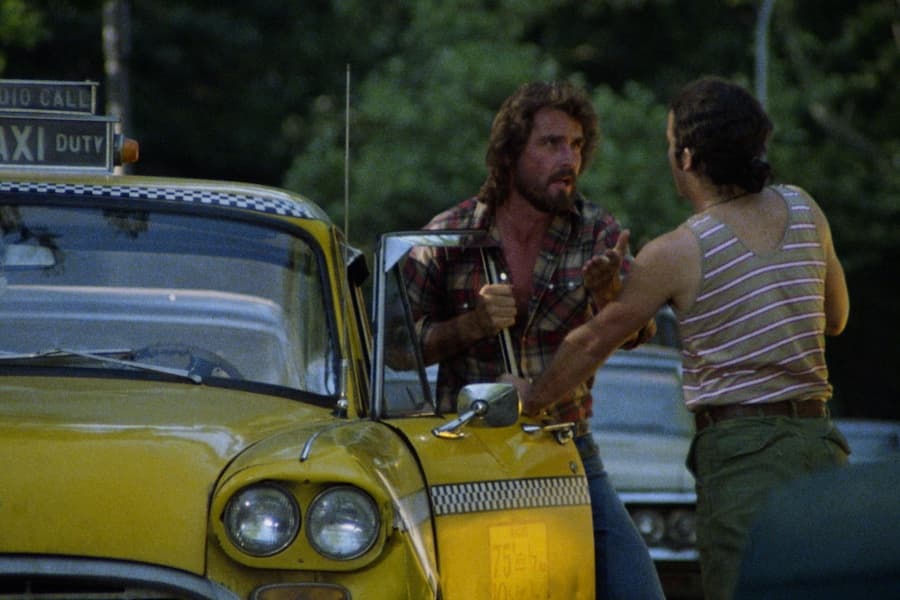
James Brolin and Mandy Patinkin in ’Night of the Juggler.' Via Kino Lorber

The crisis that gripped New York City in the 1970s provided grimy grist for several iconic movies, including “Serpico,” “Death Wish,” “Taxi Driver,” and “The Warriors.” Shot in 1978 though not released until 1980, “Night of the Juggler” doesn’t possess the same power as those films, yet the little-known picture merits a place among them, if only for its amalgamation of key aspects from each, such as the disaffected, violent loner of Martin Scorsese’s classic. 

To be re-released this Friday at the IFC Center in a new 4K version, “Juggler” serves as a compelling time capsule for those New Yorkers looking to “escape” the grim realities of the current city for those of an earlier, more desperate one. As its story of a kidnapping and pursuit follows the fairly standard course of an action B-movie, it is the film’s location shooting and gritty ’70s atmosphere that thrill. Also compelling is the narrative’s exploration of still-relevant issues, such as class conflict and racial tensions.

James Brolin stars as Sean Boyd, a truck driver/former NYC police officer who returns to the city for his daughter Kathy’s birthday one morning after a long haul. The divorced dad’s plans are interrupted, though, when an unstable Parks department employee, Gus Soltic, grabs the teenager in Central Park, mistaking her for the daughter of a real estate developer. Witnessing the abduction, the father then chases the sociopath across several boroughs, thwarted along the way by rush-hour traffic, a crowded subway, the police department, street gangs, and more.   

From its quiet but unsettling opening scene auguring bloodshed to its early shots of the hustle and bustle of the morning commute and Boyd’s easygoing charm, the film effectively establishes the dynamics of the setting and the primary traits of the main characters. A sense that the movie won’t take itself too seriously manifests through somewhat snappy dialogue and the number of joggers shown bouncing around, reflecting the decade’s running craze. 

Cliff Gorman and Abby Bluestone in ’Night of the Juggler.’ Via Kino Lorber

Once Boyd gets into a taxi driven by Mandy Patinkin as a Puerto Rican cab driver, the real fun begins, with an initial car chase in and around Central Park impressing with the stunts’ visceral scrape and crunch and the seemingly guerrilla filmmaking. In vintage press notes from Columbia Pictures, director Robert Butler discussed how the key to making it look improvised and unpermitted was to have the production’s vehicles in the foreground with actual city traffic in the background, despite the possibility of an unexpected turn by an unsuspecting driver leading to a compromised take and, potentially, worse.

One scene that almost led to serious harm to the actors, crew, and bystanders features a corrupt cop shooting at Boyd as the hero runs in and around Bryant Park. The Oscar-winning director of “Anora,” Sean Baker, considers the wild sequence to be “what movies are all about.” While some may disagree with that statement, there’s no doubting its apparent realism, as attested by citizens watching the staged melee and a production anecdote: Hearing a volley of blanks being fired, a nearby patrolman ran into the area with his gun drawn.    

New York actor Cliff Gorman might have been cast as the psychotic, racist Soltic due to the wall-eyed cast of his eyes, yet he never overplays the character’s “craziness” nor the script’s attempts at rationalization. Born in the South Bronx, Soltic laments the state of the old neighborhood as it appears in the late 1970s — like something seen at a bomb site. He cites municipal policies and the influx of people of color as reasons he is unable to pay taxes on a building he inherited, and for forcing him to resort to kidnapping. He detests “rich bastards” in particular.

Soltic isn’t the only one, though, who takes a dim view of the wealthy. Beleaguered Lieutenant Tonelli, played by another great New York actor, Richard S. Castellano, has an encounter with a powerful tycoon and dismisses the arrogant man with a sapient reproof. Even Boyd expresses dismay at the values of the rich in an argument with his Connecticut-residing ex-wife.

When this disdain of affluence is combined with mentions of inflation, layoffs, and an exodus of residents, one might confuse the events onscreen with those of today. A sequence in a Times Square-adjacent sex shop, with some of its real-life peep show performers in speaking parts, brings one back to the sleaziness of the bygone era. Further sordidness arrives when Soltic seems to seduce Kathy (Abby Bluestone) by having her wear his mother’s old dress. As abductor and abductee hide out in his dark and decrepit home, the insecure and helpless teenager experiences Stockholm syndrome.

By the time the movie ends, much of the initial impact has dissipated owing to frantic plotting, underdeveloped characterizations, and tired gags. Its climax, though, in the dank water tunnels beneath the Central Park Reservoir, once again leverages a city location to provide impressive ambience, while enhancing the film’s look at the squalid flipside of the one and only New York.


The New York Sun

© 2025 The New York Sun Company, LLC. All rights reserved.

Use of this site constitutes acceptance of our Terms of Use and Privacy Policy. The material on this site is protected by copyright law and may not be reproduced, distributed, transmitted, cached or otherwise used.

The New York Sun

Sign in or  create a free account

or
By continuing you agree to our Privacy Policy and Terms of Use