Robert Longo’s ‘Weight of Hope,’ Opening on September 11 at Pace Gallery, Proves Both Provocative and Poignant
His choice of subjects, often sourced from journalism, take the candid force of a well-placed camera shot and amplify it to almost hyper dramatic effect.

Robert Longo: ‘The Weight of Hope’
Pace Gallery, 540 West 25th Street, New York, New York
Through Oct 25, 2025
Robert Longo, in his early work, was known for his signature jumping figures. Leaping and pirouetting on Lower Manhattan rooftops, they encapsulated youth, boldness, the launch of a new precarious era met with elan. They even figured prominently in one of his signature pop culture moments, the music video for New Order’s “Bizarre Love Triangle,” which he directed.
Since then, however, Mr. Longo has become increasingly stately, large-scale, and ponderous, creating cinematic works replete with political and historical weight. His upcoming show at Pace gallery “The Weight of Hope,” features just these sorts of monumental images, imbued with as much gravitas as his earlier jumping youths were imbued with lightness.
This is a huge show, on the heels of his exhibit “The Acceleration of History,” recently held at the Milwaukee Art Museum. Pace, in a kind of sequel, features 26 of his massive charcoal drawings, including three sculptures and three films. Thirty-three studies will also be included on multiple floors of the gallery, as well as a piece for the gallery façade. Opening on September 11, a date already freighted with dread and remembrance, it proves to be both provocative and poignant.
Mr. Longo’s choice of subjects, often sourced from journalism, take the candid force of a well-placed camera shot and amplify it to almost hyper dramatic effect. Under his meticulous rendering, snapshots become giant cinematic stills. While skilled photographers grant the fleeting grace to a moment, Longo seeks to capture the moment and expand it. Many images include significant recent events, such as the January 6 riots, the unrest at Ferguson, Missouri or images from Iran protests or the Ukraine war.

Whatever Mr. Longo’s underlying sympathies, however, he appears to be chasing something broader than a mere political agenda. He wants to revel in the mythologized glory of the contemporary image. In the past Mr. Longo has expressed the desire to assimilate the entire known world into his drawing, a grandiose ambition that he finds paradoxically humbling. In this show, by contrast, he attempts to encompass the idea, the imagistic essence, of America. He wants us to feel its immensity and raw power, its chaos and volatility, its endless capacity for tragedy and grandeur.
This requires working, as he usually does, on a vast scale. It also requires working in black and white, a staple of his work that helps to amplify the solemnity and drama of his images. If there is a contemporary master of Chiaroscuro working today, it might very well be Mr. Longo. You can feel the weight of his giant American flag, with its brooding, billowing folds filling the image’s lower half and set against a black void. Though he titles the flag as “ascending,” it appears to be struggling against its own heft.
The same sombre draping is echoed in his covered statue of the Confederate general, Robert E. Lee. You might recall a protest around the tearing down of this particular statue in 2017, which then led to the infamous Unite the Right rally. A flash point that galvanized the nation over its own history, Mr. Longo’s covering hangs over Lee’s statue like a shroud.
Another flag appears, this time tattered and flown by a protester against a burning building illuminating the night sky. Once again, drama and contrast dominate the image. This is his take on the 2020 Black Lives Matter protests, following the death of George Floyd.

Mr. Longo is not only confined to the contemporary American scene, however. He has long been known for his combination of disparate images culled from sources that make viewers wonder at his internal logic. He includes his re-rendering of Gentileschi’s spectacularly gory baroque masterpiece “Judith Slaying Holofernes.” Mr. Longo has often championed Gentileschi’s rage and trauma-driven oeuvre over his contemporary Caravaggio, citing his almost reckless penchant for intensity. Here, in overblown scale in black and white, we can truly feel what he’s talking about.
There are international drawings as well, such as his female Iranian protester holding a picture of the woman detained and likely killed by the Iranian regime, Mahsa Amani, for failing to properly wear her Hijab. Here her iconic smiling photograph occupies the center of focus, obscuring the face of the older woman holding her. There is only the impressively rendered hand clutching it, against the background a blur of bodies.
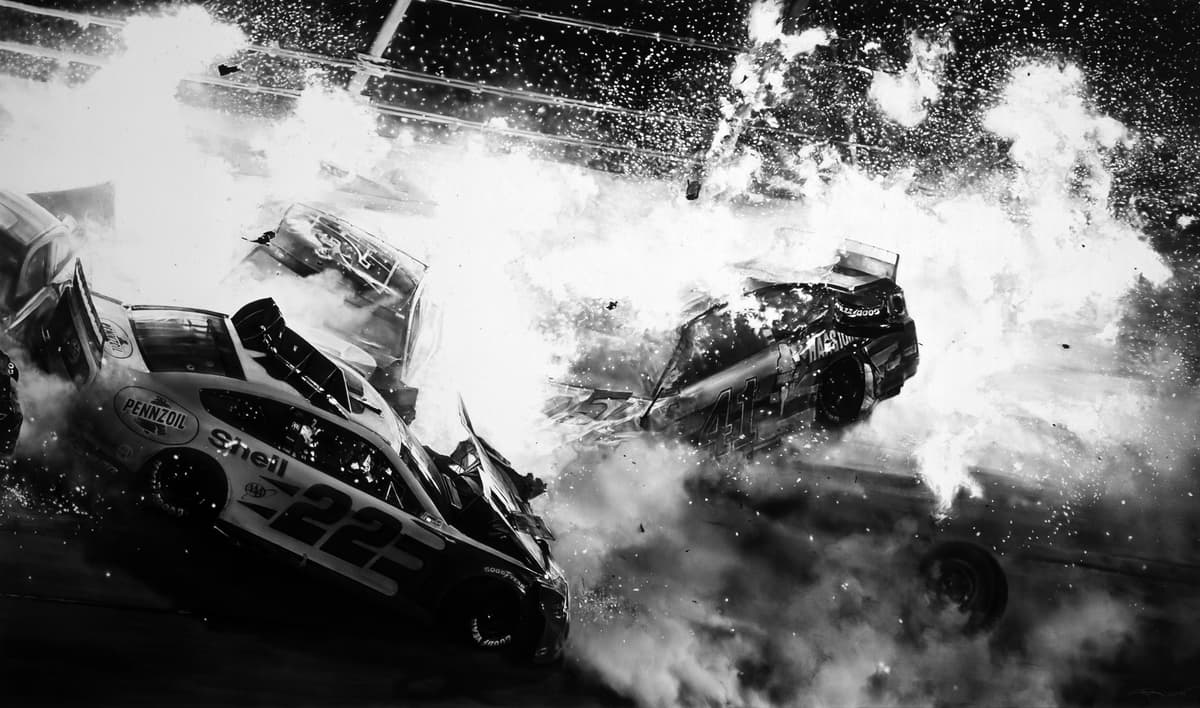
At other times, however, he gives in to pure violent mayhem. His drawing of a Nascar crash at Daytona captures one of those pure adrenaline moments where disaster nearly melds into ecstasy. We are at the limit of the American dream here, where ambition, technology and sheer grit go awry in an explosion of metal, shattered windshield and dust. It is the logical endpoint of the earlier rodeo. It is also quite mad.
As always, Mr. Longo’s rendering is so virtuosically skilled that the eye is often fooled into thinking these are overblown photographs. This assured technique belies his decades long investigation of the contemporary image. One of the famous progenitors of the so called “Pictures Generation,” Mr. Longo — along with his then-partner Cindy Sherman — explored their feelings towards American culture by subjecting found images to an almost forensic analysis. Unsure of what the future held, they delved into what was most at hand: the constant deluge of images from news, advertising, and entertainment.
Mr. Longo is the current heavyweight of this school, its founder and its ruler, diving deeply into the discontents of the American image in a manner both unsettling and exhilarating.
_____________
Correction: Mr. Longo’s Untitled Work, ‘(Falling Flag),’ reflects the artist’s response to the 2020 Black Lives Matter protests. An earlier version misstated the subject matter.