
Russ Anixter’s Hippie Big Band Translates Rock, Classical Tunes Into Jazz Vocabulary

It’s to Anixter’s credit that his reinterpretations don’t make a point of getting all ‘jazzy’ for their own sake; he stays true to the essence of the originals.
Tom Buckley
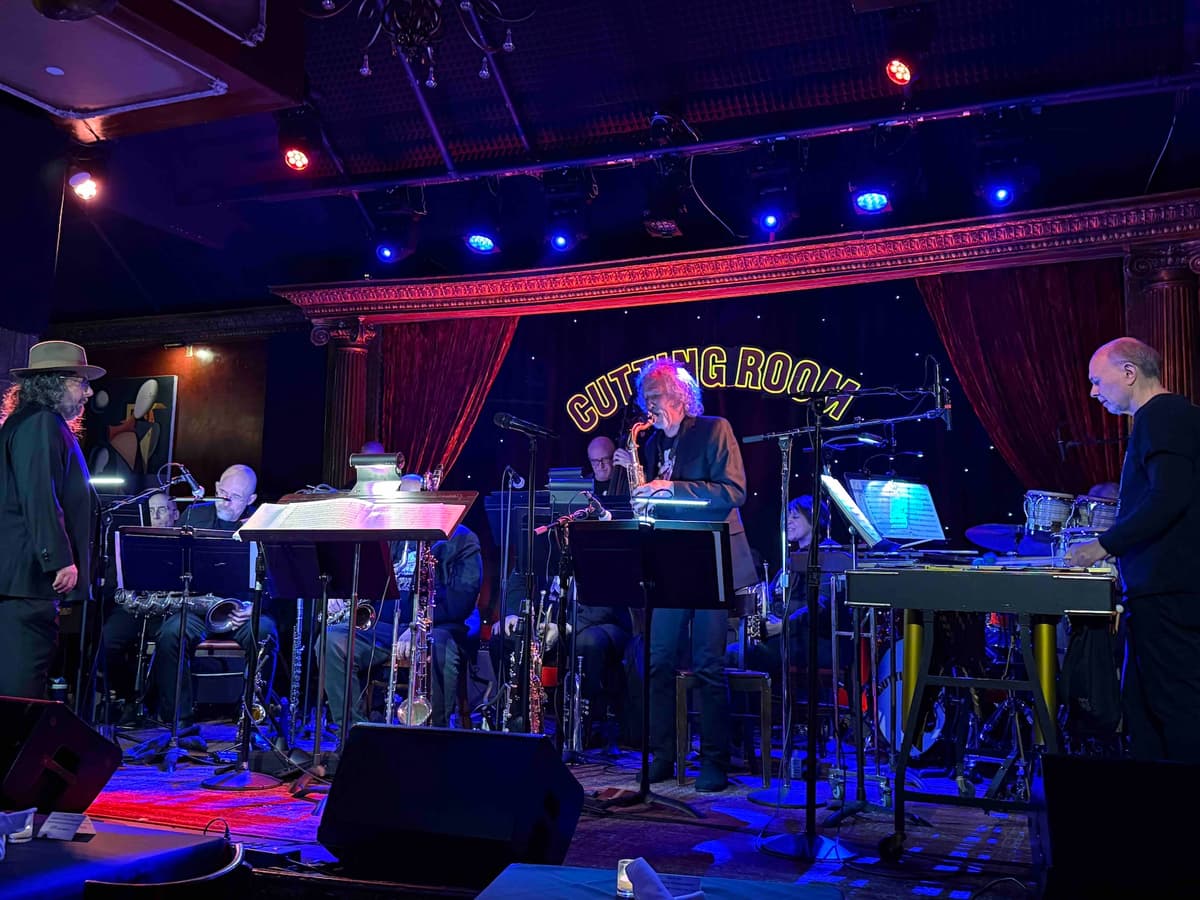
Russ Anixter, Stan Harrison, and Frank Bayes at the Cutting Room. Tom Buckley

Russ Anixter’s Hippie Big Band
‘What Is?’
russanixter.com

When rock ’n’ roll arrived, a lot of the older jazz musicians — and even more so, jazz fans — professed to detest it. Yet at least as late as the end of the 1960s, jazz and rock had more in common than those veteran listeners cared to admit. The ironic thing is that nobody realized it at the time.

Eventually, so-called progressive rock would deliberately incorporate more values from both jazz and classical music, and then the various so-called fusion bands would more formally consummate the relationship between the two musics.  Yet even without either of those subgenres, this was a period when rock sounded a lot like jazz and vice versa.

There also was a generation of musicians, mostly born in the early 1950s, who grew up immersed in jazz, and studying it formally in schools that were only beginning to implement jazz studies programs, such as Berkeley, Juilliard, and the Manhattan School of Music. But they also loved the more musically adventurous contemporary pop groups, such as the Allman Brothers Band and Little Feat, as well the major singer-songwriters, like Joni Mitchell and Van Morrison, and also such imposing cultural signifiers as the Beatles and the Grateful Dead.

All of those creators are represented on the debut album by a Staten Island-based arranger, composer, and bandleader, Russ Anixter, which he launched with his 11-piece ensemble last week at the Cutting Room. Both the concert and the album commenced with what is, more or less, the title song, “What Is Hip?” The track by Tower of Power proceeds to answer its own question.  

We’ve heard attempts to “jazz up” rock tunes — even as some in earlier generations made a point to “jazz up the classics,” in swingtime treatments of Tchaikovsky and Brahmes. It’s to Mr. Anixter’s credit that his reinterpretations don’t make a point of getting all “jazzy” for their own sake; he stays true to the essence of the originals while translating them, as it were, into something more like a jazz vocabulary.

It was especially clear that this jazz vocabulary is distinguished by some of the more esoteric instruments in the arsenal — this was neither a “smartening” of rock or a “dumbing down” of jazz. One soloist who received a lot of solo space — and justified it all — was percussionist Bill Hayes, who had displayed in front of him a set of Latin percussion implements such as congas and bongos and also a full-scale xylophone and a vibraphone; yes, they have sufficiently different sounds to necessitate the schlepping of both of these rather unwieldy instruments to the gig.  

At the opposite side of the stage, the reed section included Frank Vicar playing low-A baritone saxophone, the rare curved soprano sax, and the unwieldy, anything-but-delicate alto flute; three highly unusual horns and truly a reed-smoker’s dream.   

Little Feat’s “Dixie Chicken” — believe it or not, I heard it for the first time as sung by the late Jack Jones, and not bad either — and Greg Allman’s “Whipping Post” are funky dance numbers that fit rather organically into the big band jazz framework; special guest Steven Bernstein, whose Millennial Territory Orchestra is paying Carnegie Zankel in two weeks, graces both with his slide trumpet, a horn that sounds kind of like a cornet on acid. 

There are also a pair of ingenious mash-ups. Joni Mitchell’s “Free Man in Paris” now struts about to the tune of Eddie Harris’s “Freedom Jazz Dance,” which some of us prefer to think of as Jimmy Heath’s “Gingerbread Boy.” There are two Dead dirges, “St. Stephen” and “Turn On Your Love Light,” affixed together in a way that’s refreshingly tuneful. While the Dead were known to be all about protracting jamming, these and “Uncle John’s Band” remind me that Jerry Garcia and company wrote some pretty good tunes as well.

“He Said, She Said” is one of the more successful attempts to jazzify Lennon & McCartney; Matt Owens plays the melody on a tightly muted, wah-wah-ing trumpet that sounds like post-post-postmodern Duke Ellington — though it’s more authentically Ellingtonian than those arrangements of Beatles songs actually played by the Duke’s band.  

“Into the Mystic,” also famously recorded by the Allman Brothers, isn’t even the jazziest ever song by Van Morrison: That honor would probably go to “Moondance,” but Mr. Anixter’s arrangement reconfirms how hip and musically substantial that great Irish songwriter’s output was and is.

The biggest surprises derive from the worlds of stage and screen: “Heaven On Their Minds” comes from Andrew Lloyd Webber’s “Jesus Christ Superstar,” and in an earlier age would have been denounced by rock purists — yes, there are such things — as a Broadway-style approximation of heavy metal style. Mr. Anixter shows that Sir Lloyd-Webber is a graduate in good standing of the School of Rock.  

The most remarkable track might be the conclusion, the theme from the 1966 TV series “The Green Hornet,” which was composed by Billy May, loosely inspired by and liberally adapted from a theme from the 1900 Russian opera “The Tale of Tsar Saltan (Сказка о царе Салтане)” by Nicolai Rimsky-Korsakov. Now we have big-band swing — with solos from Messrs. Owens and Hayes and wailing guitarist Michael Aarons — classical music and rock, all in the same triple-decker sandwich together. It’s quite the satisfying meal, indeed.


The New York Sun

© 2025 The New York Sun Company, LLC. All rights reserved.

Use of this site constitutes acceptance of our Terms of Use and Privacy Policy. The material on this site is protected by copyright law and may not be reproduced, distributed, transmitted, cached or otherwise used.

The New York Sun

Sign in or  create a free account

or
By continuing you agree to our Privacy Policy and Terms of Use