
Set in the Present, a Political Drama, ‘Oedipus,’ Lands on Broadway After a Successful West End Run 

‘Oedipus’ finds Robert Icke, who previously earned acclaim adapting Aeschylus’s ‘Oresteia’ — in addition to classics by Ibsen and Chekhov — helming another Greek tragedy.
Julieta Cervantes
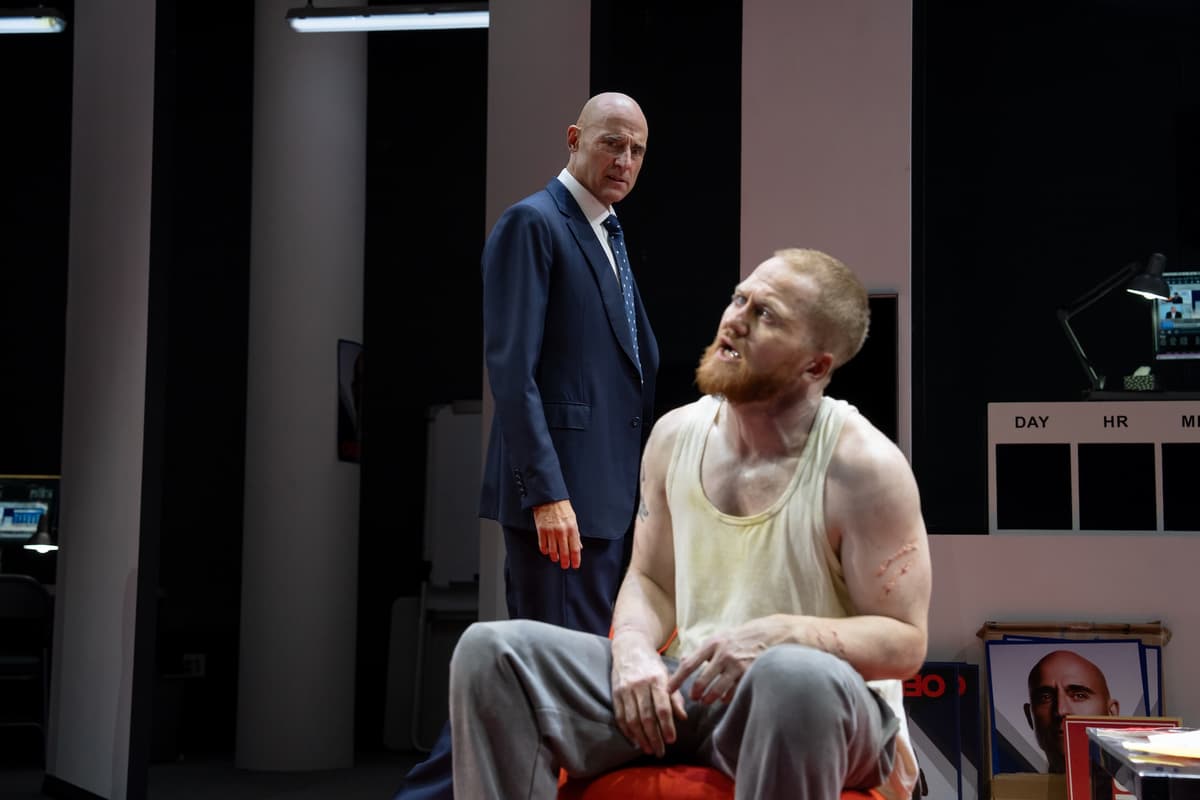
Mark Strong and Samuel Brewer in 'Oedipus.' Julieta Cervantes

There’s often cause to be skeptical when a production, riding a wave of critical praise, arrives at New York via London, as overheated revivals helmed by British directors like Jamie Lloyd and Rebecca Frecknall have shown in recent years. This season, happily, is proving to be a good one for new political drama from abroad.

Just weeks ago, Lincoln Center Theater welcomed the U.K.-based “Kyoto,” a crackling two-act piece that found thrills and chills in the unlikely subject of an international climate conference held in 1997. Now, Broadway is hosting “Oedipus,” the latest work from English playwright and director Robert Icke, which is set in the present — though as its title suggests, its roots stretch back much further.

“Oedipus,” which had its premiere at Amsterdam before enjoying a successful run on the West End, finds Mr. Icke, who previously earned acclaim adapting Aeschylus’s “Oresteia” — in addition to classics by Ibsen and Chekhov — helming another Greek tragedy. It’s the one in which a poor guy is abandoned at birth to avert a terrible prophecy but ends up fulfilling it anyway, unwittingly killing his biological father, a king, and then marrying his mother, thus landing the father’s title.

In Mr. Icke’s play, Sophocles’s tragic hero is reborn as a charismatic politician — played by a superb Mark Strong, one of several actors reprising their performances in the London staging — who first appears before us on an enormous video screen, making his final pitch to reporters and voters before an election. The office is later described as the most important in the country, but while the British accents suggest prime minister, no nation is specified.

Oedipus refers to speculation concerning his wife, Jocasta — the characters share names with their counterparts in Sophocles’s play and Greek mythology — who happens to be the widow of Laius, a previous occupant of that office. There’s also a promise to reveal a birth certificate: a nod, perhaps, to petty rumors that swirled around an American president not terribly long ago, but also a clue that this Oedipus will face problems even if he emerges victorious.

John Carroll Lynch in ‘Oedipus.’ Julieta Cervantes

We’re then taken inside Oedipus’s campaign headquarters, made sleek and chilly in Hildegard Bechtler’s scenic design, with a prominent digital clock marking the time this protagonist has before learning of his fate, and not just where the election is concerned. Teiresias, the blind prophet of the original play and legend, shows up in his contemporary guise, looking like a college protester but speaking like a frightened lamb in Samuel Brewer’s tender portrait; Oedipus angrily dismisses his predictions. 

Under Mr. Icke’s bracing but nuanced direction, the temperature then lowers for a bit as we get to know various members of Oedipus’s family and inner circle. Merope, his elderly adoptive mother, shows up desperate to have a private word with him; Anne Reid deftly conveys her controlled urgency. His grown children with Jocasta are on hand, represented here by Polyneices and Eteocles, who casually reveals his brother is gay; James Wilbraham and Jordan Scowen, respectively, play the clashing siblings, while a spirited Olivia Reis appears as Antigone, the only daughter included in Mr. Icke’s variation, who butts heads with her mother.

Lesley Manville, who won an Olivier Award playing Jocasta in London, delivers the most intimately devastating performance. The picture of elegance in Wojciech Dziedzic’s classy costumes, the celebrated actress traces, with aching empathy, the struggle of another woman in the public eye to maintain her composure as the world she has carefully assembled begins to crumble around her. Some of her exchanges with Mr. Strong are so tender — and sexy, frankly — you may feel like you’re intruding on them, though you’ll likely find it impossible to look away.

Those who see “Oedipus” expecting some scathing commentary on the politics of our time may, in fact, come away disappointed. Mr. Icke is less interested in preaching to a perceived choir, or stirring up controversy with views that might prove less chic, than he is in examining the human frailties and yearnings that impact the powerful as well as the weak.

“I want you to know in this moment that, through it all, you were loved,” Jocasta tells Oedipus toward the end. “Not what you did. Not the mark you left. You.” If that’s not enough to save the two from their terrible fate — played out to stunning, harrowing effect in this production — it’s a key takeaway from Mr. Icke’s insightful, compassionate, and feverishly entertaining new spin on an ancient classic.


The New York Sun

© 2025 The New York Sun Company, LLC. All rights reserved.

Use of this site constitutes acceptance of our Terms of Use and Privacy Policy. The material on this site is protected by copyright law and may not be reproduced, distributed, transmitted, cached or otherwise used.

The New York Sun

Sign in or  create a free account

or
By continuing you agree to our Privacy Policy and Terms of Use