
Singer Deborah Silver, Who Displays a Glorious Excess in Everything She Does, Goes Big With the Count Basie Orchestra

She could make an album with just a trio, but wouldn’t it be more fun to have the entire Count Basie Orchestra? On top of that, ‘Basie Rocks’ features multiple marquee-name guest stars.
Fadil Beriha; via Deborah Silver
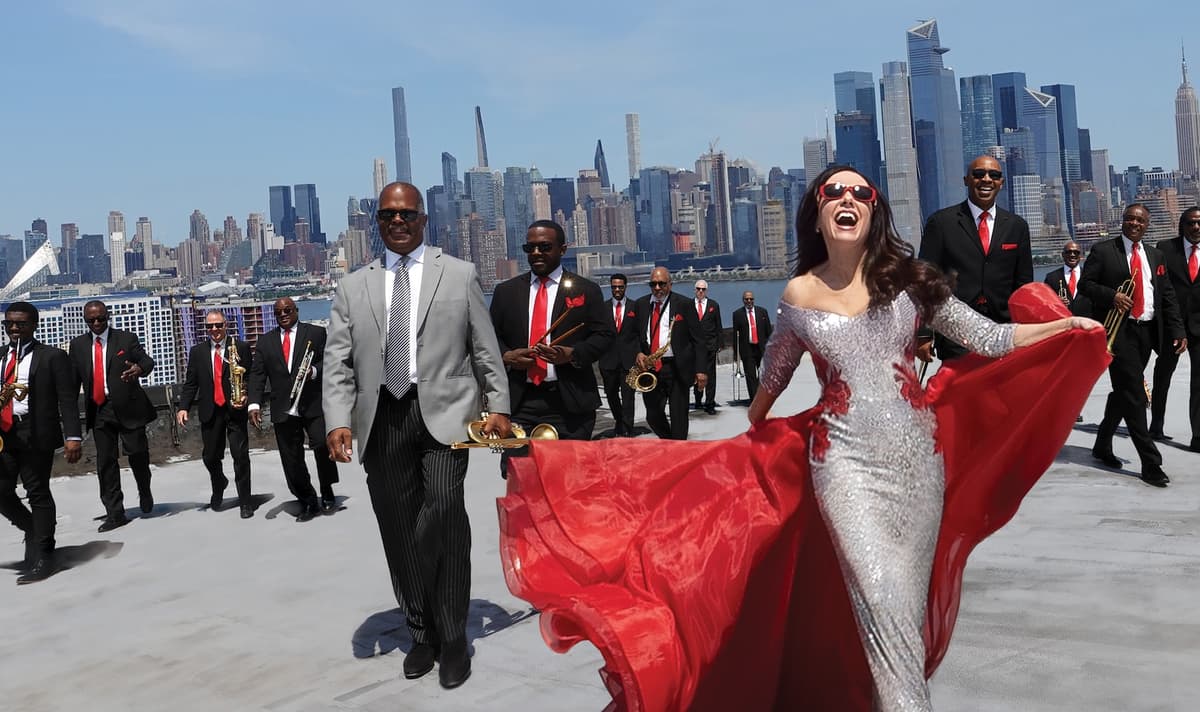
Deborah Silver with members of the Count Basie Orchestra. Fadil Beriha; via Deborah Silver

Deborah Silver With the Count Basie Orchestra
‘Basie Rocks’
Green Hill Productions

The sole Beatles song on Deborah Silver’s new album, “Basie Rocks,” is “A Hard Day’s Night.”  If I had my druthers, it would have been “Hey Jude,” because Ms. Silver’s professional motto would seem to be, “Take a sad song and make it better.”

In the world of the Great American Songbook, a lot of singers are determined to make you cry and tear your heart out; in the world of pop, rock, and soul, too many artists seem interested only in showing off their chops and technique and overwhelming you with empty vocal pyrotechnics. Ms. Silver would seem to be one of the few who wants only that you should have a good time, and everything she does is focused in that direction.

To that end, there’s a kind of glorious excess in her work. She could make an album with just a trio — she certainly doesn’t necessarily need anything more than that to sustain our interest — but wouldn’t it be more fun to have the entire Count Basie Orchestra? On top of that, how about using marquee-name guest stars? And because it’s an album of big band jazz interpretations of classic rock tunes, why not recruit them from across the pantheon of contemporary jazz and all-time pop greats? Wouldn’t that be even more fun? 

The opening track, the Rolling Stones’s “Paint It Black,” asks a musical question: What’s an Indian-influenced “raga rock” classic without a Latin beat and Arturo Sandoval? The veteran Cuban trumpeter is kind of icing on the cake, but Ms. Silver — along with producers Steve Jordan and Scotty Barnhart, the latter also the director of the Basie organization — clearly prefer an abundance of frosting on their pastries. The same is true for the arrangers, John Clayton, Andy Farber, Kris Johnson, and Mr. Barnhart again, in that nearly every track has a special guest or featured soloist.

In fact, Ms Silver and company are maximal even where they’re being minimalist: Mr. Farber’s arrangement of “Tainted Love,” the 1964 Gloria Jones hit, opens with the singer being backed by bass (Mr. Clayton) and finger snaps; it’s kind of a 21st century descendent of Peggy Lee’s iconic arrangement of “Fever.” Even then, she is quickly joined by Kurt Elling, and soon the full orchestra enters dramatically behind the two of them. 

Like most of Ms. Silver’s albums — a personal favorite is the Western swing-styled “Glitter and Grits,” with Ray Benson, from 2020 — “Basie Rocks” is rather an out-of-the-box idea. No one other than the Count himself, on two albums of Beatles tributes, has previously thought to Basie-fy pop hits of the 1960s and ’70s. 

Speaking of out of the box, it doesn’t get more so than “Bennie and the Jets”; you might think that before you can deliver an intelligent interpretation of a song, you would need to start with one where the lyric makes some kind of literal sense. Wrong: Even though she doesn’t bother trying to illuminate this rather impenetrable narrative, Ms. Silver still runs with it — and has fun with it. I can’t make head or tails of what Elton John is trying to say, but ask me if I care.  Mr. Barnhart’s arrangement empowers Bennie and her jets with a propulsive swing, and I’d rather dance to it than try and decode it.

“Bennie” has got to be a rare example of a jazz ensemble celebrating music that has nothing to do with jazz. Another is “Old Time Rock and Roll,” the 1979 Bob Seger hit, for which Ms. Silver is joined by trombonist Wycliffe Gordon. Mr. Barnhart’s arrangement begins by taking the lyric literally; the opening line is, “Just take those old records off the shelf,” and the first thing we hear is Mr. Gordon moaning expressively over what has been doctored to sound like 78RPM shellac surface noise.

Mr. Gordon, who also plays several different trumpets and cornets and sings, is one of the few living musicians with a distinct sonic identity — as with Christian McBride, his voice stands out even when he’s just speaking. Mr. Gordon also joined Ms. Silver at an album launch event at Birdland a few weekends ago. 

Another famous contemporary trombonist, Trombone Shorty, joins Ms. Silver on “Joy to the World,” which I find remarkable not least because I never thought of this as a song to be sung — kind of like “American Pie” and “We Will Rock You.” I always assumed it was just to be chanted en masse by stoners waving matches and lighters at concerts. Still, the Shorty/Silver duet is highly copasetic — a comparatively straightforward tail of an alcoholic amphibian — and ends with the signature three-note Basie tag.

Conversely, Mr. Johnson’s chart of “Fly Like an Eagle” sounds the least Basie-esqueof the 11 tracks here; I wouldn’t have guessed it was a Basie production on a blindfold test. It hardly matters, as Mr. Johnson does a superb job incorporating a lot of disparate elements: the Steve Miller classic, the Basie band, Ms. Silver, and the jazz guitar star Bill Frisell. I’m so accustomed to Mr. Frisell’s playing being a whole production unto itself that I’m amazed how all the elements fit together.

Despite no “Jude,” we get two Paul McCartney songs in the middle of the album, the aggressively bluesy “Hard Day’s Night” and the surprisingly subtle “Band on the Run,” again a song more chanted than sung. 

It’s to Ms. Silver’s credit that she isn’t afraid to put herself side by side with such scene stealers as Messrs. Elling, Gordon, and Shorty.  Despite everything that’s going on around her while she’s in the eye of a musical hurricane, no one ever pulls focus from her. It’s still Deborah Silver’s album.  

The set ends with Joe Walsh’s 1974 “Life’s Been Good,” in which Ms. Silver is still in the spotlight despite a fetching give-and-take sequence by saxophonist Doug Lawrence and yet a third trombonist, Mark Williams. Mr. Barnhart, playing with a harmon mute, has the final say as he takes us out, and now it’s his turn to be joined by Ms. Silver, who even though she’s scatting makes the words of the song’s title ring true.


The New York Sun

© 2025 The New York Sun Company, LLC. All rights reserved.

Use of this site constitutes acceptance of our Terms of Use and Privacy Policy. The material on this site is protected by copyright law and may not be reproduced, distributed, transmitted, cached or otherwise used.

The New York Sun

Sign in or  create a free account

or
By continuing you agree to our Privacy Policy and Terms of Use