
‘Sweet Smell of Success,’ a Chronicle of Shattered Innocence, Finds New Life on the Stage
A classic tale of the press has lost none of its power as an account of moral compromise.
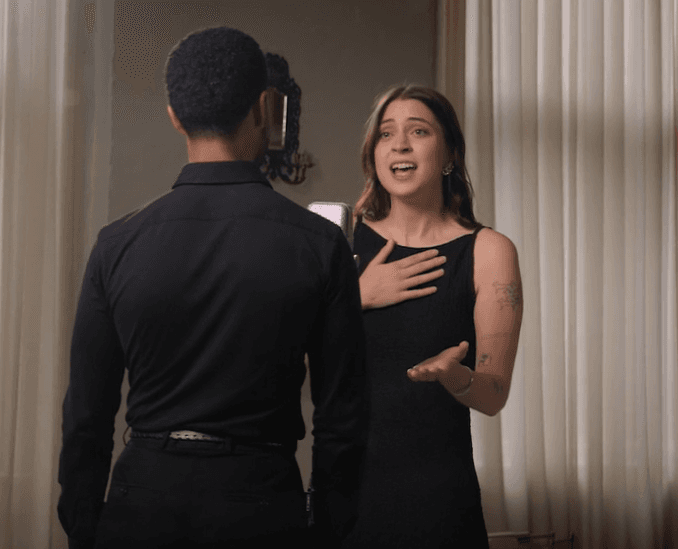
‘Sweet Smell of Success’
Presented by MasterVoices
At Rose Hall, Jazz at Lincoln Center November 21 & 22
From a distance, you might assume that “Sweet Smell of Success,” in its two major incarnations, a classic film noir from 1957 and an underappreciated Broadway musical from 2002, is a quaint but long out-of-date story about the old world of what we now call “legacy press.”
In his day, Walter Winchell. — the inspiration for “Sweet Smell”’s despotic columnist, J. J. Hunsecker, was by far the most-read individual in America if not the world. He was a king maker who not only made stars — and just as often, broke them — but also wielded what today seems like an unbelievable sway over media, politics, culture, sports, government, elections, and even religion. Generations before social media, Winchell was by far the biggest “influencer” of his time.
That world is long gone — as P. G. Wodehouse would say, “it is one with Nineveh and Tyre” — and, ironically, to the extent that Winchell is remembered at all in the 21st century it’s for his depiction in “Sweet Smell of Success.” However, in a new concert production being mounted by MasterVoices this weekend, co-creator and lyricist Craig Carnelia — who wrote the score with the late Marvin Hamlisch — and director-conductor Ted Sperling are aiming to illustrate how that the work is more relevant than era to the current political and cultural moment.
“When planning projects for Master Voices, there are a couple of requirements,” Mr. Sperling told the Sun in a Zoom interview. “First, I have to love the material. Second, I want to feel like it has something to tell us right now. And of course when I’m programming, it’s usually around a year in advance, so I have to predict a little bit what ‘now’ will feel like.”
By that standard, “Sweet Smell of Success” feels even more timely and topical than it did in 1957. In 2025, the kind of self-serving “spin” served up by J. J. in cahoots with the devious and desperate press agent Sidney Falco is nothing compared to the deliberate misinformation being foisted upon the public in 2025.
“Sweet Smell of Success” originated with a 1950 story by Ernest Lehman, a former press agent turned fiction writer. In a very real way, the story was payback for all the columnists, Winchell especially, who made PR men like Lehman “crawl like a bug” to get column inches in the newspapers. Lehman, who would later become an award winning screen writer (for the Hitchcock classic “North By Northwest” no less) and even producer, was helped with the screenplay by Clifford Odets, one of the all-time great American playwrights.
Working with producer and star Burt Lancaster, director Alexander Mackendrick, and, in the role of a lifetime, costar Tony Curtis, they came up with one of the most memorable Hollywood films of the studio era. I actually saw Barry Levinson’s 1982 “Diner” — in which one character models his every word and every move after “Sweet Smell” even before I saw the 1957 classic. There’s even a famous gag about the movie on “The Simpsons” (viewable here), surely a sign of widespread cultural acceptance.
Around the time of the Broadway production, Stephen Sondheim told theater historian Laurence Maslon that he didn’t think “Sweet Smell” would make a good musical. “It doesn’t sing to me,” he said. Still, a coterie of theater buffs have regarded this work as a cult classic for 20 years now. Craig Carnelia relates how the idea came from Marty Bell, who worked with Garth Drabinsky of the Livent production company. Mr. Bell also recommended John Guare to do a treatment for the book, and for Mr. Carnelia to do the lyrics with the acclaimed composer Marvin Hamlisch.
The team of Messrs. Hamlisch, Guare, and Carnelia didn’t only adapt the screenplay, they also went back to the source, even to the inspiration, Winchell himself, and came up with new great lines of their own — not in the film — like “The difference between men and pigs: pigs don’t turn into men when they drink.”
For better or worse, virtually everyone born after 1957 has grown up assuming that J. J. is an accurate representation of Walter Winchell. It’s true that the actual Winchell was surely a megalomaniac with an almost psychotically overprotective attitude towards his daughter, whom he named Walda — which is pretty damning right there — manifested as J. J.’s kid sister Susan in the story.
In reality, Winchell — as we know from Neal Gabler’s monumental biography — also did a lot of good. He fought antisemitism and other forms of racial prejudice, and helped America wake up to the Nazi menace even before World War II. He could be petty and vindictive, but unlike J. J., he didn’t go around ruining lives and crushing souls to salve his own monstrous ego.
Mr. Sperling adds that MasterVoices selects projects which include “an important role for the chorus because we have a volunteer chorus of 150 singers.” In the film, we never see the readers who follow J. J.’s column and cling to every little piece of dirt that he gives them. Here, the chorus is called “the whisperers,” and they represent the 60 million subscribers who unlock J. J.’s not-so-cryptic hints and magnify his suspicions and innuendo.
In re-addressing this material, Mr. Carnelia notes, “One of the things we restored is I put together a composite version of the two openings, which both have the same music. The first opening was called ‘Rumor’ and the second opening” — the one actually heard on the cast album — “was called ‘The Column.’ The second does a good job at setting up what Sidney needs and what he’s clamoring for. But the song ‘Rumor’ was much better at setting up the tone of the show.”
The show fluctuates between the epic scope of the large-scale choral numbers, including the memorable “Dirt,” and more intimate love songs. “I Can Not Hear the City,” which has been kept alive by leading cabaret singers such as Eric Comstock and Barbara Fasano — and which is one of the great romantic numbers by the composer of classics like “The Way We Were” and “What I Did For Love.”
Those songs go a long way towards counterbalancing the overall sleazy outlook of “Sweet Smell of Success,” and providing some actual sweetness. Whether as a movie or a stage musical, “Sweet Smell” so vividly depicts its world of moral compromise and shattered innocence, that, in the words of one ex of mine, “every time I see it, I feel like I have to take a shower afterwards.”