
‘The Musicians’ Offers Diverting Sounds and Antics, If Not Necessarily Resonance

Centered on a string quartet formed to play a never-performed piece with treasured Stradivarius instruments, the new French film makes its debut at the Cinema Village this Friday.
Via Outsider Pictures
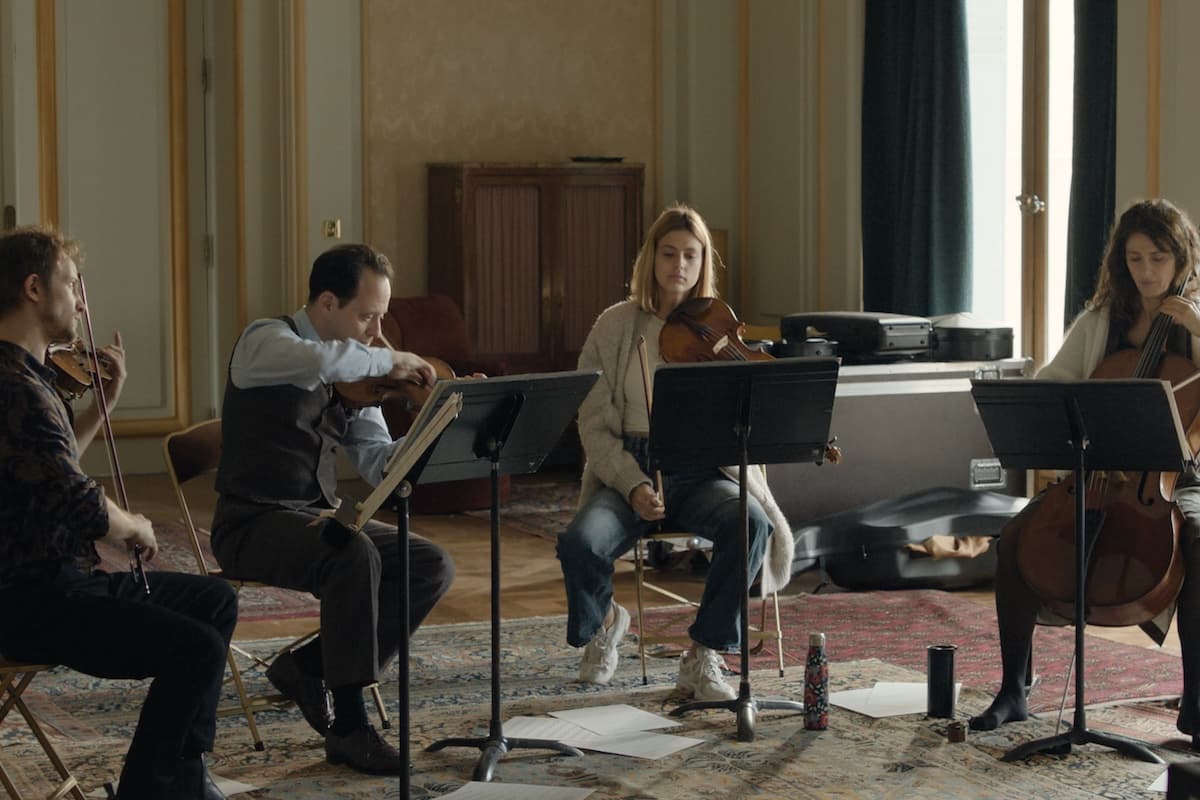
Mathieu Spinosi, Daniel Garlitsky, Emma Ravie, and Marie Vialle in ’The Musicians.’ Via Outsider Pictures

Classical music lovers and musicians cooling their heels and fingers before the upcoming season’s events may want to check out “The Musicians,” a new French film making its debut at the Cinema Village this Friday. Centered on a string quartet formed to play a never-performed piece with treasured Stradivarius instruments, the feature fuses light comedy and slight drama to create a refreshing divertimento during the so-called dog days of summer. 

First and foremost the film is an appreciation of musicians, with rehearsal scenes reflecting writer/director Grégory Magne’s admiration and respect for the process of interpretation and collaboration. At one point, a quartet is likened to hundreds of starlings flying in perfect unison, and one wonders if the filmmaker, who wrote the screenplay during lockdown, was making an allusion to how a classical music authority, Alex Ross, compared orchestras and opera houses to dinosaurs and chamber ensembles to resilient birds. 

What is certain is the actors and actresses’ confidence and ease with their respective instruments, as each is a real musician or a thespian who is also an instrumentalist. 

The story begins with the purchase of a long-lost Strad cello at auction after socialite Astrid Carlson (Valérie Donzelli) convinces the board of her family’s company, of which she is chairwoman, to foot the bill. The reason for the acquisition stems from a wish of her recently deceased father: to bring together four long-separated quartet instruments crafted from the same tree by the illustrious luthier. During his life, the cultured patriarch had acquired the cluster’s two violins and viola, and he even commissioned an original work to be performed once all of the instruments were reunited. 

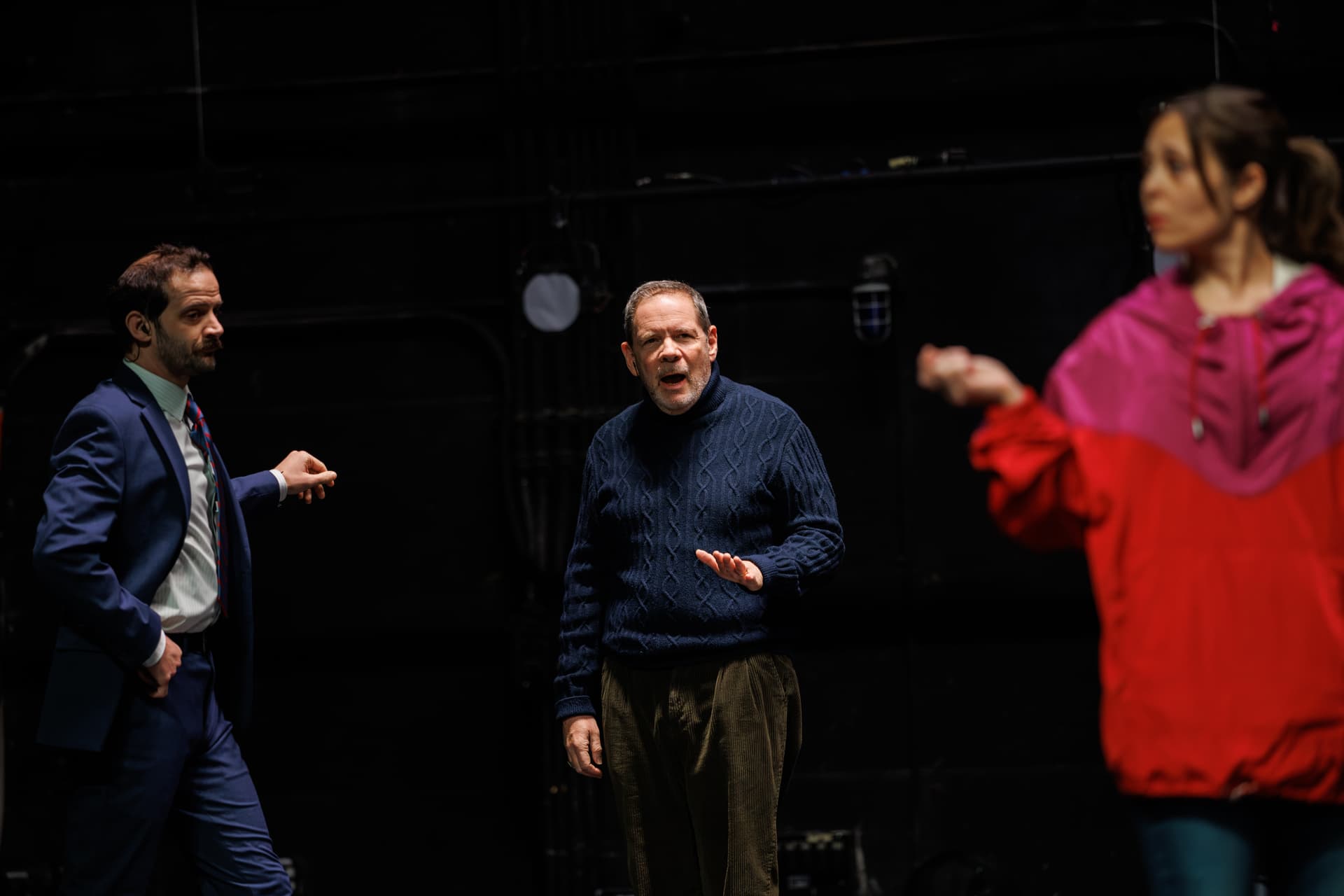
Frédéric Pierrot in ’The Musicians.’ Via Outsider Pictures

Once the cello is secured in the first few scenes, the film’s plot proceeds fairly smoothly, with only the occasional musical flub or interpersonal squabble worrying us as to whether the concert will be pulled off. The foursome consists of concertmaster George, a young, egotistic, demanding virtuoso; second violinist Peter, an accomplished player who is near totally blind; Lise, a no-nonsense, masterful cellist who used to be in a trio and a relationship with Peter; and Apolline, a girlish violist who is also a social media influencer. 

It is Apolline who stretches the film’s credibility and reveals Mr. Magne’s concessions to marketability. Her lack of formal education and inexperience provides thematic material for so many scenes that the character seems to need to justify her inclusion to the filmmaker himself, and not just to the fictional group. Instrumentalist-turned-actress Emma Ravie has an alluring air about her, but Apolline’s presence amongst distinguished, consummate professional musicians proves mystifying, despite explanations referring to her hundreds of thousands of followers and talk of her “beautiful soul” while playing.

Apart from using poetic, at times dopey, dialogue to describe music and its performance, Mr. Magne takes care to also address the complex, often-difficult dynamics involved in playing in a group. When the composer of the piece to be performed, Charlie Beaumont, is coaxed by Astrid into helping the discordant foursome, he suggests at one point that for a quartet to sound good, each member has to play a bit out of tune in order to synchronize with the others. 

Regarding the piece itself, it is by a film composer, Grégoire Hetzel. While generally appealing, it’s also derivative, with the work of Bernard Herrmann, Philip Glass, Michael Nyman, and others mixed into its strains and refrains. Like the film, the score is engaging but never striking, with no motif explored with expressive variation nor much depth.

Each actor is charming in his or her respective role, yet two actors stand out. Mathieu Spinosi nimbly understood what the script required of him and spoofs George’s pomposity without, well, overplaying it like his character’s cadenzas. As the slightly eccentric Charlie, Frédéric Pierrot displays discomfort or arch amusement often wordlessly, allowing his expressive facial features to do most of the talking. It’s a wry take on the modern composer, though a bit of backstory and a few notes from his private life would have enhanced the character, who almost becomes the lead in the ensemble movie.

Some of the best moments in “The Musicians” naturally occur when music is “in the air,” such as during most of the rehearsals as the four work out a rhythm and interpretive direction. A late scene involving an impromptu performance of “Where Did You Sleep Last Night?” (a.k.a., “In the Pines”), the blues staple popularized by Lead Belly and later Nirvana, is also a delight. 

As expected, the big performance at film’s end goes off without a hitch, though a ninth-hour comic mishap nearly cancels the event. The composition we hear doesn’t reach the heights of Haydn’s, Mozart’s, or Beethoven’s chamber music, yet in its lovely tonal movement our quartet gratefully attains an exquisite harmony, leaving us smiling as they do.


The New York Sun

© 2025 The New York Sun Company, LLC. All rights reserved.

Use of this site constitutes acceptance of our Terms of Use and Privacy Policy. The material on this site is protected by copyright law and may not be reproduced, distributed, transmitted, cached or otherwise used.

The New York Sun

Sign in or  create a free account

or
By continuing you agree to our Privacy Policy and Terms of Use