
The Premise of ‘Kyoto’ May Not Seem Enticing, but the Play Makes Policymaking Thrillingly Theatrical
Joe Murphy and Joe Robertson have provided a commanding, crackling script, and directors Stephen Daldry and Justin Martin oversee a superb cast and sustain a pulsing pace that will likely leave you riveted throughout its two acts.
Not since Alexander Hamilton squared off against Thomas Jefferson in a rap battle in a certain blockbuster Broadway musical has policymaking been as thrillingly theatrical as it is in “Kyoto,” a new play tracing the negotiations that led to a historic agreement concerning climate change.
That agreement was the Kyoto Protocol, a treaty established in 1997 after representatives from more than 150 countries met at that Japanese city — following other meetings at Geneva, Berlin, Rio de Janeiro, and elsewhere, stretching back to 1990 — to hammer out a package of measures to reduce the global emission of greenhouse gases.
Exotic locations aside, that might not suggest a terribly sexy process. But playwrights Joe Murphy and Joe Robertson have provided a commanding, crackling script, and directors Stephen Daldry and Justin Martin — who previously staged the play at London, to wide acclaim — oversee a superb cast and sustain a pulsing pace that will likely leave you riveted throughout its two acts.
As it was in the U.K., the ensemble is led by American actor Stephen Kunken in the role of Don Pearlman, a lawyer and oil industry lobbyist who, after holding positions in the departments of energy and the interior during the Reagan administration, created a non-governmental organization called, ironically, the Climate Council.
As the play details it, Pearlman then set about using his legal and political experience and his sheer wiles to ensure that no accord would be reached — at least, none requiring the American government, and by extension its corporate bed partners, to make any concessions to the developing countries that stood to gain the most from such an agreement, and suffer the most if none was reached.

Mr. Kunken’s Don, who also narrates the play, blazes across and around the stage like Gordon Gekko on speed, dazzling and seducing us even as he makes us cringe. Paul Englishby’s original music, soft and poignant at times, becomes busier and jazzier when Don is playing with words and sentences to avoid written commitments — “I love a question mark,” he says at one point — or waxing forth about “the idea of America,” as he puts it. “Sometimes,” he tells us, “freedom means war.”
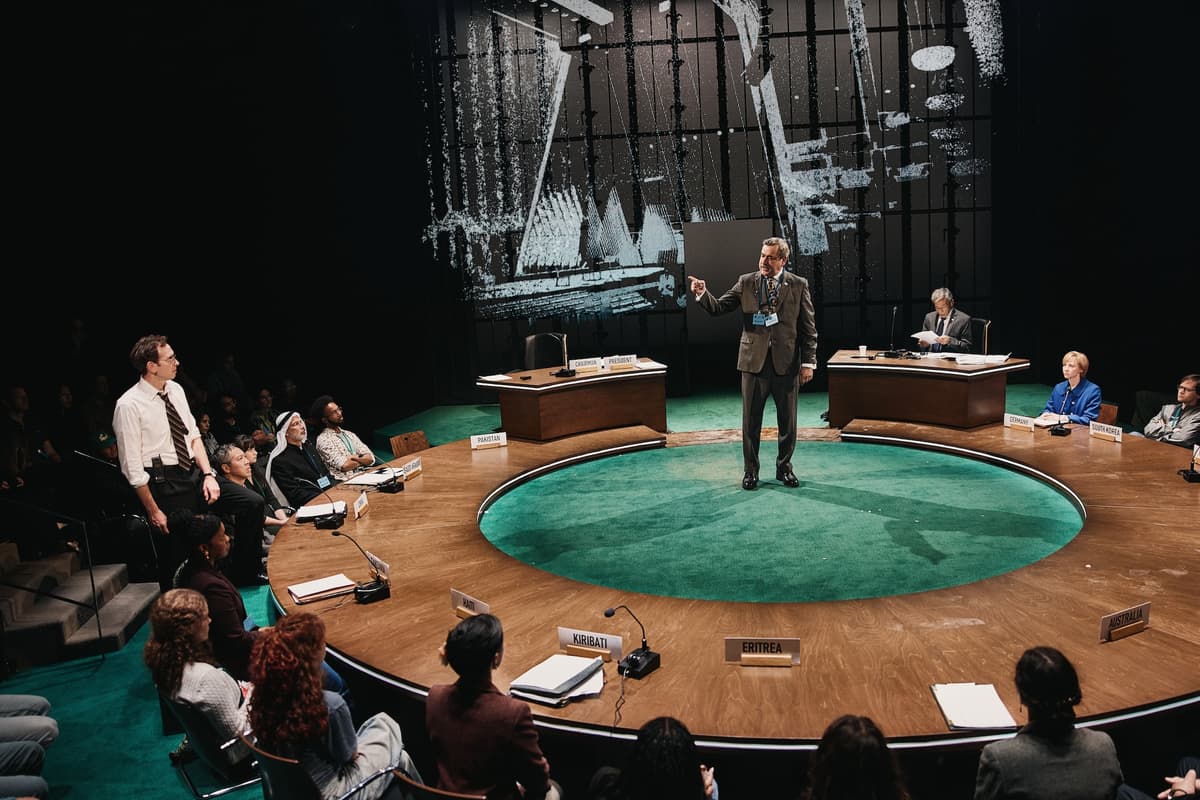
Messrs. Daldry and Martin, currently represented on Broadway by the visually and sonically overwhelming “Stranger Things: The First Shadow” — Mr. Daldry’s many stage and screen credits also include “The Crown,” the popular Netflix series — opt for a less garish but similarly aggressive approach, incorporating vivid video design by Akhila Krishnan and using immersive techniques to ensure audience members feel like participants. Upon entering the theater, everyone is given a delegate’s tag representing one of the nations involved.
Miriam Buether’s sleek, striking set features an enormous roundtable, like one you might find in a United Nations meeting room, where a few seats are left open so that some ticket holders can join the performers as their characters spar and parry, increasingly frantic and sleep-deprived. Dariush Kashani wittily plays Mohammed Al Sabban, the Saudi Arabian representing the Organization of Petroleum Exporting Companies, with a wiliness that rivals Don’s.
Feodor Chin is sterner and more forbidding as Professor Shukong Zhong, who attends on behalf of China, shrewdly forming alliances with developing countries. Roslyn Ruff and Taiana Tully lend elegance and grit as representatives of Tanzania and the island state of Kiribati, and Erin Darke cuts a similarly imposing figure as Angela Merkel, Germany’s environment minister at the time, who muses of Don, “I’ve dealt with men like him my whole life.”
The American contingent is, it must be said, especially entertaining: Kate Burton delivers her usual razor-sharp comic timing as the harried head of the national delegation; a hilarious Peter Bradbury brings even more manic energy to the part of a dissenting scientist eager to aid Don in thwarting progress. Don is tracked more ominously by a group of figures clad in black, representing the “Seven Sisters” — a nickname for a cartel of leading oil companies in the 20th century — who encourage his baser instincts.
Jorge Bosch, a marvelous Spanish actor, appears as Raúl Estrada-Oyuela, the Argentinian attorney and diplomat who chaired the Kyoto meetings, presented here as Don’s ethical foil and the play’s moral anchor. Engaging Ron in a game in one scene, Raúl peppers his fellow lawyer with seemingly rhetorical questions, ending with, “If the science becomes clear and we do need to act, do you agree that we should, for the sake of your children and mine? And would you work with me to make sure that we do?”
“Kyoto” only flirts with sentimentality again in its epilogue, when Ron’s wife, Shirley — a sympathetic figure throughout, gracefully played by Natalie Gold — steps forward to document what transpired in his life and in the world after the treaty was signed. “In 2001, he helped prevent the United States from ratifying the Kyoto Protocol,” she informs us, adding, “To love someone you disagree with is to hold two contradictory things in your head at once. Raúl would call that compromise. I call it marriage.”
Shirley concludes on a positive note, reminding us, “For a moment, the whole world, we did agree.” It’s difficult not to share her nostalgia, but happily, “Kyoto” offers more than wistful memories; it’s a spectacular ride — a lot more fun, surely, than it was for the real-life players.