
The Toyota 4Runner Trailhunter Was Built To Get Far Away From It All
Toyota’s popular SUV returns with its most rugged version yet.
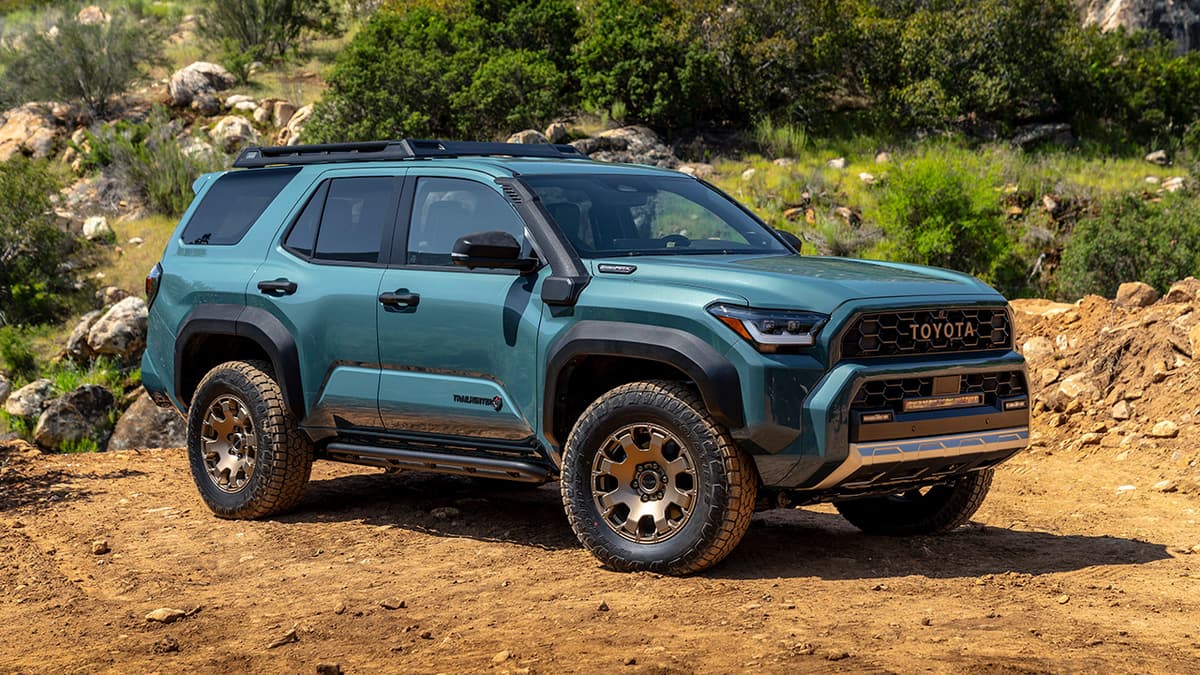
Toyota sells a lot of 4Runner SUVs to customers who will never take them off the pavement, but now it has one designed to go as far away from civilization as one dares.
The 2025 4Runner Trailhunter is a new top-of-the-line trim for the model, which has been fully redesigned for the first time in 15 years.
The extremely rugged SUV has been outfitted for an increasingly popular type of off-roading known as overlanding, which involves long slogs into the wilderness across rough terrain.
The 4Runner is offered in a broad range of more mainstream trims, starting at $42,765 for a two-wheel-drive truck, but the Trailhunter is priced at $68,895. It comes with a hybrid powertrain based around a 2.4-liter turbocharged four-cylinder engine that’s rated at 326 horsepower and 465 pound-feet of torque, which rivals some V8s. Propulsion is provided through an eight-speed automatic transmission and four-wheel drivetrain.
As far as efficiency is concerned, the hybrid 4Runner Trailhunter is far from a Toyota Prius, but its 23 mpg combined rating is a huge improvement over the last-generation 4Runner’s 270-horsepower V6, which delivered just 17 mpg. The hybrid is also featured in other high-end 4Runners, while the lower trims have a four-cylinder without electric assist rated at 278 horsepower, 317 pound-feet and 21 mpg in four-wheel drive models

The 4Runner is a true truck that shares its body-on-frame platform with the new Land Cruiser that launched last year and sits above it in Toyota’s lineup, although they are roughly the same size. Instead of the fancier Land Cruiser’s retro styling, the 4Runner has a more modern, chiseled look with a long hood and flared fenders that wrap around the Trailhunter’s chunky 33-inch all-terrain tires. A built-in air compressor installed in the large 42.6-cubic-foot cargo area comes with a coiled hose that is long enough to reach all of the tires, if you have to pump up any in the middle of nowhere.
The underbody of the vehicle is protected by steel skid plates and tube-style steel rock rails below the doors, for when the 4Runner Trailhunter’s impressive 10.1 inches of ground clearance aren’t adequate for your off-road adventure. On top, there is a metal roof rack that can carry up to 165 pounds when the vehicle is in motion and support 770 pounds when it is parked, so a tent can be installed. A set of special shocks is engineered to withstand heavy burdens and long days on the trail without failing.
The 4Runner Trailhunter’s most eye-catching feature is a snorkel-style air intake that runs alongside the passenger-side front roof pillar and designed to prevent dust and water from getting into the engine. Its position by the window means you can actually hear the turbo and engine loudly sucking in air, which is entertaining … until it isn’t. It gets old in stop-and-go traffic.
The interior has the same layout as the rest of the 4Runner lineup, which includes a digital instrument cluster, a large tablet-style touchscreen sticking out of the dashboard for the infotainment system and many buttons and knobs for the climate and other controls.
The seats are upholstered in an easy-to-clean synthetic leather and the front buckets are heated and ventilated. The rear ones are accessed through a tight door and don’t offer much legroom for a midsize SUV. They can be flipped forward or folded down to expand the trunk, but that does not create a perfectly flat load floor. The Trailhunter is not available with a third row of seats because the hybrid battery is mounted to the cargo area floor, but seven-passenger seating is optional for several non-hybrid models.

A full package of electronic driver aids for the street is standard and includes automatic emergency braking, blind-spot monitoring and lane-centering adaptive cruise control. A 360-degree camera system helps with parking and can be left on at low speeds to negotiate tight trails.
The 4Runner Trailhunter is surprisingly pleasant to drive on the highway for a vehicle that is as unabashedly truck-like as it is. It has an independent front suspension, but also a solid rear axle that is best suited for serious off-road terrain and helps it achieve a 6,000-pound towing capacity.
Customers who buy the 4Runner Trailhunter for more than cosplay at the middle-school drop-off line will find it to be as capable as it looks in the woods. I didn’t attempt any cross-country drives, but did take it to a rocky playground with sections tougher than most SUVs can handle, and it handled them well.
The hybrid system’s electric motor provides lots of grunt for crawling up slopes, which can be multiplied by switching to the four-wheel-drive system’s transfer case into its low range. A Multi-Terrain Select feature further fine-tunes the traction management with settings for Snow, Mud, Sand and Dirt, and the front swaybar can be disconnected with the press of a button to add wheel articulation for very uneven surfaces. That reduces stability at high speeds, however, so you need to remember to reconnect it before you head back to the real world.