
‘There Was a Puddle of Blood’: NYPD Detective Describes Slain CEO’s Murder Scene, as Luigi Mangione’s Defense Tries To Suppress Crucial Evidence
The unusually drawn out hearings over the evidence seized at a Pennsylvania McDonald’s have stretched over two weeks.
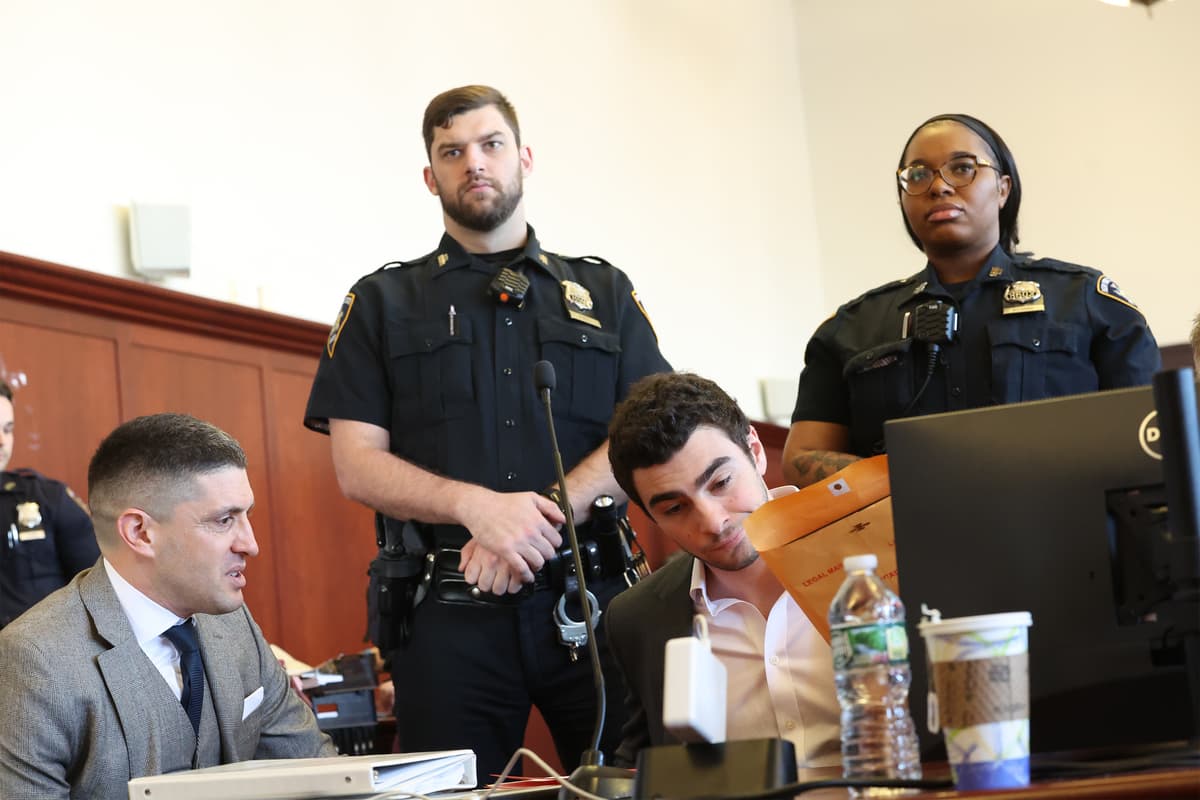
On the eight day of pretrial suppression hearings in the case against Luigi Mangione, accused of gunning down the CEO of UnitedHealthcare, Brian Thompson, on a midtown Manhattan street, a detective from the New York police department testified. Detective David Leonardi said that surveillance cameras showed the suspect walking past the victim in a hotel lobby the night before the fatal shooting.
“Pre-incident,” Det. Leonardi said, “we have the person of interest in the same lobby as Brian Thompson actually walking by him in the lobby.”
Thompson, 50, a father of two, who lived in the Minneapolis area, had come to New York last December to attend an annual investor conference at the Hilton Hotel. In the early morning hours of December 4, he was walking towards a side entrance, when a man came up behind him and shot him first in the leg, then in the back. Thompson died about half an hour later at the hospital.
Five days after the shooting, Mr. Mangione was arrested at a Macdonald’s in the heart of Altoona, a small Pennsylvania town, about 230 miles west of New York city. He is charged with Thompson’s murder both in New York state and in federal court, where prosecutors are seeking the death penalty.

Defense attorneys for Mr. Mangione, who has pleaded not guilty to all charges, have argued that evidence seized during the arrest should be precluded from the upcoming trial because their client’s backpack was searched without a warrant and he was questioned by Altoona police officers for about twenty minutes without having been read his Miranda rights.
On Tuesday, prosecutors for the Manhattan District Attorney’s office, who brought the charges, called Det. Leonardi, the commanding officer for the detective squad that investigated the shooting, to detail how the Altoona police cooperated with the NYPD and handed over the evidence they recovered during the arrest.
Prosecutor Joel Seidemann also asked what Det. Leonardi encountered when he first arrived at the crime scene.
“There was a puddle of blood that had accumulated next to the wall,” the detective recalled. He said he also saw a “pile” of brass casings on the sidewalk, and that there were “markings on the brass.” He said three words had been etched into the shell casings, “deny, depose, and I can’t remember the third one.” He added that these words are used by “insurance companies” to “get rid of cases so they don’t have to pay out.”

According to various media reports, the words “delay, deny and defend” were written on the shell casings. The pejorative terms refer to health insurers delaying payment on claims, and then defending their actions in court. The phrase is also the title of a 2010 book by Jay Feinman that is harshly critical of the insurance industry.
Surveillance camera footage, the detective testified, captured the suspect walking past Thompson inside a hotel lobby – the name of the hotel was not given, but Thompson was staying at a luxury hotel across the street from the more pedestrian Hilton, according to media reports.
After the shooting, street cameras recorded the suspect leaving “the scene on a bike” and traveling “to 86th and Amsterdam, where he gets into a cab.” A camera inside the taxi took a picture of the suspect wearing a mask – but revealing his distinctive eyes and bushy eyebrows – which the NYPD gave to the media, as they searched for the suspect’s whereabouts.
Prior to the shooting, the detective testified, “We found the name Mark Rosario, when we followed him (the suspect) back to the hostel… and we got the records from the hostel.”

Without providing too much details (which will most probably be revealed during the upcoming trial), the detective said that his team was able to trace the suspect’s path to a youth hostel uptown in Manhattan’s Bloomingdale neighborhood, where he stayed before the shooting and had checked in using the name Mark Rosario. He added that investigators also “believed that name was used to purchase a bus ticket to come to New York.”
“We ran it and it came with no hit,” Det. Leonardi testified, meaning the name appeared to be fake. The detective said that the NYPD did not release the name Mark Rosario to the public.
Five days later, the detective said, he was at the Manhattan District Attorney’s office, discussing this case, when Altoona police officers were called to a McDonald’s because a customer told a manager at the fast food restaurant that a man eating his breakfast resembled the suspected shooter from New York. The officers asked the man for ID and he provided a driver’s license from New Jersey with the name Mark Rosario. The officers ran the license number and it turned out to be fake.
“Mark Rosario,” Det. Leonardi said on Tuesday, recalling how he spoke to Altoona police officer Lieutenant Hanelly, who testified last week. “It’s possible that he has my person of interest.” He testified that he told Lt. Hanelly, “I would like no one to speak to him and all the property held.”

“We drove down to Altoona, PA,” the detective recalled, admitting that he had never heard of the town Altoona before that day. “I went with multiple people,” he told defense attorney Marc Agnifilo during cross-examination.
The detective testified that he asked the Altoona police officers to turn all the evidence over to him, and that they were very cooperative and agreed to do so. The local district attorney’s office signed a warrant to transfer the evidence over to the NYPD, and after opening each evidence envelope, inspecting it, sealing and signing it, the detective personally drove all the evidence back to New York City, where it was handed over to the crime laboratory for testing.
The detective also said that he wanted to speak to “his person of interest,” and that he asked for a room to be set up for him to do so.
“Without knowing what the rules were in Pennsylvania, you set up a [room] where Mangione is being interrogated on video?” Mr. Agnifilo asked the detective, who replied that he “was being guided by the legal counsel that I had with me,” most probably someone from the district attorney’s office.

“Are you aware that he (Mr. Mangione) said certain things to himself… while he thought he was in a room by himself?” Mr. Agnifilo asked, indicating that Mr. Mangione had been brought into a room, and had been left there alone, and was not told that he was being videotaped.
Unlike New York, Pennsylvania is a two-party consent state, meaning that to legally record a private conversation, one must get permission from every person involved. And Mr. Mangione, it appears, did not consent to being recorded on video. (New York is a one-party consent state, meaning the police can interrogate someone and record it on video without getting consent.)
When Mr. Agnifilo began asking the detective if he was aware of Pennsylvania’s two-party consent laws, prosecutors began to object. The presiding judge, Gregory Carro, called the attorney to the bench and shortly after, prosecutors agreed to withdraw any statements Mr. Mangione may have made inside the interrogation room.
“I understand that the DA is withdrawing these statements, so no further questions,” Mr. Agnifilo said.
The judge signaled that the hearings, which began on December 1, may be wrapping up this week. “Hopefully we wind up on Thursday,” Judge Carro said on Tuesday afternoon.
The hearings will resume on Thursday at 11:30am.