
Thrilling Adaptation of Michael Chabon’s ‘Kavalier and Clay’ Brings Pulitzer-Winning Novel to the Opera Stage
Like the original novel, the opera, opening Sunday, pays homage to the postwar fascination with superheroes that transcend the shortcomings of fate and circumstance.
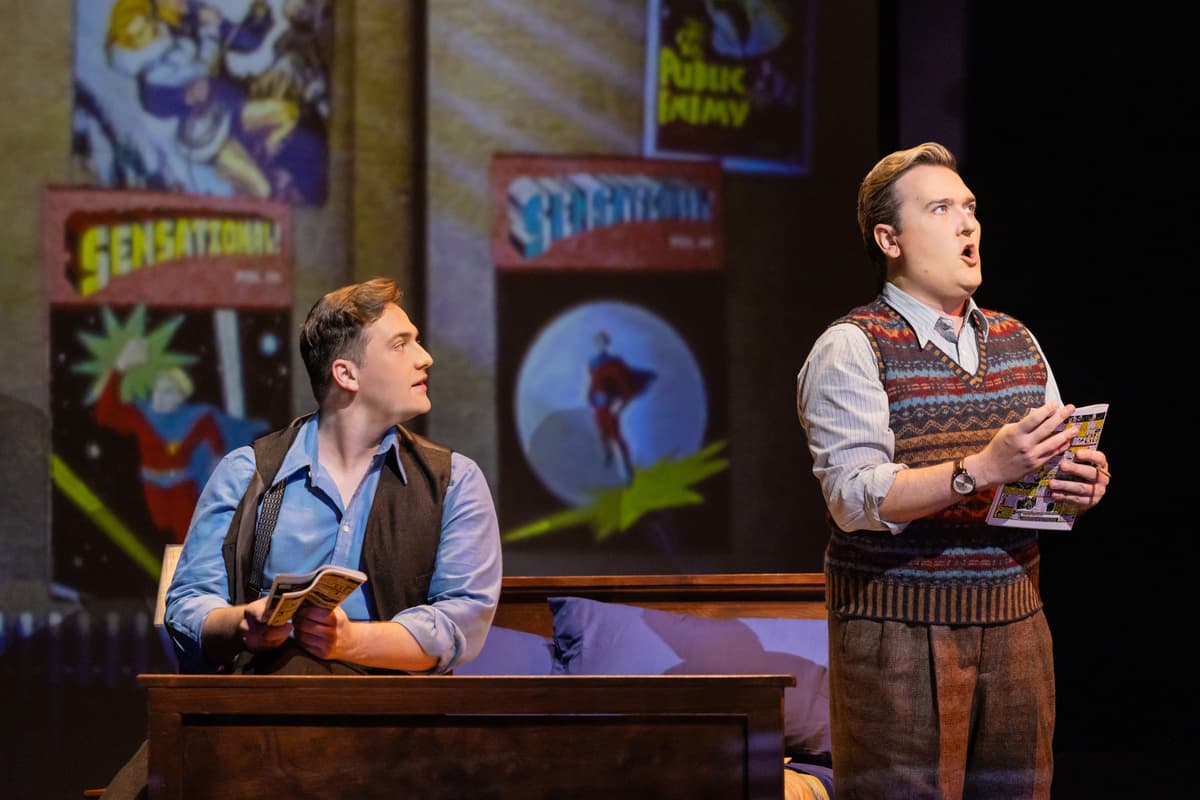

“The Amazing Adventures of Kavalier and Clay,” an opera adapted from Micahel Chabon’s Pulitzer-winning novel of the same title, promises to be one of the most innovative and spectacular premieres in recent memory. The opera, composed by Mason Bates together with librettist Gene Scheer, under the direction of Bartlett Sher and the baton of Yannick Nézet-Séguin, will take to the stage of the Met for the first time on Sunday night.
“Kavalier and Clay” follows the lives of two Jewish cousins as they launch a new comic book at postwar New York City. Joe Kavalier, an artist and stage magician, escapes Nazi-occupied Prague smuggled inside a coffin that allegedly housed its famous Golem. His cousin Sammy Clay, a polio survivor, is confined to a Flatbush apartment under his overbearing mother, obsessed with Superman while dreaming of writing pulp fiction. Upon landing, the mysterious Joe hooks up with his hapless cousin Sam, and together they launch a new comic, “The Escapist.” A new superhero is born out of Jewish diaspora and trauma.
Mr. Bates, known for his previous opera “The (R)evolution of Steve Jobs),” blends three main musical styles for Mr. Chabon’s World War II-era opus. There is the frenetic bustling of 1940s Big Band Jazz to represent New York. Haunting Jewish Folk motifs, including the Ani’Man’im chorus, represent the themes of Jewish displacement, flight, and the Shoa. Sections addressing the nascent superhero, the Escapist, are underscored with abstract, electronically driven motifs.

Running at two-and-a-half hours, the opera treats the original novel’s six-part story arc, with Mr. Scheer’s libretto condensing the book’s expansive maze into two acts. The novel’s many digressive subplots, however, still appear in the form of dreamlike vignettes. Baritone Andrzej Filończyk sings the haunted and stoically heroic Kavalier, while Miles Mykannen adds his bright tenor as the engaging Sammy. Sun-Ly Pierce sings Rosa Saks, Kavalier’s American love interest, while baritone Edward Nelson portrays the radio actor Tracy Bacon, Sammy’s secret love interest.
Under the auspices of Mr. Bate’s soaring and elegiac score, the production does a marvelous job weaving together the myriad strands and themes of the original novel. There is the horror of the Holocaust and the reality of escaping Europe as a Jew under Nazi occupation. There is the incredible thrill of landing in New York at a time of unparalleled optimism, chaos, and madcap energy. There is also the transmutation of the refugee and immigrant experience into a new venture: imagining oneself as a mythical new being in a new art form, the comic book. Like the original novel, the opera explores and pays homage to the postwar fascination with superheroes that transcend the myriad shortcomings of fate and circumstance.
Borrowing from its successful workshopping at the Indiana University Jacobs School of Music, Mr. Sher keeps the production’s innovative use of multimedia elements. Designed by London’s 59 productions, a company known for its immersive theatre productions in hits like “Matilda the Musical,” they have built a towering proscenium filled with screens that broadcast cinematic projections as well as animated and graphic elements. These work as a central driver of the opera’s narrative, providing glimpses into the inner states of characters, historical flashbacks, and flights of fantasy.
A Wagnerian Gesamkuntswerk, “Kavalier” turns the Met’s already impressive 80-foot-wide, 101-foot-deep stage into a living comic book page. In conjunction with this unprecedented attempt at immersive opera, sound designer Rick Jackobson, in his Met debut, uses new technology to sync animated and graphic cues with the live orchestra, such as the demise of a villain directly triggering flashes of light and other on-screen elements.
It has already been proven that no amount of technical stage wizardry, however, can fully engage the contemporary eye or mind. We are already jaded by decades of theme park and IMAX theatre razzle dazzle. If it weren’t for the opera’s riveting story and compelling score, the production would not stand. At its heart, “Kavalier and Clay” is an intimate family story that encompasses unfathomable tragedy and crushing loss. It follows its characters as they piece themselves and their families back together, struggling through trauma, insecurity, and rootlessness through love and creativity.
The Met could be well on the verge of premiering a triumph, one that employs elements never used on its historic stage. It promises to be a rousing production encompassing folkloric Prague, postwar jazz-era New York, and the Escapist’s techno-utopian visions. It is also, ultimately, a loving tribute to artists who devoted their imaginations in the service of new art, to those who courageously used their creativity to escape and vanquish actual fascism.