Trump Wins Major Appeals Court Victory That Could Clear the Way for Dismissal of Felony Convictions in Stormy Daniels Case

The Second Circuit wants a nonagenarian judge to take a second look at whether the Daniels case belongs in federal court.

Steven Hirsch-Pool/Getty Images
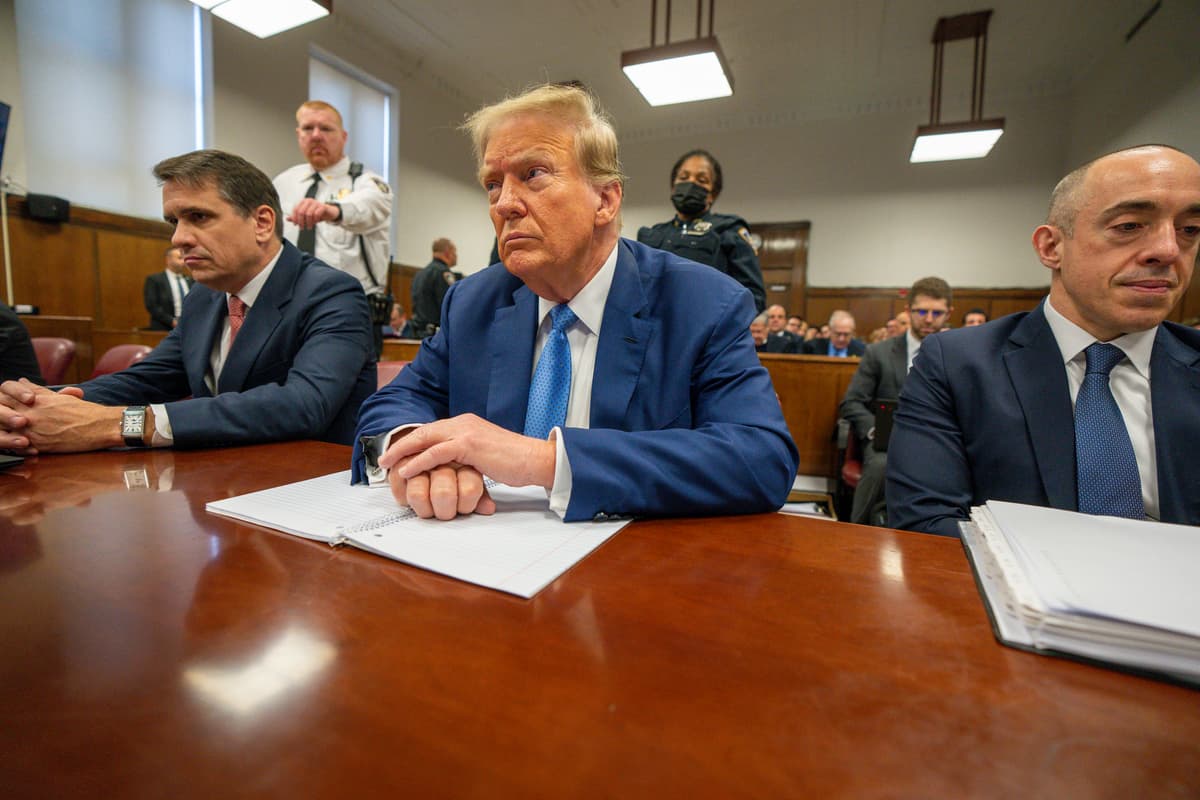
President Trump appears in court during his trial for allegedly covering up hush money payments at Manhattan Criminal Court on May 20, 2024 at New York City. Steven Hirsch-Pool/Getty Images

The unanimous ruling by a panel of the Second United States Appeals Court that gives President Trump another opportunity to argue that he is entitled to mount a presidential immunity defense in federal court is a breakthrough in his efforts to overturn his 34 hush money felony convictions in the so-called “Stormy Daniels” case.

The three-judge appellate panel — all Democratic appointees —  ordered a federal trial court judge, Alvin Hellerstein, to look again at whether he “adequately considered issues relevant to the good cause inquiry so as to enable meaningful appellate review.” Judge Hellerstein, 91, has twice rejected Mr. Trump’s efforts to move to a federal forum the case brought by Manhattan District Attorney Alvin Bragg, also a Democrat, who won reelection on Tuesday. 

The Second Circuit writes that “We leave it to the able and experienced District Judge to decide whether to solicit further briefing from the parties or hold a hearing to help it resolve these issues. We express no view and ‘neither rule nor imply’ that the District Court should resolve Trump’s motion …  in any particular way.” The ruling amounts to a victory for the president.

Judge Hellerstein, who was appointed to the bench by President Clinton, first ruled that Mr. Trump’s case did not belong in federal court because he reckoned that the payments to the adult film actress Stormy Daniels were “private unofficial acts” not connected to federal duties. Some of the payments, though, which were cycled through the attorney Michael Cohen, were allegedly made in the Oval Office.

Mr. Trump tried again to move his case to what he called an “unbiased federal forum” after the Supreme Court’s ruling in Trump v. United States that official presidential acts are presumptively immune from prosecution, while unofficial ones lack that protection. Judge Hellerstein once again denied that request, reasoning that “Private schemes with private actors, unconnected to any statutory or constitutional authority or function of the executive, are considered unofficial acts.”

The Second Circuit panel, though, found that Judge Hellerstein’s analysis was incomplete because he did not consider “whether certain evidence admitted during the state court trial relates to immunized official acts or, if so, whether evidentiary immunity transformed the State’s case into one that relates to acts under color of the Presidency.” One key issue could be the admissibility of evidence from a former senior aide, Hope Hicks, to Mr. Trump.

Mr. Trump is separately appealing his convictions in New York state court, where he is also invoking presidential immunity. The state trial judge, Juan Merchan, has denied that immunity is relevant to the verdict because he contends that the entire case against the 47th [president is centered on private acts. Mr. Trump’s appeal, though, urges New York’s intermediate appellate court to revisit that determination.

The president also argues that Judge Merchan, with whom he has locked horns so vociferously that a gag order was imposed by the jurist, ought to have recused himself from the case. Judge Merchan — who insisted he remain on the case — donated small sums to Democrats, including then-candidate Biden, in the 2020 election. The judge’s adult daughter Loren is employed at a Democrat-aligned consulting firm that advised some of Mr. Trump’s most devoted foes, including former Vice President Kamala Harris and Senator Adam Schiff.

Mr. Trump also contends that the case ought to be tossed because of Judge Merchan’s jury instructions. The Manhattan jurors were instructed that although falsification of business records is usually a misdemeanor in New York, if they found that Mr. Trump had his eyes on a second crime they could convict him of a felony. The jurors, Judge Merchan decided, need not agree on the nature of that second crime — only that one was contemplated.

Mr. Trump — and not only the president — argue that such an instruction is unlawful because it violates a Supreme Court case from 2020, Ramos v. Louisiana, that a unanimous jury is required for conviction in all criminal cases, federal and state. While unanimity has been required in federal cases since 1886, until Ramos states could still settle for something less. 

Federal fora are generally seen as more favorable for defendants, especially high-profile Republicans like Mr. Trump who are being tried in heavily Democratic districts. The jury pool for the federal Southern District of New York  is drawn from a more politically heterogeneous area than just Manhattan. For the same reason Mr. Trump’s erstwhile chief of staff, Mark Meadows, has endeavored to move his election interference trial, formerly belonging to the Fulton County District Attorney, Fani Willis, to federal court. 


The New York Sun

© 2025 The New York Sun Company, LLC. All rights reserved.

Use of this site constitutes acceptance of our Terms of Use and Privacy Policy. The material on this site is protected by copyright law and may not be reproduced, distributed, transmitted, cached or otherwise used.

The New York Sun

Sign in or  create a free account

or
By continuing you agree to our Privacy Policy and Terms of Use