Trump’s Tariffs Overlook the Strategic Nature of America’s Alliance With India
Why is the president imposing on India stiffer levies than on New Delhi’s regional competitors?
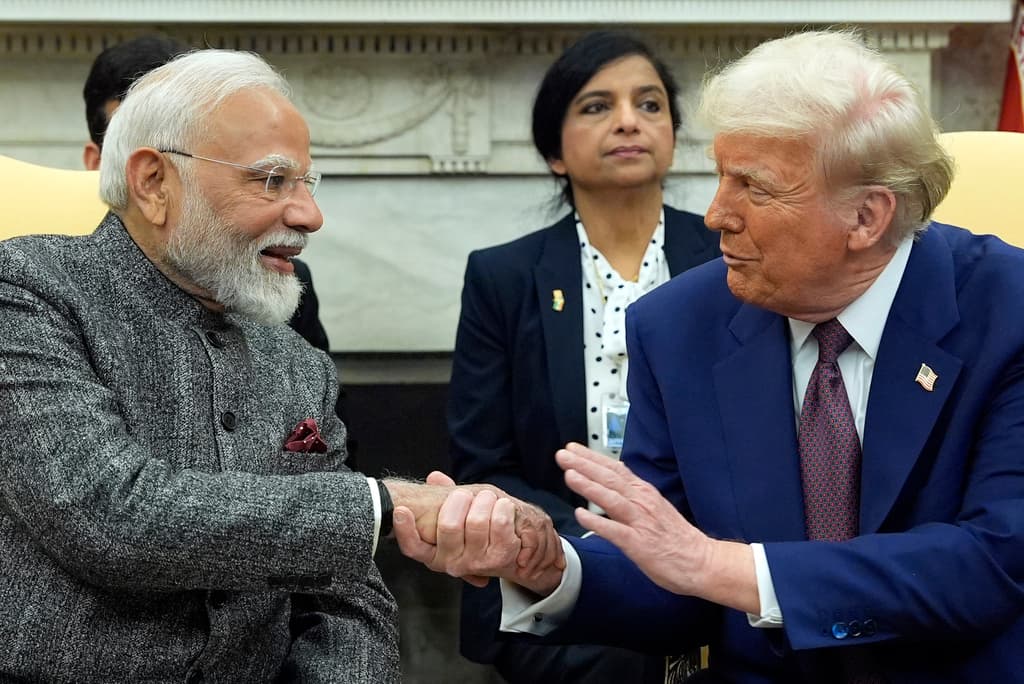
India, a strategic partner of America, feels betrayed by President Trump’s sweeping 25 percent tariff on all Indian-origin goods, effective later this week. Mr. Trump is threatening to “substantially” raise the tariff rate on Indian exports in response to New Delhi’s apparent intransigence over the purchase of Russian oil.
India’s frustration is all the more pointed because New Delhi’s regional competitors have received comparatively lower rates. Pakistan, in particular, received a tariff reduction to 19 percent from 29 percent on exports, which is lower than rates imposed on other regional economies — Bangladesh’s rate is 20 percent, and Communist Vietnam’s is 20 percent.
Furthermore, America and Pakistan have announced a deal that “marks the beginning of a new era of economic collaboration, especially in energy, mines and minerals, IT, cryptocurrency, and other sectors,” Pakistan’s finance minister said in a statement.
Speaking on Fox Radio, Mr. Trump also announced that India may face additional penalties for purchasing Russian military equipment and energy. Secretary Rubio added that India’s purchase of oil from Russia is “most certainly a point of irritation” with Washington, stressing that even though India is an ally, America cannot align with New Delhi 100 percent of the time.
Yet, it is difficult to understand the American policy of punishing India, an ally of the West against terrorism, while strengthening ties with Pakistan, which is beset by groups that the Department of State designates as terrorist.
On April 22, India experienced in Jammu and Kashmir what New Delhi’s envoy to Jerusalem, J.P. Singh, compared to its own October 7 massacre. The terrorists targeted their victims based on religion. In certain cases, the terrorists stripped victims to determine their religious identity. Victims were forced to recite the Kalma, or Shahada, the foundational declaration of faith in Islam. The armed terrorists then executed their victims at gunpoint.
The attack was claimed by the Resistance Force, which serves as a proxy for Lashkar-e-Taiba, a Pakistan-based Salafi-jihadi organization and United Nations-designated terrorist outfit. The Resistance Force and its alias, the People’s Anti-Fascist Front, are recognized as rebranded versions of Lashkar-e-Taiba, created to evade sanctions imposed on the latter organization.
A few days before the terrorist attack, Pakistan’s army chief, Field Marshal Asim Munir, outlined a religious ideological position against India, stating that “we are different from the Hindus” and that Kashmir “is our jugular vein.”
Speaking on April 15, Field Marshal Munir told overseas Pakistanis gathered at a convention that Islamic civilization is superior to the West: “Our beloved ones who are overseas, because you live in different civilizations, never forget that you belong to a superior ideology and a superior culture.”
Commenting on the terrorist attack in Kashmir, Major Gaurav Arya, a prominent Indian security affairs commentator, urged Indians to “recognize the enemy, please,” explaining that it was not the heads of Pakistani terrorist groups active in Indian Kashmir, but “the Pakistani army chief.”
Two of Pakistan’s terror groups, Lashkar-e-Taiba and Jaish-e-Mohammed, have established connections with Hamas. On February 5, these two groups jointly organized a conference titled “Kashmir Solidarity and Hamas Operation ‘Al Aqsa Flood’ Conference” at Rawalakot, in Pakistan-occupied Kashmir, coinciding with Pakistan’s so-called Kashmir Solidarity Day. The event was attended by a senior Hamas leader, Khaled Qaddoumi.
On May 7, 2025, India launched Operation Sindoor in response to the Pakistani jihadi terror attack. During the military operation, several terrorists linked to Pakistan-based groups were killed by India.
Subsequently, photos emerged showing top Pakistani military officers attending the funerals of these terrorists in military uniform. “India has cited an image showing the coffin of a terrorist draped in Pakistan’s flag as undeniable evidence of Pakistan’s involvement in global terrorism,” an Indian news organization, NDTV, reported.
On top of that, on August 3, Pakistan’s minister for commerce, Jam Kamal Khan, met with the Iranian minister of industry, mines and trade, Mohammad Atabak, at Islamabad. During this meeting, Pakistan’s minister congratulated the Iranian government on its “victory” in the 12-day war against Israel and America
So why should India face penalties while Pakistan receives rewards? The logic is for the Trump administration to reconsider its current policy, ensuring that future decisions reflect the true spirit of partnership, by upholding shared democratic values and contributing to global security — not undermining it.
American success in its trade negotiations with India calls for a more empathetic, nuanced approach — one that recognizes India not as a competitor, but as a key strategic ally for the 21st century.