Wisconsin Lawmaker Urges Trump To Pressure Canada in Trade Talks Over Runaway Wildfires Soiling America’s Summer Skies
With Canadian wildfires seemingly out of control, states from Wisconsin to Maine and as far south as Pennsylvania and Minnesota are facing air quality warnings.
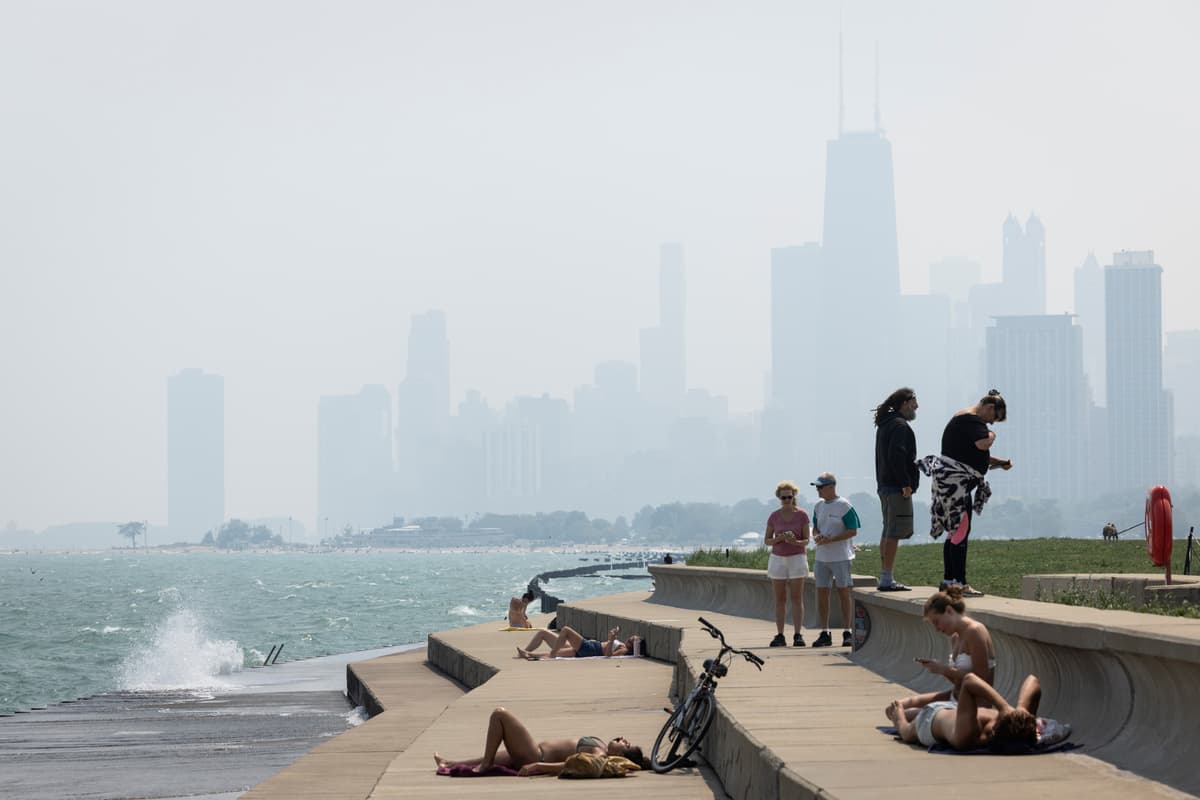

Sprawling wildfires burning up more than 25,400 square miles of Canadian forest and sending smoke southward has one Wisconsin lawmaker asking President Trump to include penalties in his trade talks with Canada for harming Americans’ health and summer enjoyment.
With wildfires seemingly out of control, states from Wisconsin to Maine and as far south as Pennsylvania and Minnesota are facing air quality warnings and recommendations to cancel sports and other leisure activities. Boston’s Logan Airport implemented ground delays this week due to smoke. More than 600 American firefighters have traveled north to help combat the blazes.
Wisconsin’s 7th District congressman, Tom Tiffany, says the impact on America means it’s time to get the federal government involved.
“We’re going to be persistent on this. I’m hoping at some point that we can even get the administration involved with this because there’s no reason for this to be happening. They have the ability to control fire if they just choose to do it,” Mr. Tiffany told a local radio host, Dan O’Donnell.
Tariff discussions are continuing this week after Mr. Trump said he would impose a 35 percent levy on products coming to America from Canada this Thursday unless a deal is reached. Mr. Tiffany said he is calling for action after receiving what he described as a “conciliatory” but ultimately do-nothing response from Canadian officials to a letter he sent in early July asking how they were managing the fires, which have been burning for months.
“I think that would be a good thing for them to put on the table. We will be urging them to do it,” Mr. Tiffany, who is a member of the House Natural Resources Committee, said.
Canada’s Interagency Forest Fire Center shows more than 743 active fires in Canada, with 15 new ones as of Tuesday. Canada has had more than 4,070 wildfires this year, with June’s burnt acreage more than 4.5 times higher than the 10-year average. At the same time, Canada has had three months in a row of below-average rainfall.
Many of the fires are believed to be caused by arson or human error, countering the narrative that climate change is responsible. However, climatologists note that changes in weather caused by climate change enable fires to burn hotter and wider before being extinguished. They also note that burning live forests eliminates the natural resources used to store carbon emissions.
According to a 2021 study conducted by McMaster University’s Remote Sensing Lab, Canada’s forests store 327 billion tons of carbon, equivalent to about 25 years of human carbon emissions globally.
An Atmospheric Monitoring Service, Copernicus, reports that Canada’s wildfires this year have emitted about 180 million metric tons of carbon, a fraction of annual American carbon emissions of 5 billion metric tons but equivalent to a large chunk of Canada’s 670 million metric tons of annual output.
Mr. Tiffany, however, says fires are more extreme because Canadian and American environmentalists are preventing forest management that would enable the forest service to clear brush or conduct controlled burns and fire breaks.
He added that the Canadian government has tools at its disposal to deal with fires, even those caused by arson, but they are not being employed because the “preservationist mentality” prevents forest management.
“When you’re not cleaning up the forest floor or managing the habitat, it’s ultimately going to get burned out,” he said.
Mr. Tiffany said that the impact is not just environmental, but economic, as “corporate environmental groups” on both sides of the border sue to prevent habitat management.
“You wonder why the cost of 2x4s and other lumber has gone up,” he said. “This is in part the reason for that.”
Mr. Trump’s call for a 35 percent tariff was described as a means to punish America’s northern neighbor for failing to prevent fentanyl from crossing the border, though the “emergency” use of tariffs by the Trump administration has been used to elicit an array of concessions from American trade partners.
Talks are ongoing with Canada, but Prime Minister Carney has resisted the claim of a porous border for drugs, responding that only 1 percent of fentanyl in America makes its way from Canada. On Tuesday, Mr. Carney announced $700 million in loan guarantees for the forestry industry as well as another $550 million to diversify markets and assist laid-off forestry workers.
In June, the president issued an executive order calling for federal agencies to use available technology, including artificial intelligence, data sharing, innovative mapping, and weather forecasting to enhance state and local wildfire identification and response capabilities. The order also directs agencies to change its rules to “drive responsible land management.”
Mr. Tiffany said he hopes economic pressure will influence Canada to do the same.
“I mean they’re a sovereign country; we can’t make them do anything but we’re hoping that they are a sensitive enough bunch that maybe public opinion will sway them to change how they’re doing it,” he said.