‘You’re a Good Person Who Did a Bad Thing’: Judge Sentences Weeping Young Woman Entrepreneur to Seven Years in Prison for Fraud
Charlie Javice is out of jail while she appeals.
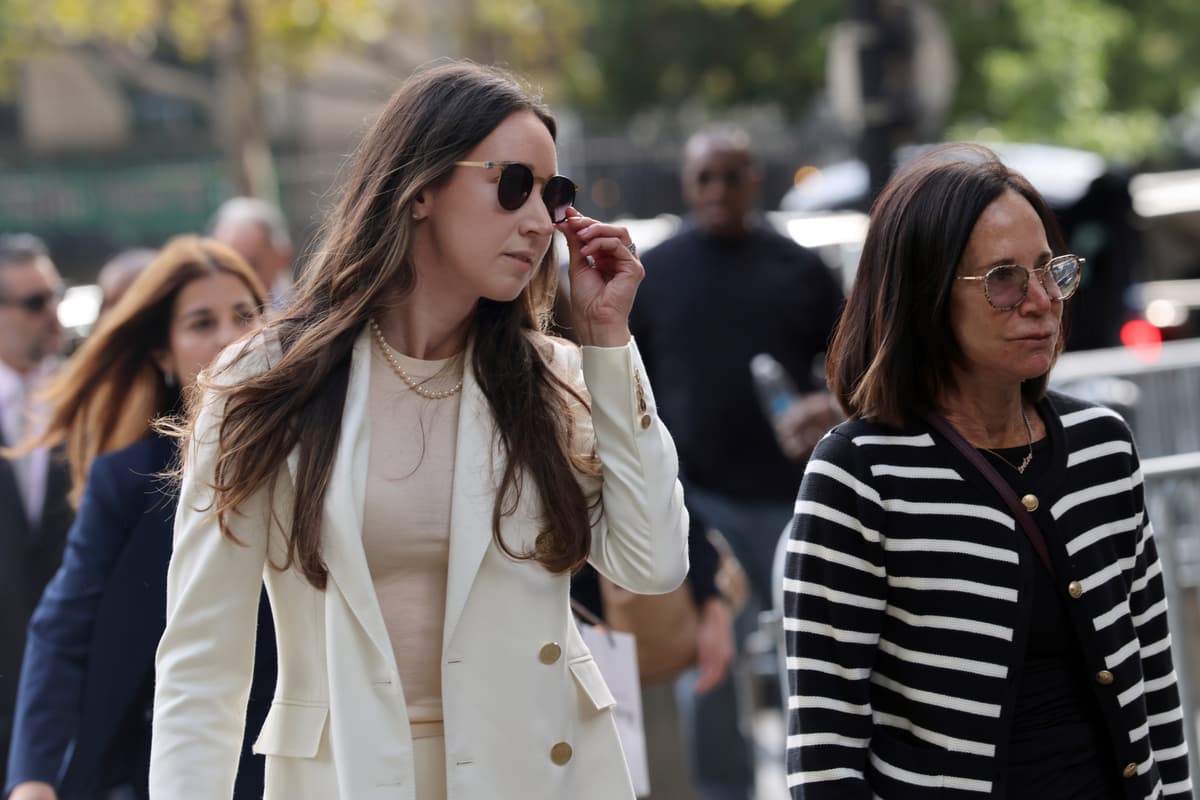
A charismatic young woman entrepreneur, Charlie Javice, who was convicted of defrauding JPMorgan Chase, was sentenced to seven years in prison on Monday. She was also ordered to share with her co-conspirator a restitution amount of close to $300 million, and to forfeit more than $22 million. But in a surprising win for the defense, the judge granted the request that Javice remain free on bail while her attorneys appeal her case.
“You’re a good person but you have done a bad thing,” a U.S. district judge, Alvin Hellerstein, who is 91 years old, told Javice, 33, at her sentencing hearing at a federal courthouse in Manhattan. He also told her that her “words” had been “very moving.”
The defendant, who wore a cream-colored silk suit with large gold buttons, had addressed the court and asked the judge to “temper justice with mercy.”
“I am deeply sorry and I ask with all my power for forgiveness,” Javice said, as she tried in vain to hold back tears. “At 28 I did something that runs against the grain of my upbringing. … Not a day passes that I don’t feel profound remorse.”

In March, a jury convicted Javice and her co-conspirator, the chief growth officer of her company, Olivier Amar, of bank fraud, wire fraud, securities fraud, and conspiracy to commit wire and bank fraud.
“The evidence was overwhelming,” a juror, who did not want to give his name, told the Sun in the hallway of the courthouse. The man had come to the sentencing hearing to find out how the judge would punish the defendant he and the other jurors had convicted. He said it took merely eight hours to reach the unanimous guilty verdict on all counts. But he also said that the case was an embarrassment for JPMorgan Chase, a supposedly sophisticated banking colossus.
In 2021, Javice sold her start-up, Frank, to JPMorgan Chase for $175 million, falsely claiming the company had more than four million users, when in reality it had only about 300,000.
The online platform, which Javice had founded four years prior, was designed to help students fill out the complicated government financial aid forms used to apply for aid for college or graduate school. The young entrepreneur was invited to cable news programs, and even made the prestigious Forbes “30 Under 30” list.

JPMorgan Chase was interested in purchasing Frank because it hoped to reach a younger clientele that would potentially sign up for checking accounts and credit cards. The bank assembled a team of 350 experts to verify the information that Javice and Amar had provided.
“Three hundred and fifty people doing due diligence?” the juror said, shaking his head. “What were those people doing? You take an address and you call that person, it’s embarrassing.”
JPMorgan Chase even hired an independent company to authenticate the four million users Javice claimed her company had. Trial testimony disclosed that, during the period when the bank was reviewing Frank’s books, the company never actually contacted the people listed on the spreadsheets; instead it counted the four million plus rows, and when the number of rows equaled Javice’s number of users, it gave the green light.
The judge noted that the bank executives had “a lot to blame themselves,” but added that he was punishing Javice’s conduct, “not JPMorgan’s stupidity.”

Prosecutors had asked that Javice be sentenced to 12 years in prison, while the defense requested that she be given a sentence “somewhere in the neighborhood of 18 months.”
In his sentencing argument, defense attorney Ronald Sullivan referred to the case of Elizabeth Holmes, the biotech entrepreneur who was convicted of fraud in connection with a fake blood-testing company she created and sentenced to 11 years and three months in prison. Mr. Sullivan said that unlike Holmes, “who did not have a real company,” and who “endangered patients,” Frank was a real online platform that helped hundreds of thousands of students apply for financial aid. Javice’s fraud, the attorney said, was “different in character, different in kind, and different in degree.”
Mr. Sullivan further argued that the bank got “exactly the type of information” it had asked for. It was given “real data,” names and email addresses of young adults, “just not as many” as it had hoped for. Among the four million-plus supposed users, the attorney reminded the judge, were also a few hundred thousand real names and addresses.

“But there was never an account of what was correct and what was not correct,” Judge Hellerstein pushed back. “There is no obligation by the customer to mitigate what he received.”
“We argued,” the defense attorney insisted, “that JPMorgan had a sophisticated team.”
“The value was in the customer list and the customer list was made up of synthetic, augmented names. The value of the asset was reduced to zero,” the judge said. “They wanted to have the names, and she made up phony names.”
An assistant U.S. attorney, Micah Fergenson, told the judge that JPMorgan didn’t purchase a “functioning business”; instead it “acquired a crime scene.” He criticized not just the “brazenness of her lies but the breadth,” meaning the length of time that Javice continued to cover up the truth. Mr. Fergenson said that she was driven by greed when she accepted a $29 million cut from the purchase, about $22 million of which was transferred to her account.
After a lengthy debate, the judge ordered that Javice return the $22 million, and calculated close to $300 million in restitution that Javice and her co-conspirator must pay back to the bank.
Regarding the prison sentence, the judge appeared to be less moved by the arguments from her attorneys than by Javice’s own statements and by the many letters the defense had submitted from friends and family, which detailed the different types of community services Javice had engaged in. Javice also spoke poignantly about her desire to become a mother.
Judge Hellerstein sentenced her to 85 months in prison, followed by three years of supervised release. But he allowed her to remain free on bail while her attorneys appeal her case. That process could take years and offers Javice the chance to get pregnant with her partner, and have a child.