America Sets Plan To Handle Crush of World Cup Visa Applications by Boosting Embassy Staffing Worldwide

Applicants from many countries will need to undergo in-person interviews and a social media screening process that can stretch for months.

Jacquelyn Martin/AP
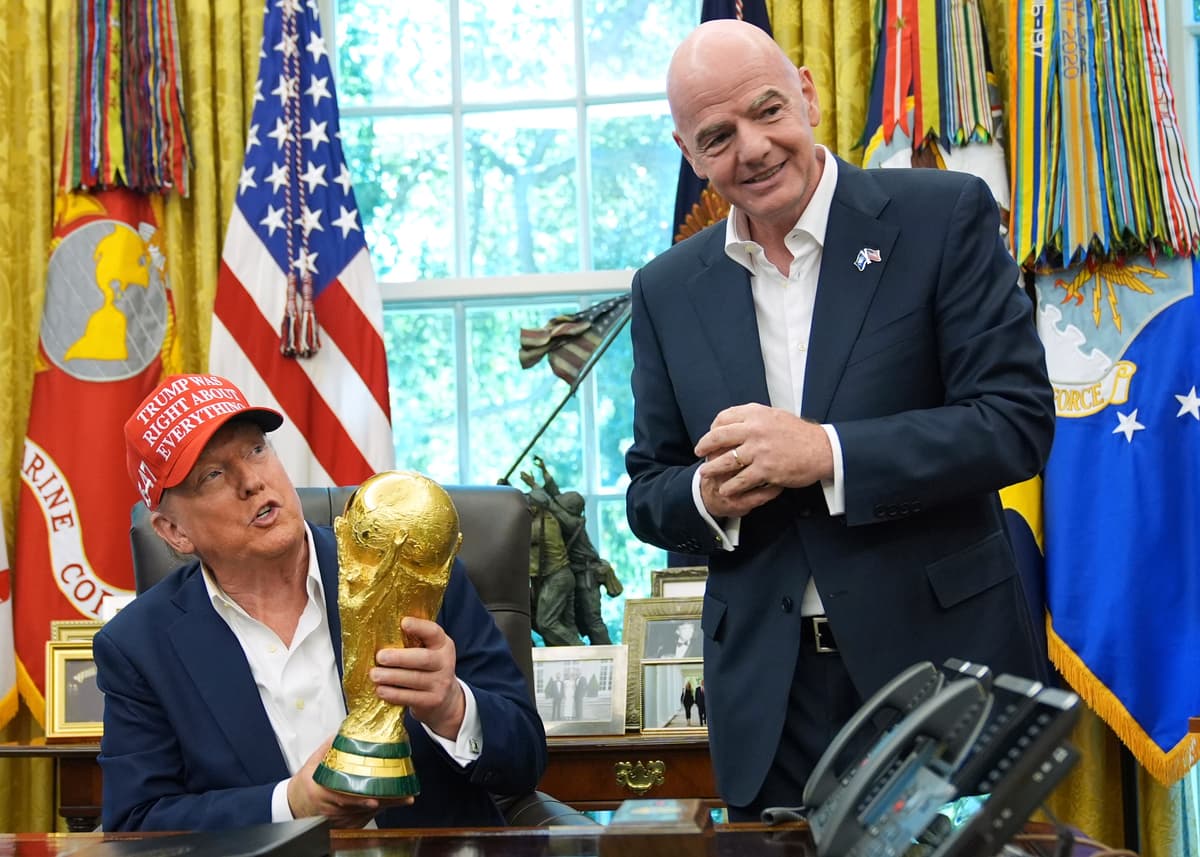
President Trump holds the FIFA World Cup Winners Trophy as the FIFA president, Gianni Infantino, looks on at the White House on August 22, 2025. Jacquelyn Martin/AP

Anticipating an unprecedented influx of visa applications from international visitors looking to attend the 2026 World Cup, the Department of State is announcing plans to bolster staffing at certain American embassies and consulates to handle the demand.

The department advised those interested in attending the World Cup — which will be jointly hosted by the United States, Mexico and Canada — to begin the visa application process now. Visa and passport operations will remain open during the government shutdown that began Wednesday.

The staffing buildup is designed to ensure that the numerous soccer fans hoping to visit the United States next summer won’t be derailed by long delays. The locations where the extra staff are posted will not be finalized until the 48-nation field of competitors is set.

According to the state department, interview appointments have been scheduled over the next two months in about 80 percent of the countries with teams that have already qualified or are in the process of qualifying.

“The department is prepared to meet the demand while maintaining rigorous vetting requirements,” a department spokesman told the Associated Press. “Hundreds of staff will be sent to designated countries to ensure fans can secure visas in time.”

The Trump administration is facing international scrutiny over its immigration policies, which include tighter restrictions on temporary visas and heightened vetting procedures that have resulted in deportations of numerous foreign nationals.

Applicants can expect enhanced screening of their social media activities and other public statements — measures the administration says are necessary for security reasons.

Participants in the Visa Waiver Program — which allows travelers from primarily European and Asian countries to enter America without a visa for up to 90 days — will largely bypass the enhanced screening. Those living in countries that are not in the program will need to undergo in-person interviews and a screening process that can stretch for months.

Despite the concerns, ticket demand for the World Cup is expected to be at an all-time high.

FIFA, the governing body of the World Cup, said more than 4.5 million people have already entered an initial lottery for tickets, which opened Wednesday. Those fortunate enough to be selected can purchase tickets at prices ranging from $60 to $6,730 for first-class service under FIFA’s dynamic pricing strategy.

The FIFA president, Gianni Infantino, said the early interest in ticket sales is a positive sign.

“The whole world wants to be part of FIFA World Cup 26 — the biggest, most inclusive, and most exciting event ever,” he said. “From Canada, Mexico and the United States, to countries big and small across every continent, fans are proving once again that passion for football truly unites.”

Just as World Cup fans are focused on securing tickets and making travel plans, President Trump threw a speed bump into the process this week, suggesting he might designate certain American cities scheduled to be World Cup venues as “not safe” and block them from staging matches.

The American cities hosting matches are Atlanta, Boston, Dallas, Houston, Kansas City, Los Angeles, Miami, Philadelphia, San Francisco, Seattle, and East Rutherford, New Jersey. Mr. Trump pointed specifically to San Francisco and Seattle as cities he might target to replace as World Cup venues. “If I think it’s not safe, we’re going to move it out,” Mr. Trump told reporters at the White House.

FIFA quickly reminded the administration and the global public that hosting agreements are binding and beyond American government control and politics.

“It’s FIFA’s tournament, FIFA’s jurisdiction, FIFA makes those decisions,” the FIFA vice president, Victor Montagliani, said during a business conference at London.

“With all due respect to current world leaders, football is bigger than them, and football will survive their regime and their government and their slogans. That’s the beauty of our game. It’s bigger than any individual and bigger than any country.”

The White House previously addressed safety concerns at the World Cup in March, when Mr. Trump signed an executive order establishing a federal task force to oversee preparations and safety for the events.

The Department of Homeland Security, working with federal, state, and local law enforcement, is heading the day-to-day planning. Each city is expected to attract more than 480,000 visitors.

Despite hopes the World Cup will promote peace and unity, politics has pushed its way into the qualifying stages, with calls for Israel to be banned from the competition. Israel is scheduled to continue its Group 1 play against Norway at Oslo on October 11 and Italy at Udine on October 14.

The executive committee of the UEFA, the governing body of European football, has reportedly put on hold a vote to suspend Israel while the Trump administration attempts to broker an end to the war in Gaza.


The New York Sun

© 2025 The New York Sun Company, LLC. All rights reserved.

Use of this site constitutes acceptance of our Terms of Use and Privacy Policy. The material on this site is protected by copyright law and may not be reproduced, distributed, transmitted, cached or otherwise used.

The New York Sun

Sign in or  create a free account

or
By continuing you agree to our Privacy Policy and Terms of Use