New Photos Show Luigi Mangione Being Arrested at McDonald’s as Alleged CEO Killer’s Attorneys Seek To Have Death Penalty Charge Tossed
Defense attorneys are also claiming that Mangione’s backpack — where police found a gun and a silencer — was unlawfully searched.

Defense attorneys for Luigi Mangione, accused of gunning down UnitedHealthcare’s CEO, Brian Thompson, on a Midtown Manhattan sidewalk in December of last year, asked a New York City federal court to dismiss two charges in his indictment, one of which is death penalty eligible, in a motion filed on Saturday.
The attorneys also requested to suppress the evidence collected and statements made during Mr. Mangione’s arrest, arguing that police officers failed to follow “basic police procedure” such as reading the suspected shooter his Miranda rights and seeking a search warrant before searching his backpack, where they found the gun linked to Thompson’s murder.
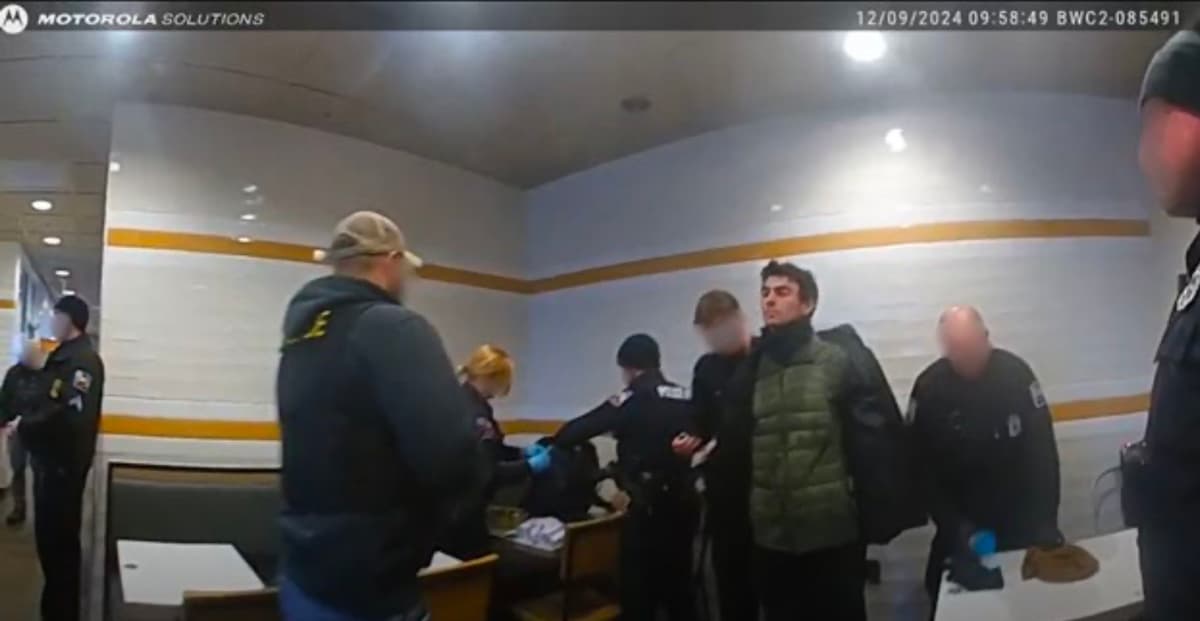
Mr Mangione’s motion includes a detailed description of how officers arrested him at a McDonald’s outside Altoona, a Blair County, Pennsylvania, town, five days after the murder.
Mr. Mangione is being prosecuted in three separate jurisdictions for crimes relating to Thompson’s murder: in Pennsylvania, where he was arrested, in New York state court, and in federal court. The four-count indictment brought against him by federal prosecutors at the Southern District of New York includes the death penalty eligible charge of “murder through use of a firearm.”

The 27-year-old defendant, who comes from an influential real estate family outside Baltimore and was his high school’s valedictorian before earning bachelor’s and master’s degrees at the prestigious University of Pennsylvania, has pleaded not guilty to all charges.
On December 4, 2024, Thompson was shot outside of the Midtown Manhattan Hilton Hotel at 6:45 a.m., as he was headed to an annual investor conference that was about to take place in the ballroom of the hotel. Thompson, a Twin Cities-based father of two children, died at the hospital about half an hour later. The killer fled the scene immediately, triggering a manhunt that lasted five days.
Surveillance cameras had caught the shooting on video. A man, dressed in a black hooded sweatshirt, wearing a black ski mask and a backpack, is seen on the footage as he emerges between two cars. He holds the gun in his right hand and shoots Thompson, who is walking toward the side entrance of the hotel, in the leg. Thompson falls to the ground. The killer then advances closer to his victim and shoots him again, firing a total of three shots.
New York City’s police commissioner, Jessica Tisch, the defense motion details, “assigned ten detectives from the NYPD’s Intelligence Division to search through social-media profiles of hundreds of young men who looked similar to the shooter and had also posted negative comments about the health insurance industry.”

Thompson’s employer, UnitedHealth Group, one of the country’s biggest health insurers, had long been the object of criticism over its allegedly parsimonious treatment of its members. While a verified figure for UnitedHealthcare’s overall claim denial rate is unconfirmed, various media outlets reported that a suggested rate as high as 32 percent, which is higher than the average for other insurers. The Department of Justice is also investigating the company’s Medicare billing practices, as reported by the Hill.
During their initial investigation, the detectives analyzed surveillance videos from street cameras to track the alleged killer’s movements throughout the city before and after the shooting.
“We used every source of video that we could collect, hundreds and hundreds and hundreds of hours from hundreds and hundreds and hundreds of sources,” the chief of NYPD detectives, Joseph Kenny, told reporters during a press conference after Mr. Mangione’s arrest.
Through their diligent work, the NYPD was able to release several photographs of a suspect, who appeared to look like Mr. Mangione. These images were shared with law enforcement across the country, as well as on mainstream and social media.

On December 9, at the Altoona McDonald’s, about 233 miles away from New York City, a customer found that a young man, who had removed his face mask to eat his breakfast, resembled the suspect wanted for Thompson’s killing. The customer immediately informed an employee at the fast food restaurant, who then called the police.
“Arriving at the McDonald’s,” the defense’s court filing details, two patrolmen, “both in full uniform and displaying badges, approached Mr. Mangione at 9:29 a.m. as he sat at a table in the back of the restaurant.”
The two officers, who were “fully armed,” then “told Mr. Mangione that someone had called the police because they thought he was suspicious.”
One officer asked to see identification, and Mr. Mangione allegedly provided a fake ID, a New Jersey driving license in the name of Mark Rosario. The same license, New York investigation had previously confirmed, was used by the suspected shooter to check into a youth hostel at Manhattan’s Bloomingdale neighborhood on November 30, four days before Thompson’s murder. During his visit, the suspected killer was caught on the hostel’s surveillance camera flirting with and smiling at the receptionist with a distinctive, toothy grin.

The officers continued to interrogate Mr. Mangione, the defense attorneys wrote, and asked him to stand up and put his hands on his head. One of the officers then “went outside to call another officer and tell him that he was ‘100 percent sure’ that Mr. Mangione was the individual that law enforcement was looking for connected to the December 4, 2024, shooting in New York,” the motion states.
Soon afterward about half a dozen more officers arrived at the McDonalds. The motion alleges that the officer “continued his custodial, non-Mirandized interrogation of Mr. Mangione by asking if his name was Mark Rosario, to which Mr. Mangione responded, ‘No.’” The officer then “asked Mr. Mangione for his real name and his date of birth, which Mr. Mangione provided. Another officer at the scene asked Mr. Mangione twice why he lied about his name. At this time, there were nine officers surrounding Mr. Mangione.”
The defense also provided numerous photographs of the arrest in their filing, showing the officers surrounding Mr. Mangione, who is first seated, then standing at the restaurant.
“At 9:48 a.m. — nearly twenty minutes after law enforcement first approached Mr. Mangione and prevented him from leaving and asked him numerous interrogation questions — Patrolman Stephen Fox finally read Mr. Mangione his Miranda warnings,” the defense attorneys wrote.

“‘The purpose of the Miranda warning is to ensure that the person in custody has sufficient knowledge of his or her constitutional rights relating to the interrogation and that any waiver of such rights is knowing, intelligent, and voluntary,’” the defense attorney stated, citing case law. “‘If a suspect is not so warned, the prosecution is barred from using statements obtained during the interrogation to establish its case in chief.’”
The defense concluded that the statements Mr. Mangione gave to the officers, including providing false identification, should be suppressed.
During his interrogation, another officer searched Mr. Magione’s backpack “that law enforcement had placed on a table out of Mr. Mangione’s reach more than 17 minutes earlier.”
“The officers continued their warrantless search through Mr. Mangione’s backpack at McDonald’s even after he was removed from the restaurant by other officers and driven to the police precinct,” the motion details.

“During this continued search of the backpack, Patrolwoman Wasser recovered a gun magazine loaded with bullets. Now realizing she had made a potentially devastating mistake by thoroughly searching the backpack of a murder suspect in a significant New York press case without a warrant,” the motion goes on, citing conversations recorded by body worn cameras, “Wasser suddenly stated that she was searching through the backpack … to make sure there ‘wasn’t a bomb or anything in here’ before putting the backpack in the car.”
The defense questions why, if a bomb threat was what the officer was concerned with, she did not notify a bomb squad. Furthermore, after the officers found “a loaded magazine” in the backpack, another officer allegedly said, “‘At this point we probably need a search warrant for it.’”
According to the motion, the search through Mr. Mangione’s backpack continued without a warrant even at the police precinct.
“Patrolwoman Wasser continued to rummage through and search the backpack in a hallway at the precinct without a warrant and recovered a silencer, a red notebook containing Mr. Mangione’s personal writings, additional writings, a computer chip, an iPhone and several USB flash drives,” the motion states.

The defense asked the court to suppress all evidence obtained during this “warrantless” search, including the ghost gun, which detectives said matched the bullets from the crime scene, and the handwritten manifesto, which allegedly states Mr. Mangione’s motives and intentions.
“The U.S. has the most expensive health care system in the world, but ranks about No. 42 in life expectancy,” Mr. Mangione wrote in his red notebook, condemning the American healthcare system. “Frankly, these parasites simply had it coming.” And directly referring to UnitedHealthcare, the UnitedHealth Group subsidiary of which Thompson was CEO, he wrote, “It has grown and grown, but has our life expectancy? No – the reality is, these [indecipherable] have simply gotten too powerful, and they continue to abuse our country for immense profit.”
The defense is also seeking to dismiss counts three and four, the firearm offenses, of the four-count federal indictment. Count three accuses Mr. Mangione of using a firearm to commit murder, a charge that is death penalty eligible. Count four accuses him of having used a firearm suppressor.
As the Sun reported, three weeks before the defendant was arraigned at federal court on April 25, Attorney General Pam Bondi publicly announced that the Department of Justice was seeking the death penalty in Mr. Mangione’s case.

On April 1, Ms. Bondi, released a statement saying, “Luigi Mangione’s murder of Brian Thompson — an innocent man and father of two young children — was a premeditated, cold-blooded assassination that shocked America. After careful consideration, I have directed federal prosecutors to seek the death penalty in this case as we carry out President Trump’s agenda to stop violent crime and Make America Safe Again.”
The federal government involving itself in a murder case that, were it not so high-profile, would have probably been handled only by the state, puts the death penalty on the table, as New York is not a death penalty state.
But the defense now argues that the federal firearm offense is not warranted because the first two crimes, count one and two — stalking — are not “crimes of violence,” which are required to convict Mr. Mangione of counts three and four.
Defense attorneys wrote that the court is required “to look at the elements of a charged statute (but not the defendant’s actual conduct) when determining whether an offense ‘categorically’ constitutes the federal definition of a ‘crime of violence,’” and they found that “the entire stalking statute fails to qualify as a crime of violence.”

In their indictment, federal prosecutors accused Mr. Mangione, in count one and two, of having stalked Thompson from “at least” November 24, 2024, until the day of the fatal shooting on December 4, writing that Mr. Mangione traveled “across state lines” to New York with the intent to “kill, injure, harass, and intimidate another person.”
The suspect’s exact movements before the killing are not yet known, or have not yet been shared with the public. Investigators believe that Mr. Mangione arrived at New York on a bus that came from Atlanta on November 24, when a surveillance camera at Port Authority Bus Terminal caught his arrival at 9 p.m.
On November 30, Mr. Mangione allegedly checked into the Bloomingdale HI New York City Hostel on the Upper West Side using the fake New Jersey license with the name Mark Rosario. It is unclear where Mr. Mangione went and what he did between November 30 and December 4.
The indictment further charges Mr. Mangione, in count two, of “stalking,” using interstate facilities, such as electronic communication services, interstate wires, interstate highways, and staying at an “interstate hostel that serves interstate customers.”

But the defense finds that both these stalking offenses can be committed without the use of violence, and that even though the result of the offense was Thompson’s death, the fatality is not the intrinsic component of the statute.
In simpler words, the defense argues that stalking someone does not require killing someone, and the offense is thus not a crime of violence.
“Both offenses can be committed through conduct intended to ‘harass’ or conduct intended to ‘intimidate’ even if that conduct is not violent in nature. The indictment’s allegation that ‘death resulted’ … does not change the analysis, because that statute… does not itself require intentional use of force,” the defense wrote.
Mr. Mangione’s next court hearings, both in state and in federal court, are scheduled for early December.