James Comey’s Double-Barrelled Strategy To Shatter Trump’s Case Against Him Before It Gets to Trial

The former FBI director’s emerging strategy to thwart his prosecution is hardly a sure thing.
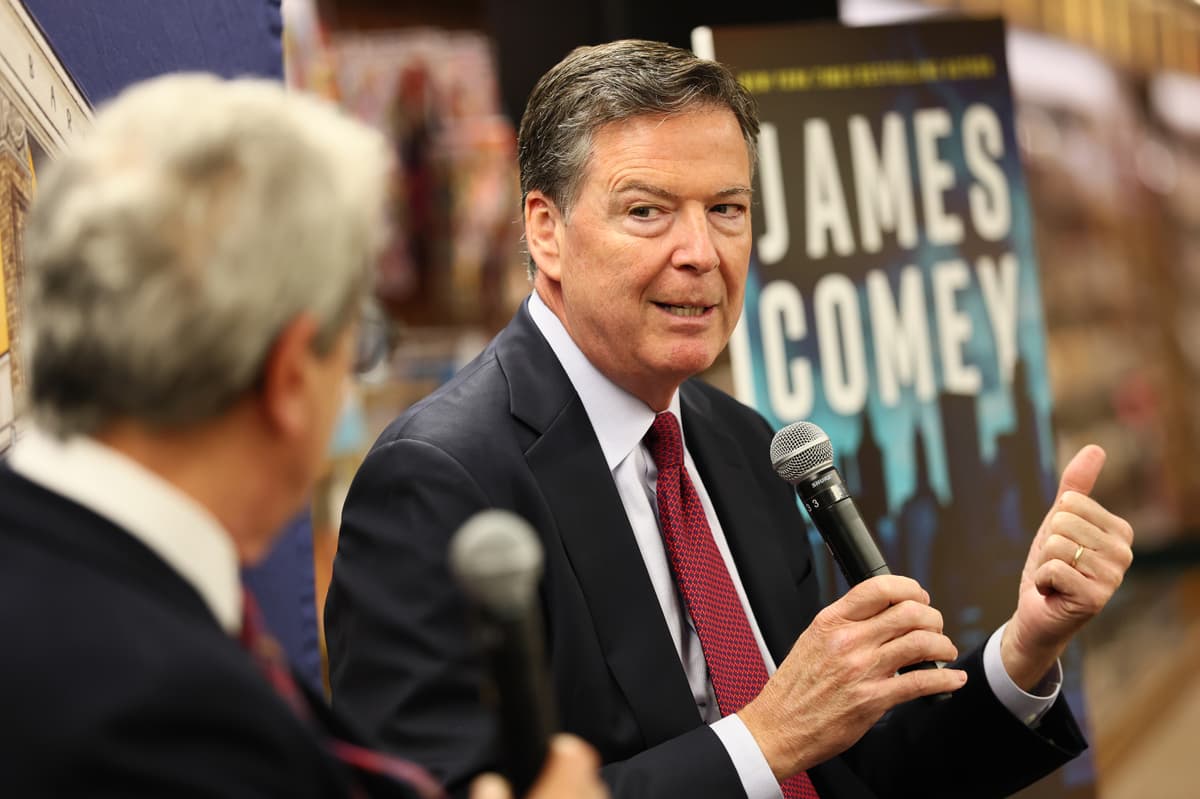
Michael M. Santiago/Getty Images
The former FBI director, James Comey, speaks at a book launch at New York City on May 19, 2025. Michael M. Santiago/Getty Images

A former director of the FBI, James Comey, plans to attack the criminal case against him from two directions — and he has to succeed on only one front to thwart President Trump’s designs for a conviction.

Mr. Comey’s strategy came into focus during his arraignment on Thursday at federal court in Virginia. He is charged with making false statements and obstructing a congressional proceeding during 2020 testimony before the Senate Judiciary Committee. His lawyer is the formidable Patrick Fitzgerald, who like Mr. Comey was formerly a hard-charging federal prosecutor.

Mr. Fitzgerald told the presiding judge, Michael Nachmanoff, that he first plans to challenge the government’s case as “selective” and “vindictive.” If the judge is persuaded that it is motivated by animus, then it will be dismissed. Mr. Fitzgerald will also contend that the presiding prosecutor, Lindsey Halligan, is exercising those responsibilities unlawfully. Judge Nachmanoff indicated that another judge will be called in to rule on that issue.

Ms. Halligan, who has never prosecuted a felony but served on Mr. Trump’s defense team for his Mar-a-Lago case, was in court for the arraignment, but she did not rise to address Judge Nachmanoff. Instead, the Department of Justice summoned a junior prosecutor from North Carolina to represent its case. Ms. Halligan, who is serving on an interim basis, signed the indictment. Mr. Trump had previously tasked her with implementing reforms to the Smithsonian Museum.

Before Mr. Comey was charged, Mr. Trump declared on Truth Social that “we can’t delay any longer, it’s killing our reputation and credibility. They impeached me twice, and indicted me (5 times!), OVER NOTHING. JUSTICE MUST BE SERVED, NOW!!!” The Wall Street Journal reports that Mr. Trump intended that to be a private direct message sent to Attorney General Pam Bondi — it was directed to “Pam.” 

The interim United States attorney for the Northern District of Virginia, Erik Siebert, was fired a day before that post. ABC News reported that Mr. Siebert refused to sign off on this prosecution. Mr. Trump blamed Democratic support for Mr. Siebert, a former District of Columbia police officer, for his decision to fire him from the powerful prosecutorial post.

The Supreme Court held in a decision from 1978 that a selective and vindictive prosecution “is a due process violation of the most basic sort.” Mr. Trump made a vindictive prosecution claim in 2023, when he was fighting the election interference case brought by Special Counsel Jack Smith. Mr. Trump’s attorneys called that prosecution “a straightforward retaliatory response to” his exercise of his constitutional rights — namely the First Amendment.

The presiding judge, Tanya Chutkan, denied Mr. Trump’s vindictiveness claim, finding that he failed to show that the case was “more likely than not attributable to the vindictiveness on the part of the Government.” The Supreme Court in 1996 ruled that a defendant must show that others similarly situated were not prosecuted for similar conduct and that the prosecution was motivated by a discriminatory purpose.

Mr. Fitzgerald argued in court that the government is engaged  in a “selective, retaliatory prosecution” against Mr. Comey “at the direction of President Trump.” The Department of Justice, though, enjoys broad discretion with respect to charging decisions. That prerogative flows from the president’s mandate to “take care that the laws be faithfully executed.”  

Federal prosecutors are also entitled to the “presumption of regularity,” which means that in cases involving executive discretion, “in the absence of clear evidence to the contrary,” courts default to the position that officials “have properly discharged their official duties.” The defendant — here Mr. Comey — bears the burden of proving irregularity. 

Mr. Comey could have greater likelihood of success showing that Ms. Halligan is acting ultra vires, or without legal authority. Federal law allows the attorney general to nominate an interim United States attorney to serve for a 120-day term. After that term expires, the federal judges in the district can vote to extend the prosecutor’s term or deny such an extension — as they did with Ms. Bondi’s pick in New Jersey, Alina Habba.

Mr. Siebert, though, was also an interim appointment — though he enjoyed the support of Virginia’s Democratic senators, he never came before the Senate for the vote that would have permanently installed him in the position. Virginia’s judges, though, extended his term before Mr. Trump fired him. A 1986 memorandum written by one Samuel Alito reckoned that “further interim appointments are to be made by the court rather than by the attorney general.”

Courts have not hesitated to rule that prosecutors were unlawfully appointed. Ms. Habba has been disqualified in New Jersey, though that ruling is paused pending appeal. Last year Judge Aileen Cannon in Florida ruled that Mr. Smith was unlawfully appointed by Attorney General Merrick Garland. She dismissed the Mar-a-Lago case in its entirety.


The New York Sun

© 2025 The New York Sun Company, LLC. All rights reserved.

Use of this site constitutes acceptance of our Terms of Use and Privacy Policy. The material on this site is protected by copyright law and may not be reproduced, distributed, transmitted, cached or otherwise used.

The New York Sun

Sign in or  create a free account

or
By continuing you agree to our Privacy Policy and Terms of Use